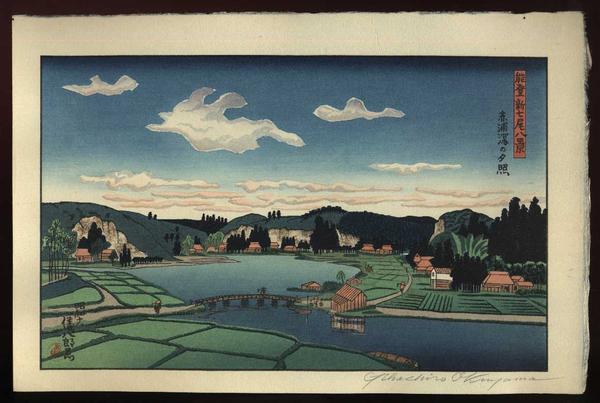
Akaurawan no Yuushou
- Medium:
- Woodblock print
- Source:
- Japanese Art Open Database
Description
Akaurawan no Yushou (Evening Glow over Akaura Bay), an undated woodblock from the series Eight Views of Noto-Shin-Nanao by Okuyama Gihachiro (1907-1981), engages the rugged coastal landscape of the Noto Peninsula on the Sea of Japan through the artist's mature sosaku-hanga (creative print) idiom. The Eight Views series transposes the centuries-old Chinese and Japanese hakkei (eight views) convention - in which a single locale is registered through a fixed cycle of seasonal and time-of-day moments - onto the Noto coast around Shin-Nanao, and the yushou or evening-glow scene gives Okuyama a natural opportunity to deploy his bold, color-rich palette. The composition is organized around the saturated chromatic event of low sun over the bay: warm reds, oranges, and burning ochres laid into weighted planes register the burning western sky and its reflection on the water, while darker coastal masses anchor the foreground. The firmly bounded color zones and the dramatic perspective characteristic of his work give the print its graphic force. A self-taught printmaker from Akita who became one of the few Tohoku-region figures in the predominantly Tokyo-and-Kyoto sosaku-hanga scene, Okuyama designed, carved, and printed the sheet himself, in keeping with the movement's foundational principle that each impression be a personally authored act. The Japanese Art Open Database, through ukiyo-e.org, preserves this impression as part of its record of Okuyama's catalogue (https://ukiyo-e.org/image/jaodb/Gihachiro_Okuyama-Eight_Views_of_Notoshinnanao-Akaurawan_no_Yuushou-00034560-031012-F06). For students of Okuyama Gihachiro, the print is particularly useful for the way it places his bold-color landscape work within the long hakkei tradition, demonstrating how the artist could absorb a classical pictorial convention into his fully personal twentieth-century idiom.
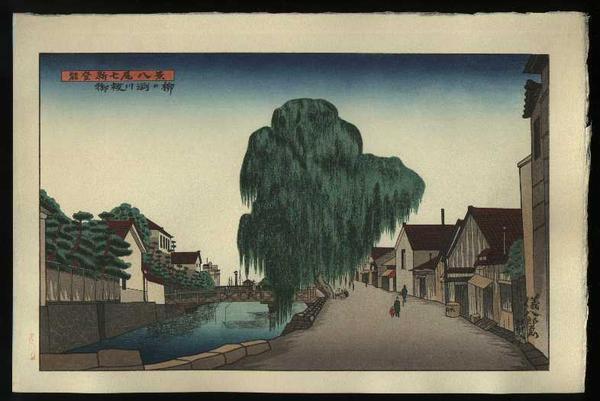
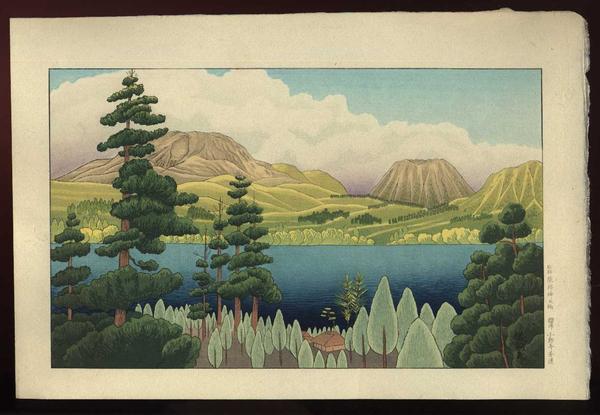
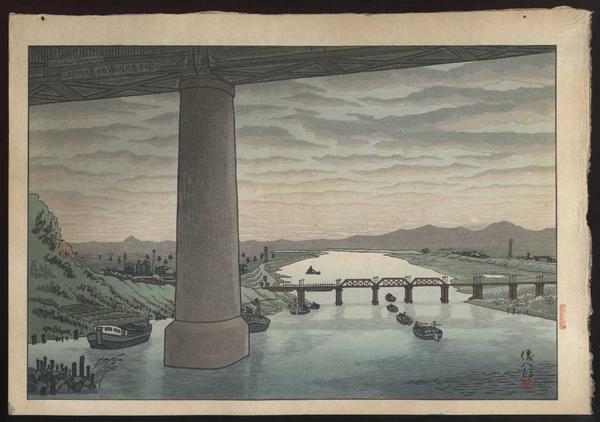
More Prints by Gihachiro Okuyama
Featured in Collections
Curated cross-cuts that include this print.
Frequently Asked Questions
Akaurawan no Yuushou was created by Gihachiro Okuyama (奥山儀八郎).