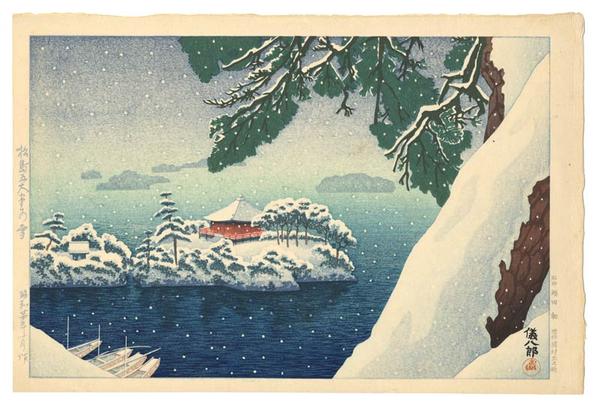
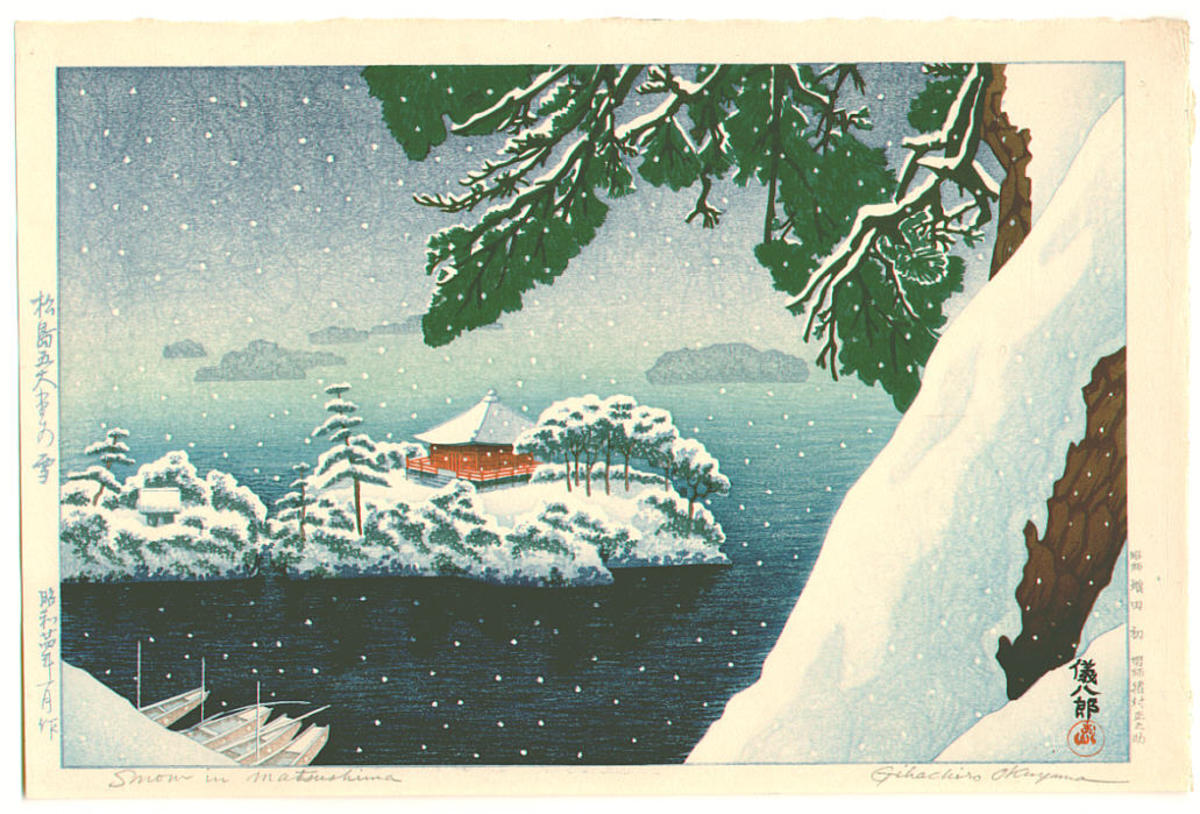
Snow in Matsushima
- Medium:
- Woodblock print
- Source:
- Japanese Art Open Database
Description
Snow in Matsushima, an undated impression by Okuyama Gihachiro (1907-1981), is a second treatment by the artist of one of the three classically designated scenic views of Japan (the nihon sankei) and demonstrates his repeated engagement with the Tohoku coast that lay close to his native Akita. Matsushima Bay, with its scattered pine-clad islets, had been celebrated in Japanese painting and poetry since at least the medieval period; snow over the bay gave Okuyama a particularly congenial opportunity to deploy the bold-color, planar idiom he had developed for northern winter subjects. In this impression the composition is structured around the dramatic massing of darkened islets against the cool reserved tones of snowed-over rock, with the chilled water of the bay registered as a weighted middle field. As elsewhere in his work, the dramatic perspective and firmly bounded color zones are the principal vehicles of expression; there is no attempt at meticulous topographic survey. A self-taught printmaker from Akita who became one of the few Tohoku-region figures in the predominantly Tokyo-and-Kyoto sosaku-hanga (creative print) scene, Okuyama designed, carved, and printed each impression himself, in keeping with the movement's foundational principle that the artist alone be responsible for every stage of production. The Japanese Art Open Database, through ukiyo-e.org, preserves this second Snow in Matsushima impression alongside related Okuyama sheets in its record (https://ukiyo-e.org/image/jaodb/Gihachiro_Okuyama-No_Series-Snow_in_Matsushima-00033508-030625-F06). For students of Okuyama Gihachiro, the existence of multiple Matsushima impressions documents his sustained engagement with the bay as a subject - and demonstrates how thoroughly he could re-approach a canonical Tohoku viewing site through repeated, personally authored impressions.
More Prints by Gihachiro Okuyama
Featured in Collections
Curated cross-cuts that include this print.
Frequently Asked Questions
Snow in Matsushima was created by Gihachiro Okuyama (奥山儀八郎).