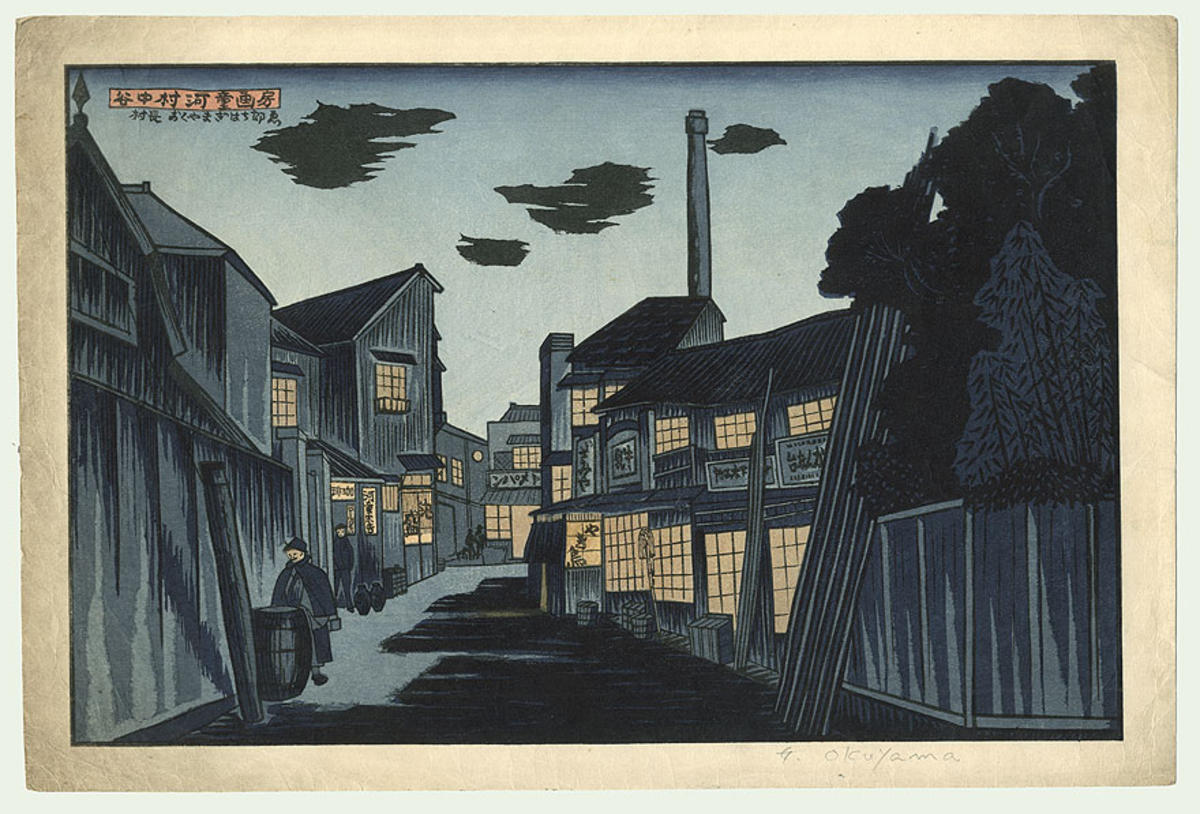
Taninakamura
- Medium:
- Woodblock print
- Source:
- Japanese Art Open Database
Description
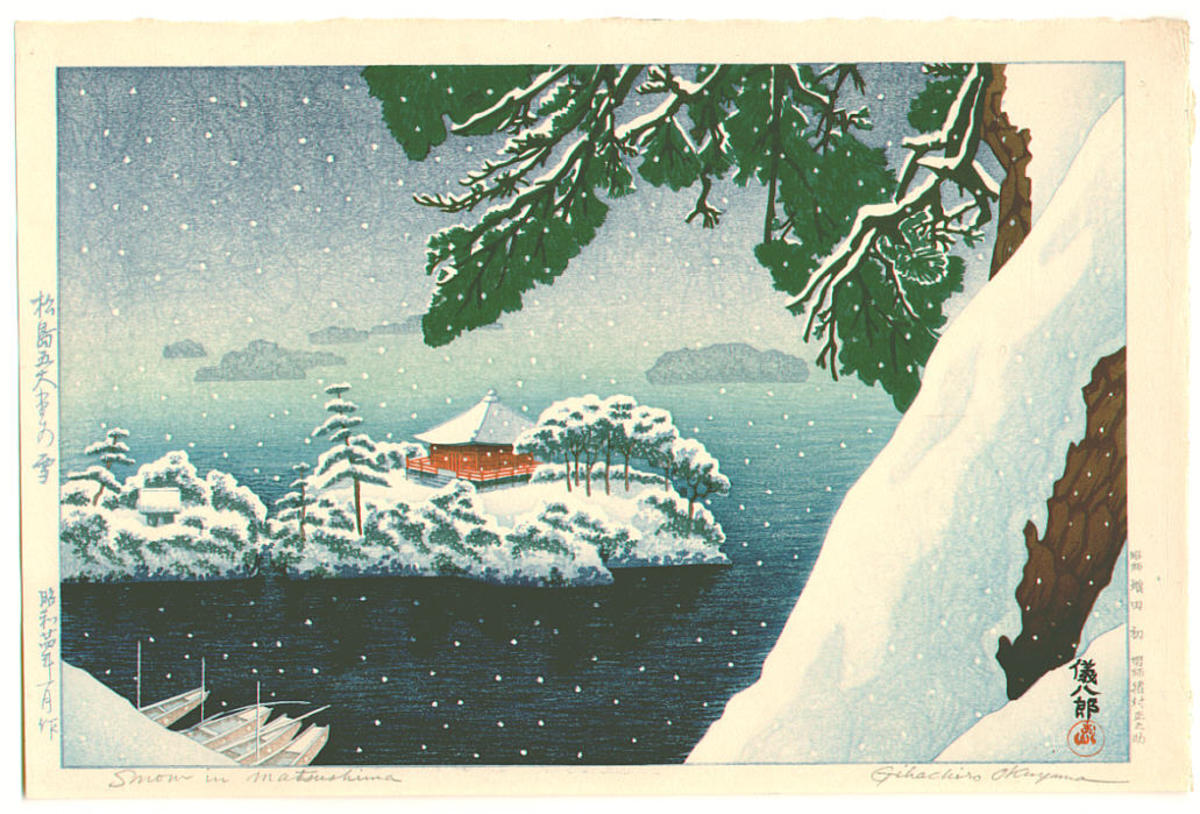
Taninakamura (Valley Village), an undated woodblock by Okuyama Gihachiro (1907-1981), engages one of the artist's most characteristic subjects - the rural village folded into hilly Tohoku terrain - through his mature sosaku-hanga (creative print) idiom. The composition is organized around the dramatic perspective for which Okuyama is best known: a high angle that allows the eye to look down into the valley settlement, where the rooflines, fields, and surrounding slopes register as weighted color planes rather than as diagrammed topography. Bold color zones - warm earth tones, deeper greens for cultivated land, cool tones for shadowed hillside - are firmly bounded against each other, giving the village a graphic, almost map-like clarity while preserving the sensation of being suspended above it. The treatment is closely related to Okuyama's snow-bound farmhouse scenes and rural festival imagery from his native Akita, and demonstrates the consistency of his interest in northern village life as a subject. A self-taught printmaker who became one of the few Tohoku-region figures in the predominantly Tokyo-and-Kyoto sosaku-hanga scene, Okuyama designed, carved, and printed each impression himself, in keeping with the movement's foundational principle that each impression be a personally authored act. The Japanese Art Open Database, through ukiyo-e.org, preserves this impression as part of a broader record of Okuyama's catalogue (https://ukiyo-e.org/image/jaodb/Gihachiro_Okuyama-No_Series-Taninakamura-00034675-090116-F12). For students of Okuyama Gihachiro, the Taninakamura print is a particularly useful demonstration of his signature dramatic perspective and his sustained commitment to the rural Tohoku village as a subject fully worthy of the sosaku-hanga medium, treated with the same bold-color discipline he brought to his famous-place subjects elsewhere in Japan.
More Prints by Gihachiro Okuyama
Featured in Collections
Curated cross-cuts that include this print.
Frequently Asked Questions
Taninakamura was created by Gihachiro Okuyama (奥山儀八郎).