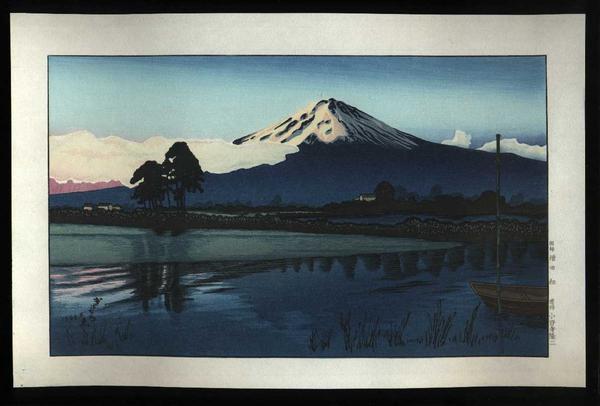
View of Mt Fuji
- Medium:
- Woodblock print
- Source:
- Japanese Art Open Database
Description
View of Mt Fuji, an undated woodblock by Okuyama Gihachiro (1907-1981), engages the most overdetermined subject in Japanese visual culture through the artist's mature sosaku-hanga (creative print) idiom. Mount Fuji has been depicted in every available format since at least the medieval period, and the woodblock tradition in particular - from Hokusai's Thirty-Six Views onward - established a deep visual vocabulary for the mountain that any later printmaker must engage with consciously. Okuyama, a self-taught printmaker from Akita who became one of the few Tohoku-region figures in the predominantly Tokyo-and-Kyoto sosaku-hanga scene, treats Fuji not as a topographic mass to be carefully delineated but as a structural pretext for bold color massing. The composition organizes the sheet around the implied conical silhouette, with weighted color planes registering the snow-capped peak against a saturated sky and a foreground built from firmly bounded zones of color. The dramatic perspective and bold-color discipline characteristic of his work give the print its graphic force, situating it within his continuing engagement with named-place subjects across Japan. As a thoroughgoing participant in the sosaku-hanga movement, Okuyama designed, carved, and printed each impression himself, in keeping with the movement's foundational principle that each impression be a personally authored act. The Japanese Art Open Database, through ukiyo-e.org, preserves this impression as part of a broader record of Okuyama's catalogue (https://ukiyo-e.org/image/jaodb/Gihachiro_Okuyama-No_Series-View_of_Mt_Fuji-00034680-031225-F06). For students of Okuyama Gihachiro, the Fuji print demonstrates how comfortably the artist could absorb the most canonical Japanese subject into his bold-color, dramatic-perspective vocabulary while preserving the sosaku-hanga grounding in personal authorship and carved wood.
More Prints by Gihachiro Okuyama
Featured in Collections
Curated cross-cuts that include this print.
Frequently Asked Questions
View of Mt Fuji was created by Gihachiro Okuyama (奥山儀八郎).