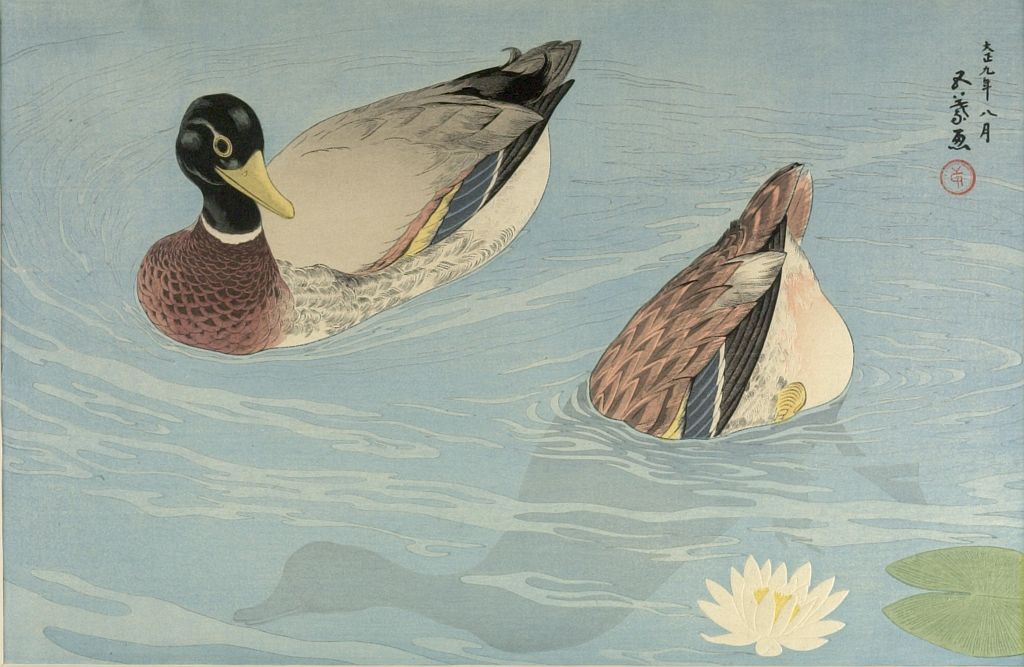
Two Ducks in a Lilypond, Taishô period, dated 1920 (9th Year of the Taishô Era)
- Date:
- Taishô period, 1912-1926
- Medium:
- Woodblock print
- Format:
- Oban
- Publisher:
- Watanabe Shozaburo
- Edition:
- Published by Watanabe Shozaburo
- Source:
- Harvard Art Museums
Description
Two mallard ducks swim on pale blue-grey water, one at left with head raised showing an iridescent green-black head, chestnut breast, and grey wings with a dark blue speculum, the other at right facing away with head submerged, its brown mottled back and pale underside visible. A single white water lily with a yellow center and two green lily pads float at lower right, with faint ripple lines and soft grey duck-shaped reflections/shadows on the water surface. Vertical Japanese text and a red seal appear at upper right; woodblock print, "Two Ducks in a Lilypond," Hashiguchi Goyō, Taishō period, dated 1920 (9th year of Taishō).
More Prints by Hashiguchi Goyo


More Birds & Flowers Prints
Featured in Collections
Curated cross-cuts that include this print.
Frequently Asked Questions
Two Ducks in a Lilypond, Taishô period, dated 1920 (9th Year of the Taishô Era) was created by Hashiguchi Goyo (橋口五葉) in Taishô period, 1912-1926.
Two Ducks in a Lilypond, Taishô period, dated 1920 (9th Year of the Taishô Era) was published by Watanabe Shozaburo (Taishô period, 1912-1926).
Two Ducks in a Lilypond, Taishô period, dated 1920 (9th Year of the Taishô Era) depicts birds & flowers, rivers & lakes, and animals.