
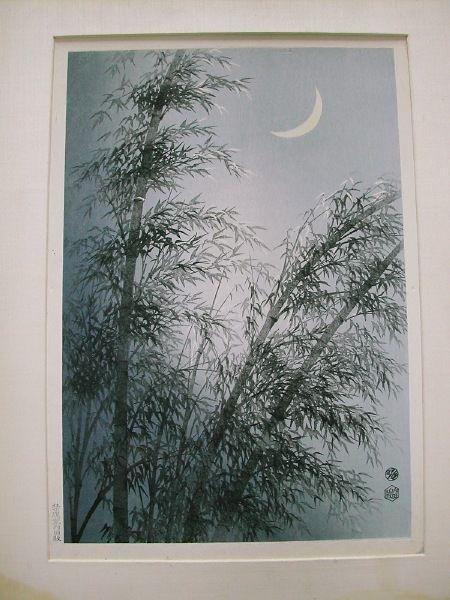
Bamboo grove
- Medium:
- Mokuhanga (Japanese woodblock)
- Image courtesy of
- Saru Gallery
Description
Bamboo grove takes up one of the recurring nature subjects in Japanese printmaking, but Kawanishi's sosaku-hanga handling would diverge sharply from the calligraphic ink-painting tradition that usually governs the motif. Rather than rendering individual culms with brush-line precision, his self-carved blocks typically build a grove from layered vertical bands of color — green over green, with shifts in hue marking depth instead of overlapping outlines. The visible woodgrain of the block, deliberately preserved in flat color areas, supplies a textural analogue to the striated bamboo stems. Light would be implied through abrupt shifts in saturation rather than the bokashi gradients favored by shin-hanga publishers like Watanabe. This is consistent with sosaku-hanga's foundational principle that the artist carve and print every block himself, refusing the division of labor inherited from the ukiyo-e workshop. Among Kawanishi's nature prints, bamboo subjects sit alongside pine, plum, and seasonal foliage as part of an ongoing engagement with the inherited vocabulary of Japanese landscape, reworked in a Fauvist key.
More Prints by Hide Kawanishi
More Trees Prints


Featured in Collections
Curated cross-cuts that include this print.
Frequently Asked Questions
Bamboo grove was created by Hide Kawanishi (川西英).
Bamboo grove depicts trees.