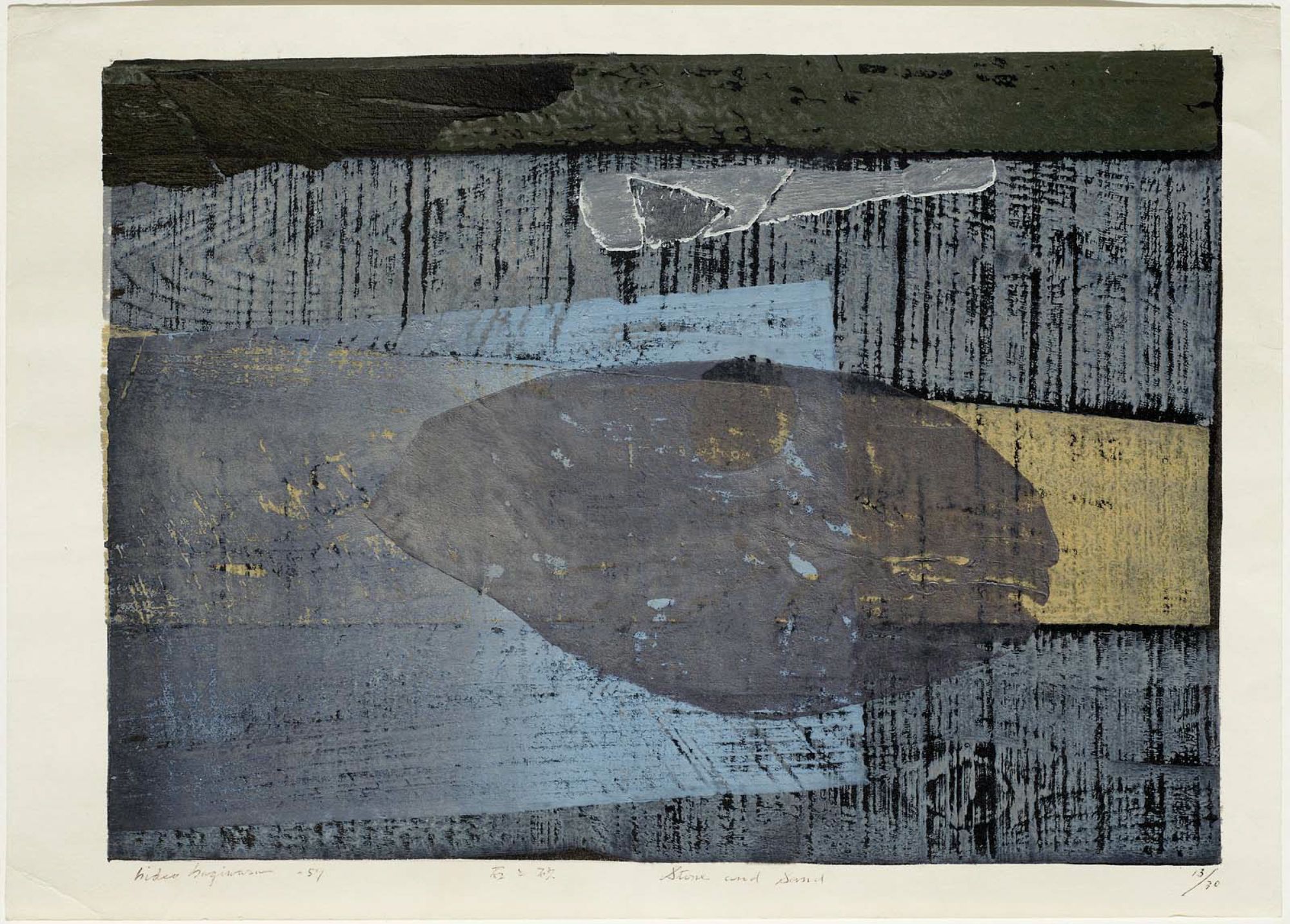
Stone and Sand (Ishi to suna)
- Medium:
- Woodblock print
- Edition:
- Self-printed
- Source:
- mfa
Description
Stone and Sand (Ishi to suna) — the two primary constituents of the dry rock garden (karesansui) that distills the Japanese aesthetic of the essential — provided Hagiwara with a subject perfectly aligned with his abstract practice. The traditional Zen garden reduced the landscape to rock and raked gravel, eliminating water, plants, and all natural specificity to leave only form and the marks of human arrangement on the fundamental geological materials. Hagiwara's carved woodblock surfaces, which worked through the marks left by the cutting tool on wood, found in the karesansui a profound formal mirror.
More Prints by Hideo Hagiwara

![Soil (3) (Dojo [3]), Damp Zone (Shitchitai) by Hideo Hagiwara](https://www.artic.edu/iiif/2/72e6d234-895b-8342-6083-79498ab9ac8d/full/843,/0/default.jpg)
More Gardens Prints
![[Garden of] Taj Mahal, No. 1 (Taji Maharu no niwa, dai ichi) by Hiroshi Yoshida](https://www.artic.edu/iiif/2/230993a7-d4f0-c979-c267-127d48e1ef1c/full/843,/0/default.jpg)
[Garden of] Taj Mahal, No. 1 (Taji Maharu no niwa, dai ichi)
Taji Maharu no niwa, dai ichi
1931
Color woodblock print; oban

Kiyozumi Garden in Moonlight
January 1938
Woodblock print, ink and color on paper

Moon over Kiyosumi Garden (Tsuki no Kiyosumien)
1938
Color woodblock print; oban
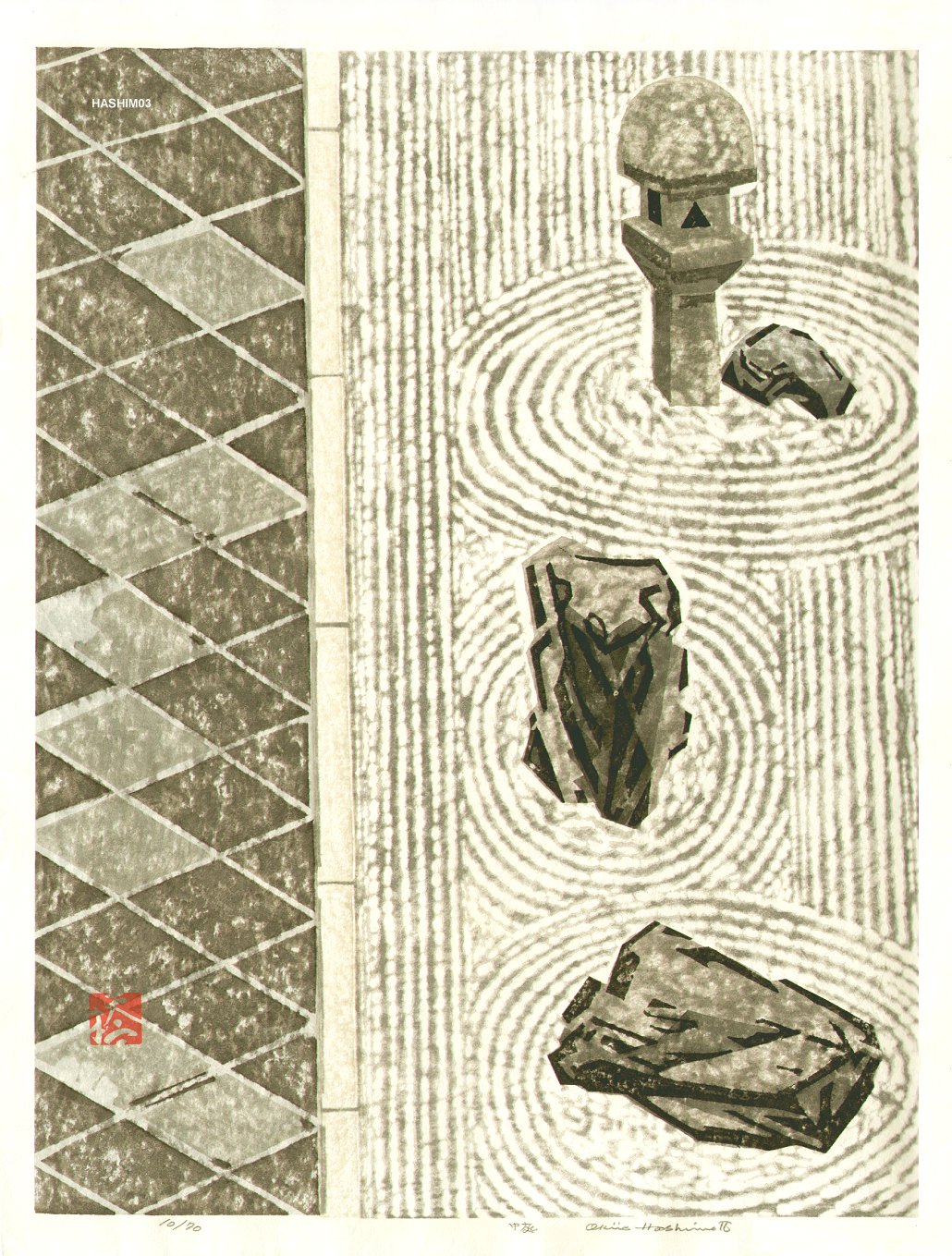
Rock garden
10/70, 1966
Woodblock print
Featured in Collections
Curated cross-cuts that include this print.
Frequently Asked Questions
Stone and Sand (Ishi to suna) was created by Hideo Hagiwara (萩原英雄).
Stone and Sand (Ishi to suna) depicts gardens and abstract.