![A Little Restaurant [at Night] (Ryoriya no yoru) by Hiroshi Yoshida — Japanese Color woodblock print; oban, 1933](https://www.artic.edu/iiif/2/e0e87290-6b97-4999-6986-731f7a56bbc9/full/843,/0/default.jpg)
A Little Restaurant [at Night] (Ryoriya no yoru)
Ryoriya no yoru
- Date:
- 1933
- Medium:
- Color woodblock print; oban
- Format:
- Oban
- Dimensions:
- 27.1 × 40.6 cm
- Publisher:
- Yoshida Studio
- Source:
- Art Institute of Chicago
Description
A night street scene rendered in deep browns and warm golden lighting, showing the wooden facade of a small restaurant with a row of round paper lanterns hung beneath its eaves and illuminated shoji windows glowing from within. A woman in a red under-robe and patterned outer kimono stands beside a hanging lantern to the left, her form reflected in the wet, glistening pavement below. "Hiroshi Yoshida," 1933, color woodblock print, oban.
More Prints by Hiroshi Yoshida
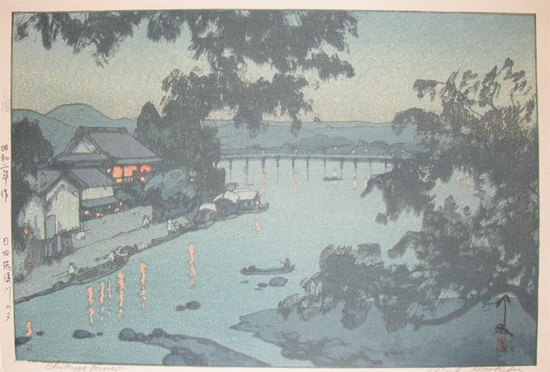
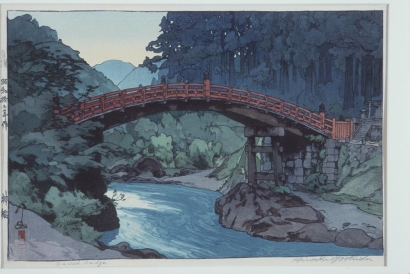
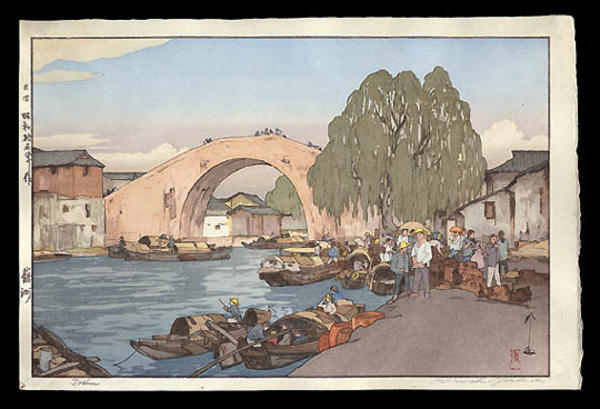
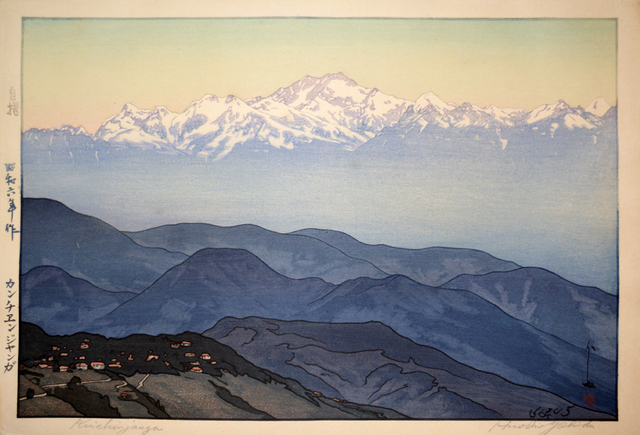
More Night Scenes Prints
Evening in East Africa
Woodblock print

Evening Shower at Teradomari (Teradomari no yau), from the series "Souvenirs of Travel, Second Series (Tabi miyage dai nishu)"
Teradomari no yau
1921
Color woodblock print; oban
![Mount Fuji on a Moonlit Night, Kawai Bridge (Tsukiyo no Fuji [Kawaibashi]), from the series "Selection of Views of the Tokaido (Tokaido fukei senshu)" by Kawase Hasui](https://www.artic.edu/iiif/2/d0960668-1e73-339a-b182-fb995a54bff0/full/843,/0/default.jpg)
Mount Fuji on a Moonlit Night, Kawai Bridge (Tsukiyo no Fuji [Kawaibashi]), from the series "Selection of Views of the Tokaido (Tokaido fukei senshu)"
1947
Color woodblock print; oban

Evening Moon at Nakanoshima, Sapporo (Sapporo Nakanoshima no yuzuki), from the series "Collection of Views of Japan, Eastern Japan Edition (Nihon fukei shu higashi Nihon hen)"
March 1933
Color woodblock print; oban
Featured in Collections
Curated cross-cuts that include this print.
Frequently Asked Questions
A Little Restaurant [at Night] (Ryoriya no yoru) (Ryoriya no yoru) was created by Hiroshi Yoshida (吉田博) in 1933.
A Little Restaurant [at Night] (Ryoriya no yoru) uses Bokashi, Nishiki-e, and Moku-hanga, on color woodblock print; oban.
A Little Restaurant [at Night] (Ryoriya no yoru) was published by Yoshida Studio (1933).
A Little Restaurant [at Night] (Ryoriya no yoru) depicts night scenes.
A Little Restaurant [at Night] (Ryoriya no yoru) measures 27.1 × 40.6 cm (Oban format).