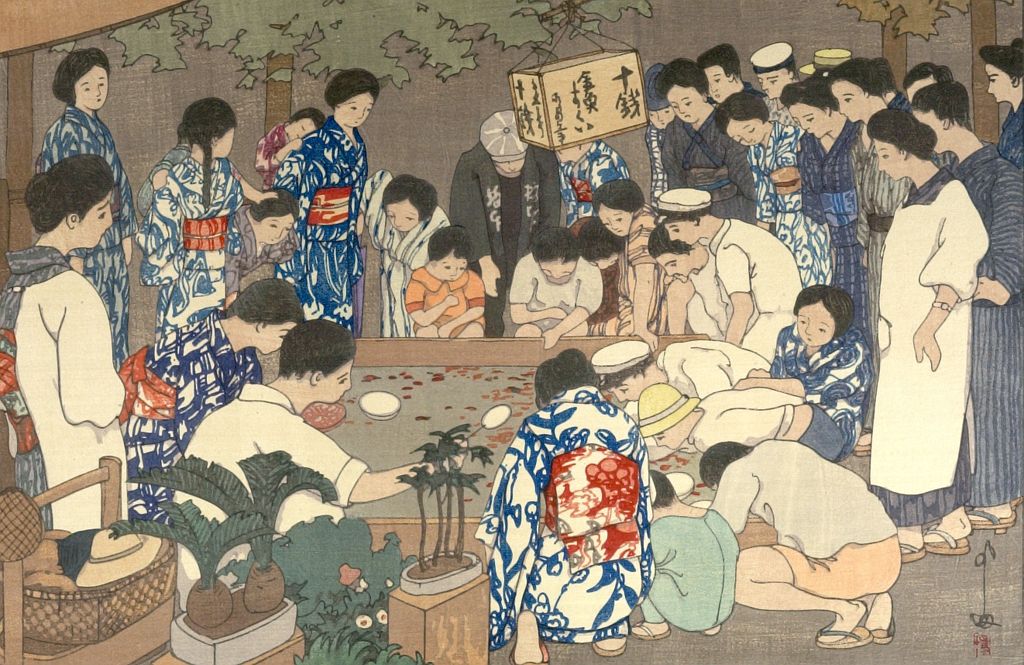
Catching Goldfish (Kingyo sukui), from the series Twelve Scenes of Tokyo (Tokyo jûnidai), Shôwa period, dated 1928
- Series:
- Twelve Scenes of Tokyo
- Date:
- Shôwa period, 1926-1989
- Medium:
- Woodblock print
- Format:
- Oban
- Publisher:
- Yoshida Studio
- Source:
- Harvard Art Museums
Description
This scene from the Twelve Scenes of Tokyo series depicts the beloved summer pastime of catching goldfish at a neighborhood festival stall — a quintessential image of Showa-era Tokyo street life. Children and their families crowd around shallow tanks, nets in hand, their reflections shimmering in the water. Yoshida brings an ethnographic affection to this intimate urban genre scene, contrasting sharply with his mountain and landscape subjects to reveal the breadth of his documentary interest in Japanese daily life.
More Prints by Hiroshi Yoshida
More Edo & Tokyo Prints

Komagata Embankment
Early Summer 1919
Woodblock print, ink and color on paper

View of Tsukuda Island from Eitai Bridge (Eitaibashi Tsukudajima), from the series "One Hundred Famous Views of Edo (Meisho Edo hyakkei)"
Color woodblock print

Yanagishima, from the series "One Hundred Famous Views of Edo (Meisho Edo hyakkei)"
Color woodblock print

Kasumigaseki, from the series “One Hundred Famous Views of Edo (Meisho Edo hyakkei)”
Color woodblock print
Featured in Collections
Curated cross-cuts that include this print.
Frequently Asked Questions
Catching Goldfish (Kingyo sukui), from the series Twelve Scenes of Tokyo (Tokyo jûnidai), Shôwa period, dated 1928 was created by Hiroshi Yoshida (吉田博) in Shôwa period, 1926-1989.
Yes — Catching Goldfish (Kingyo sukui), from the series Twelve Scenes of Tokyo (Tokyo jûnidai), Shôwa period, dated 1928 is part of the Twelve Scenes of Tokyo series by Hiroshi Yoshida.
Catching Goldfish (Kingyo sukui), from the series Twelve Scenes of Tokyo (Tokyo jûnidai), Shôwa period, dated 1928 was published by Yoshida Studio (Shôwa period, 1926-1989).
Catching Goldfish (Kingyo sukui), from the series Twelve Scenes of Tokyo (Tokyo jûnidai), Shôwa period, dated 1928 depicts edo & tokyo, fish, and animals, set at Tokyo.