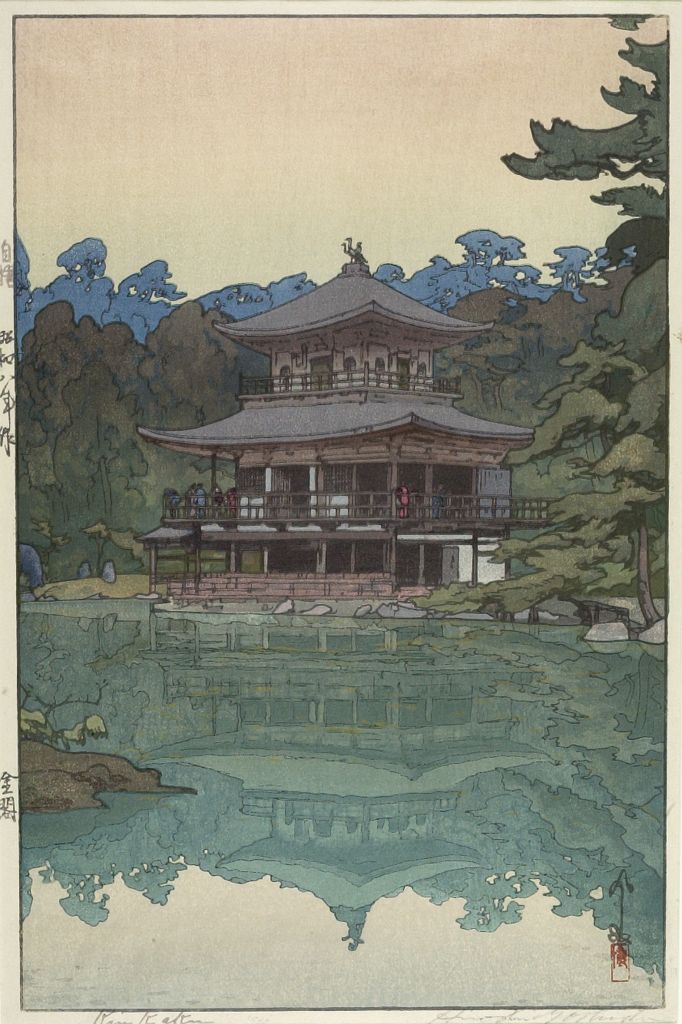
Golden Pavilion (Kinkaku-ji), Shôwa period, dated 1933
- Date:
- Shôwa period, 1926-1989
- Medium:
- Woodblock print
- Format:
- Oban
- Publisher:
- Yoshida Studio
- Source:
- Harvard Art Museums
Description
A three-tiered wooden pavilion with grey pyramidal roofs and a metal phoenix finial stands at the edge of a still pond, its upper stories open with slender support posts and railings and a few small figures visible on the balcony. Dense blue-green and dark green foliage, including a tall pine leaning in from the right, surrounds the building and rises against a pale cream sky, while the pavilion and trees are mirrored in soft, muted blue-green tones in the water below. Japanese characters and a red seal appear in the margins of the print. Woodblock print by Hiroshi Yoshida, "Golden Pavilion (Kinkaku-ji)," Shōwa period, dated 1933.
More Prints by Hiroshi Yoshida
More Architecture Prints


Featured in Collections
Curated cross-cuts that include this print.
Frequently Asked Questions
Golden Pavilion (Kinkaku-ji), Shôwa period, dated 1933 was created by Hiroshi Yoshida (吉田博) in Shôwa period, 1926-1989.
Golden Pavilion (Kinkaku-ji), Shôwa period, dated 1933 was published by Yoshida Studio (Shôwa period, 1926-1989).
Golden Pavilion (Kinkaku-ji), Shôwa period, dated 1933 depicts architecture and animals.