Himeji Castle
- Medium:
- Mokuhanga (Japanese woodblock)
- Image courtesy of
- Saru Gallery
Description
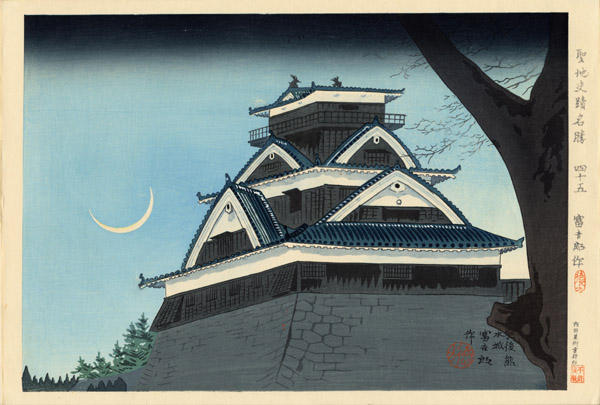
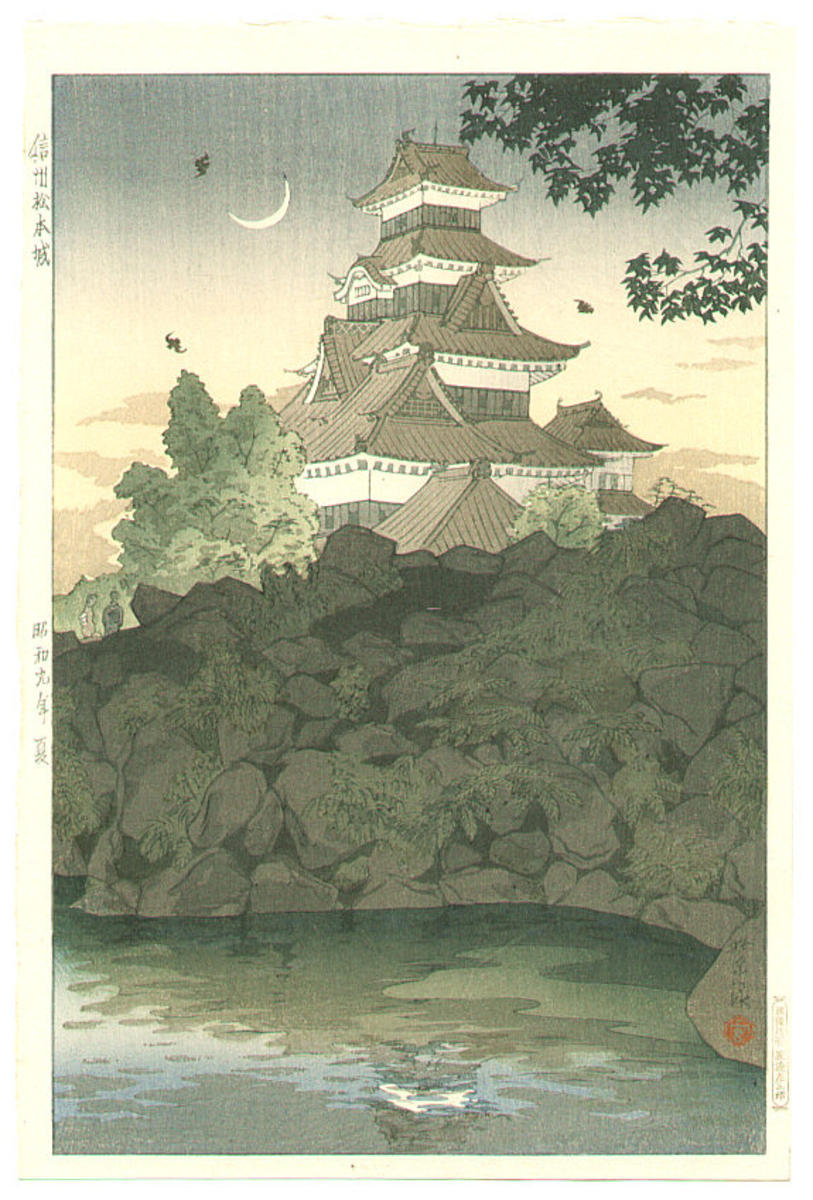
Himeji Castle, in Hyogo Prefecture, is a hilltop hirayama-jiro completed in its present form in 1609 and known for its multilayered white plaster keep, often called Shirasagi-jō or white heron castle for the bird-like silhouette of its tiered roofs. The composition likely centers the main keep against a tonal sky, with subsidiary turrets, stone walls, and pine plantings stepping down to a foreground vantage. The white plaster surfaces invite restraint in pigment, leaving large areas of lightly tinted [washi](/glossary/washi) to read as light, while the stepped roof eaves rely on careful kentō registration to keep the dark tile lines aligned across multiple color blocks. Within [shin-hanga](/glossary/shin-hanga), castle prints belong to the [meisho-e](/glossary/meisho-e) tradition revived for an early-Showa audience increasingly conscious of national heritage. Yoshida's contribution to the genre brought his characteristic fusion of Western tonal modeling with traditional mokuhanga technique to one of Japan's most recognized monuments.