
The Cherry Tree in Kawagoe
- Date:
- 1935
- Medium:
- Color woodblock print
- Format:
- Oban
- Dimensions:
- 37.6 × 39.7 cm
- Publisher:
- Yoshida Studio
- Source:
- Art Institute of Chicago
Description
Kawagoe in Saitama Prefecture — a castle town on the Kanto Plain sometimes called "Little Edo" for its surviving Edo-period merchant district — is home to a famous ancient cherry tree that Yoshida depicted in this 1935 print. Single, ancient cherry trees carry particular weight in Japanese aesthetics: unlike the massed spectacle of an avenue or hillside in full bloom, the solitary aged tree embodies the full life cycle of the sakura, its gnarled trunk and twisted branches witnesses to centuries of ephemeral seasonal blooming. Yoshida captures the tree in its full spring magnificence, its canopy extended and flowering, while the composition also acknowledges the architectural surroundings of the historic town in which the tree stands.
More Prints by Hiroshi Yoshida
More Cherry Blossoms Prints

Kumoi Cherry Trees (Kumoi sakura)
Kumoi sakura
1926
Color woodblock print

Hirosaki Castle, from the series "Eight Views of Cherry Blossoms"
1935
Color woodblock print

Chion-in Temple Gate (Romon), from the series Eight Scenes of Cherry Blossoms (Sakura hachidai)
Romon
1935
Color woodblock print
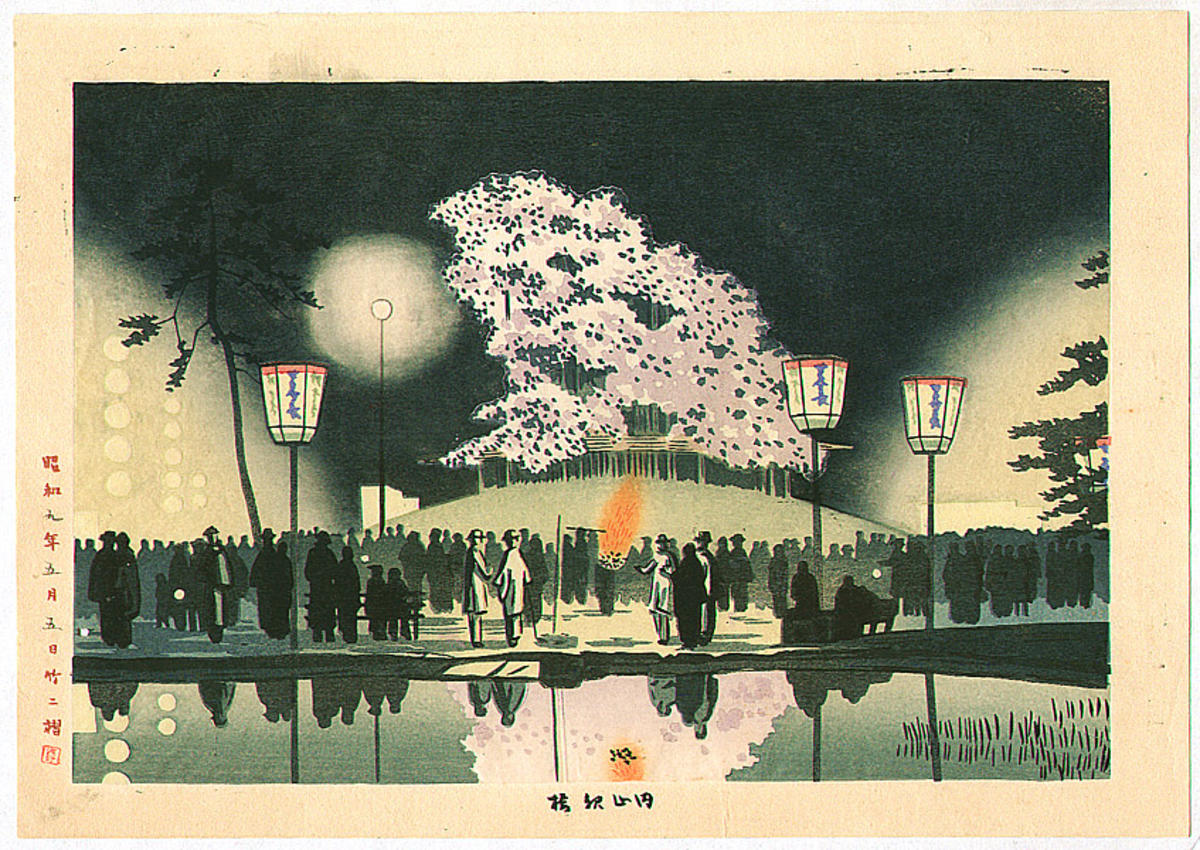
Cherry Blossoms at Maruyama Park
円山公園桜
Woodblock print
Featured in Collections
Curated cross-cuts that include this print.
Frequently Asked Questions
The Cherry Tree in Kawagoe was created by Hiroshi Yoshida (吉田博) in 1935.
The Cherry Tree in Kawagoe uses Bokashi, Nishiki-e, and Moku-hanga, on color woodblock print.
The Cherry Tree in Kawagoe was published by Yoshida Studio (1935).
The Cherry Tree in Kawagoe depicts cherry blossoms and trees.
The Cherry Tree in Kawagoe measures 37.6 × 39.7 cm (Oban format).