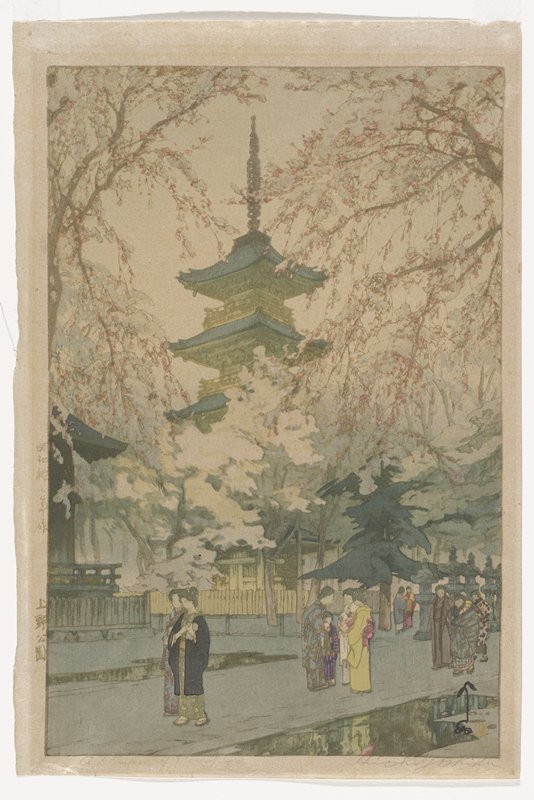
Ueno Park
- Date:
- 1937
- Medium:
- Woodblock print, ink and colors on paper
- Format:
- Oban
- Dimensions:
- 37.6 × 24.8 cm
- Publisher:
- Yoshida Studio
- Source:
- Minneapolis Institute of Art
Description
Ueno Park, Tokyo's first public park, established on the grounds of the former Kaneiji Temple, was famous above all for its cherry blossoms — the densely planted grove drawing crowds from across the city each spring. Yoshida's 1937 print captures the park in the blooming season, the trees creating a canopy of pale pink that transforms the urban space into something momentarily ethereal. The park's combination of cultural institutions, including the National Museum, and natural spectacle made it a quintessentially modern Japanese subject, and Yoshida's treatment honors both its social significance and its visual beauty.
More Prints by Hiroshi Yoshida
More Urban Scenes Prints
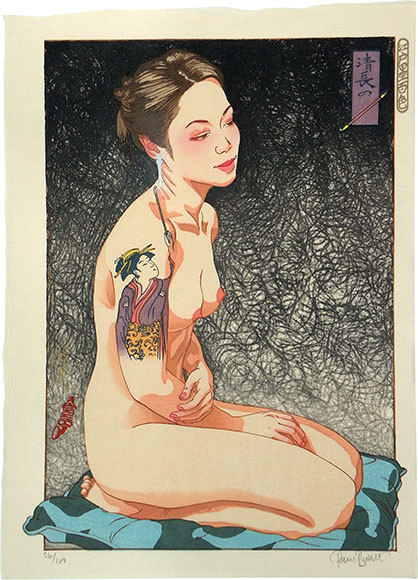
A Hundred Shades of Ink of Edo: Kiyonaga's Pipe (Edo zumi hyaku shoku: Kiyonaga no kiseru)
Woodblock print

View of Kabuki Theater from Matsuya (Ginza Matsuya yori Kabukiza), no. 3 from the series "Pictures of Ginza, First Series (Gashu Ginza dai isshu)"
1928
Color lithograph

Distant View of Mitsukoshi Movie Theater in Shinjuku from the Sixth Floor of Hoteiya (Hoteiya rokkai kara Shinjuku Mitsukoshi Musashi no kan enbo zu), no. 1 from the series "Scenery of Shinjuku (Gashu Shinjuku fukei)"
1930
Color lithograph
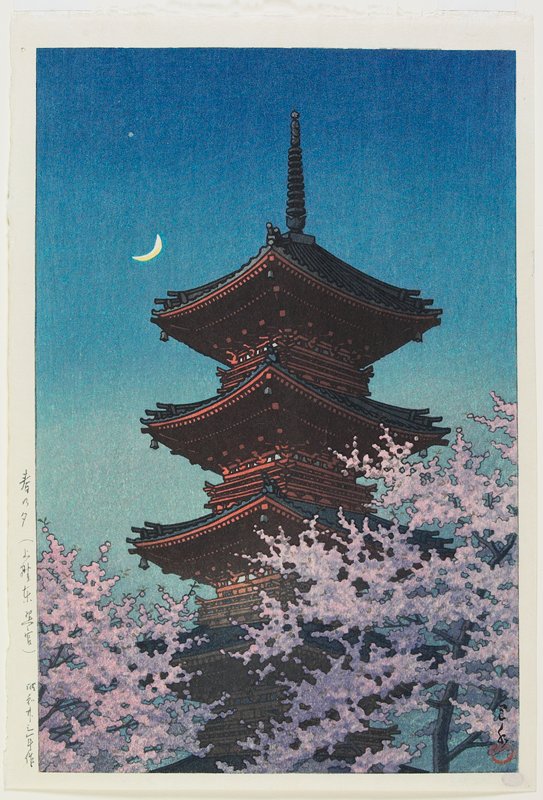
Spring Dusk at the Tōshō Shrine in Ueno
1948
Woodblock print, ink and color on paper
Featured in Collections
Curated cross-cuts that include this print.
Frequently Asked Questions
Ueno Park was created by Hiroshi Yoshida (吉田博) in 1937.
Ueno Park was published by Yoshida Studio (1937).
Ueno Park depicts urban scenes, set at Ueno.
Ueno Park measures 37.6 × 24.8 cm (Oban format).