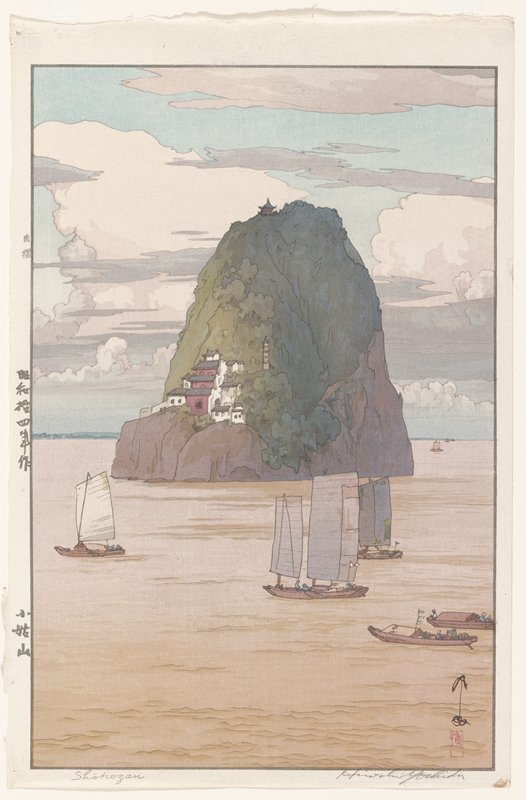
Xiaogushan
- Date:
- 1939
- Medium:
- Woodblock print, ink and color on paper
- Format:
- Oban
- Dimensions:
- 40.9 × 26.7 cm
- Publisher:
- Yoshida Studio
- Source:
- Minneapolis Institute of Art
Description
Xiaogushan is a small rocky mountain in Liaoning Province, northeastern China, its pine-clad granite outcroppings rising from the sea near the city of Panjin. Yoshida traveled in Manchuria and northeastern China during the late 1930s, and his prints of the region document a landscape of rocky coastlines and pine forests that share visual affinities with the Seto Inland Sea scenery he knew intimately. The 1939 date places this print in a politically charged period, but Yoshida's vision remains consistently focused on the landscape itself rather than the geopolitical context through which he traveled.
More Prints by Hiroshi Yoshida
More Seascapes Prints
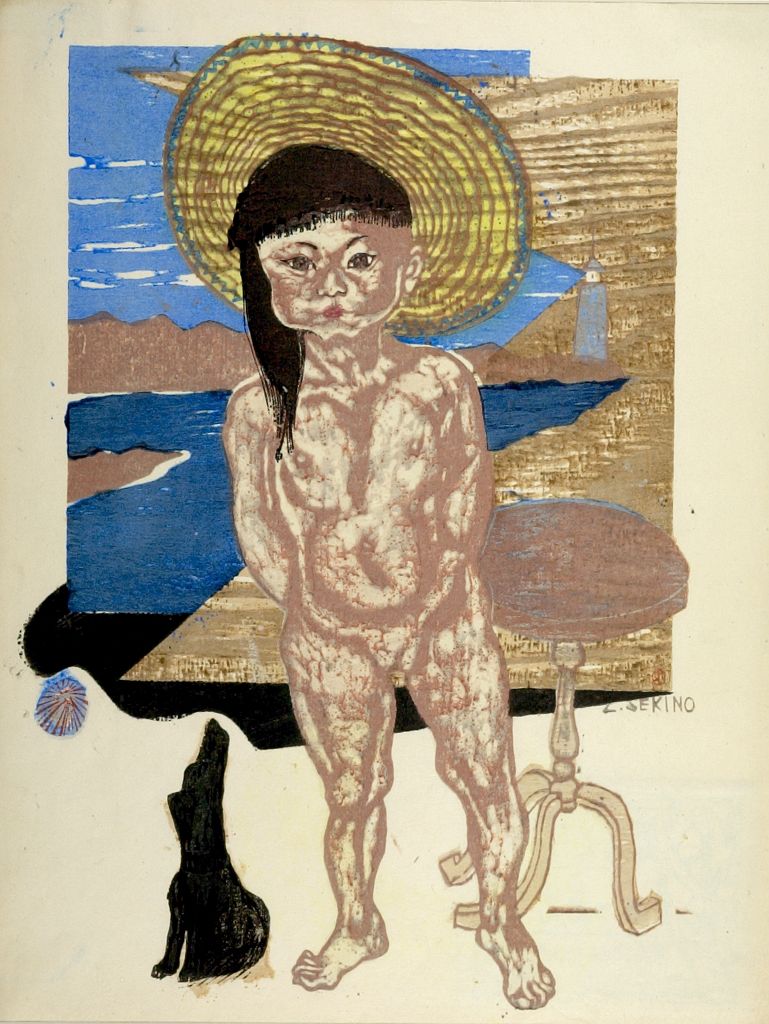
Child of the Sea
1940
Woodblock print

The Beach at Kaiganji in Sanuki Province (Sanuki Kaiganji no hama), from the series "Collection of Views of Japan II, Kansai Edition (Nihon fukei shu II Kansai hen)"
1934
Color woodblock print; oban

Pacific Ocean, Awa Province (Boshu Taikai), from the series "Souvenirs of Travel, Third Series (Tabi miyage dai sanshu)"
Boshu Taikai
1925
Color woodblock print; oban

Pine Beach at Miho (Miho no Matsubara), from the series "Selection of Views of the Tokaido (Tokaido fukei senshu)"
September 1931
Color woodblock print; oban
Featured in Collections
Curated cross-cuts that include this print.
Frequently Asked Questions
Xiaogushan was created by Hiroshi Yoshida (吉田博) in 1939.
Xiaogushan was published by Yoshida Studio (1939).
Xiaogushan depicts seascapes, trees, and mountains.
Xiaogushan measures 40.9 × 26.7 cm (Oban format).