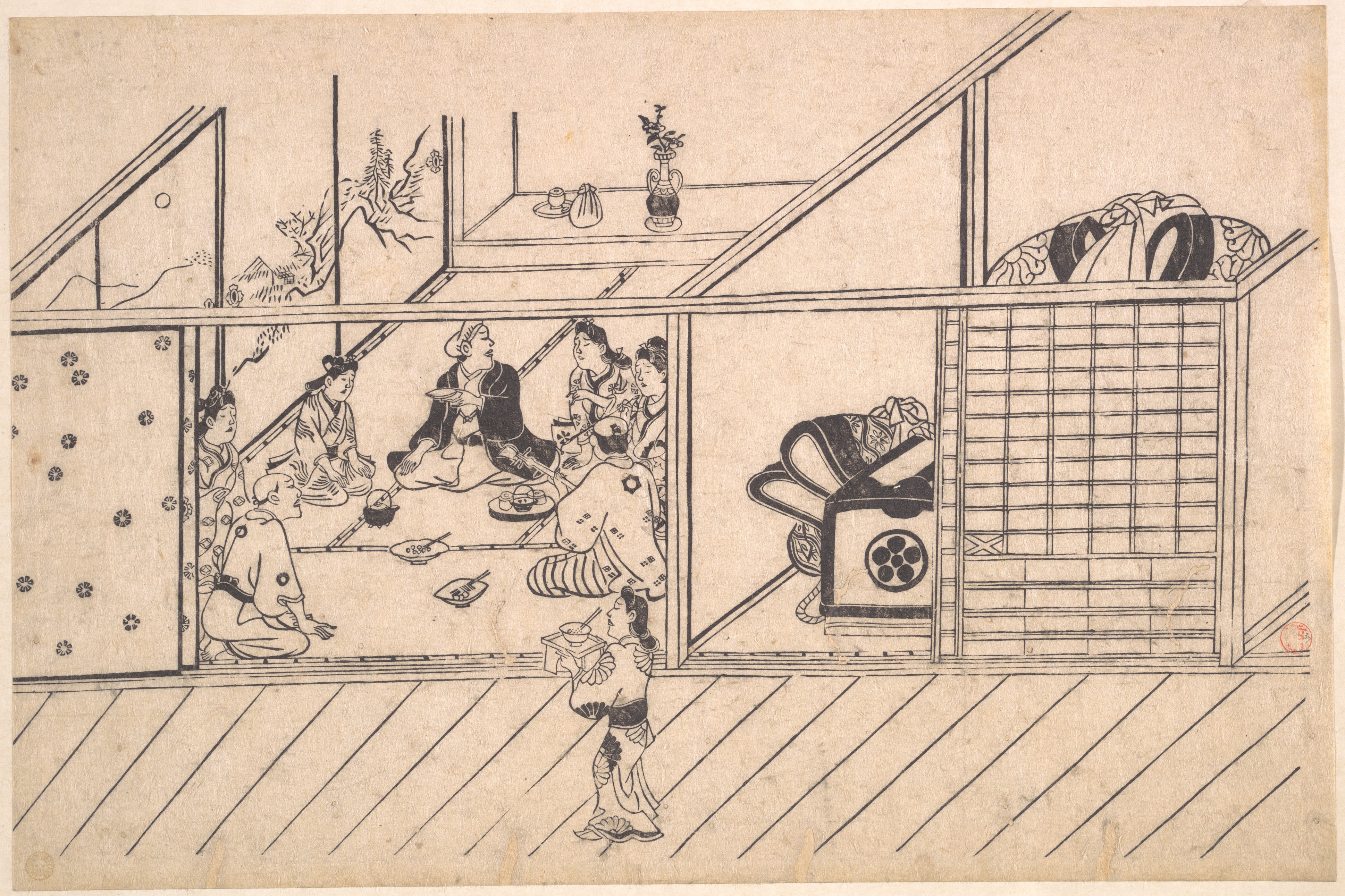
A Banquet in a Joroya
- Date:
- ca. 1680
- Medium:
- Monochrome woodblock print; ink and color on paper
- Source:
- Metropolitan Museum of Art
Description
A Banquet in a Jorōya, a horizontal book illustration by Hishikawa Moronobu in the Metropolitan Museum of Art, looks inside a Yoshiwara establishment during a private party. A jorōya was a courtesan house, and Moronobu sets the scene in the interior reception room where guests have removed their outer robes, taken their place at lacquered trays of food and saké, and called for music. The ukiyo-e founder organizes the composition along a single long ground line of tatami: at one end the patron lounges against an armrest as a senior courtesan pours from a saké flask; in the middle a shamisen player and a singing kamuro maintain the entertainment; at the far end attendants ferry trays and bedding through a sliding door. The architecture is deliberately spare—just enough lattice and shoji to read as interior—so that Moronobu can give the figures the full visual weight. His robes are unmistakable: bold curving outlines, broad sleeves drawn with a single fluid stroke, and pattern fields kept open so the silhouettes carry the design. Although the Met catalogue assigns a date around 1670, the print belongs to the broader run of Yoshiwara subjects Moronobu produced through the 1670s and 1680s, when he effectively invented the visual vocabulary for picturing the licensed quarter. Within the larger arc of early Edo ukiyo-e, A Banquet in a Jorōya is an important precursor to the courtesan interior scenes that Sukenobu and Utamaro would later refine, and a clear demonstration of why Hishikawa Moronobu is named as the ukiyo-e founder.
More Prints by Hishikawa Moronobu
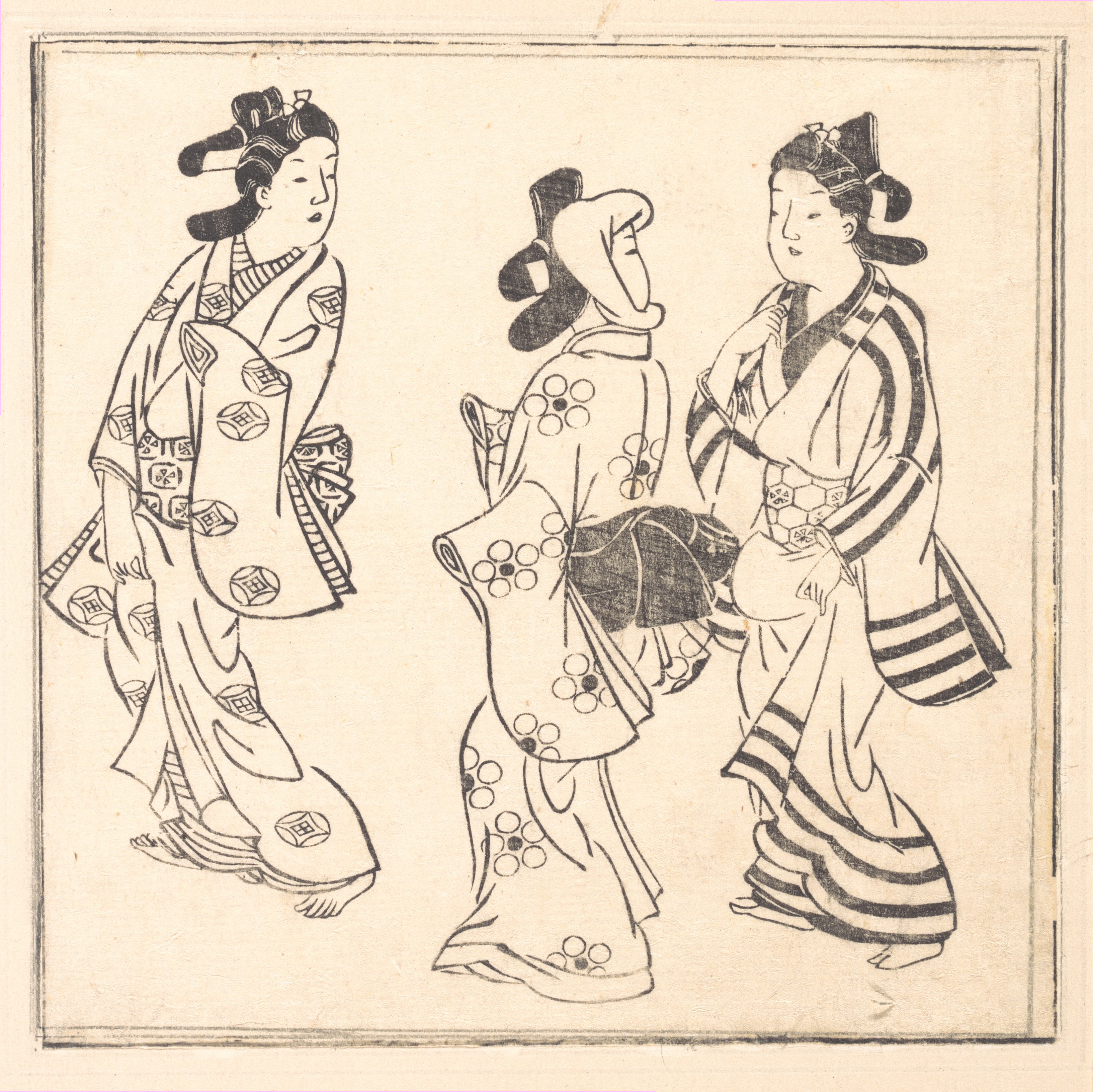
Leaf from a Book Entitled: Wakoku Hiaku-jo: One Hundred Japanese Women
Monochrome woodblock print; ink on paper

Fūryū sugatae hyakunin isshu
1695 Genroku 8
Woodblock- printed book; 3 vols.
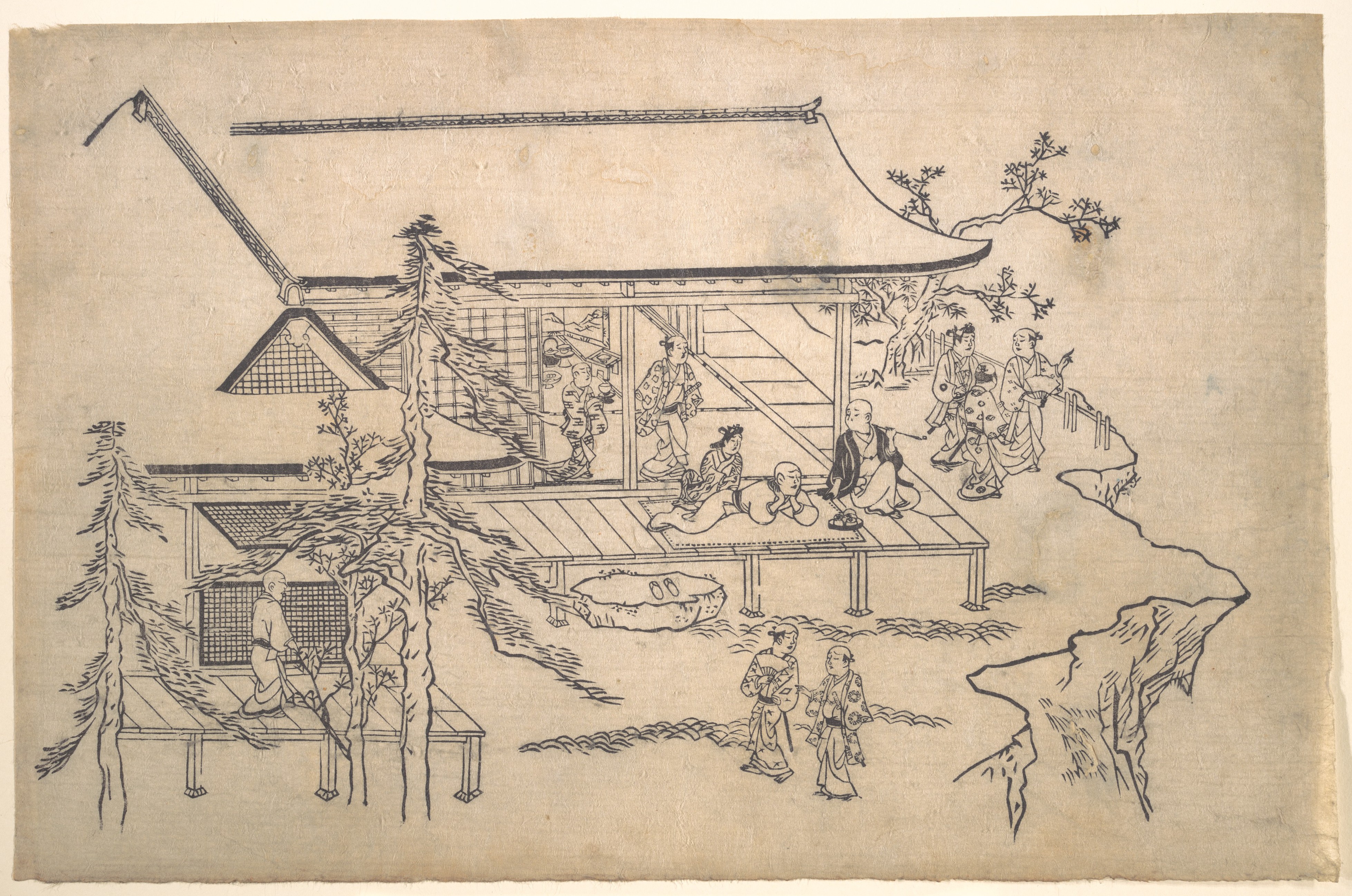
Flower-Viewing Scene
ca. 1685
Monochrome woodblock print (sumie); ink on paper
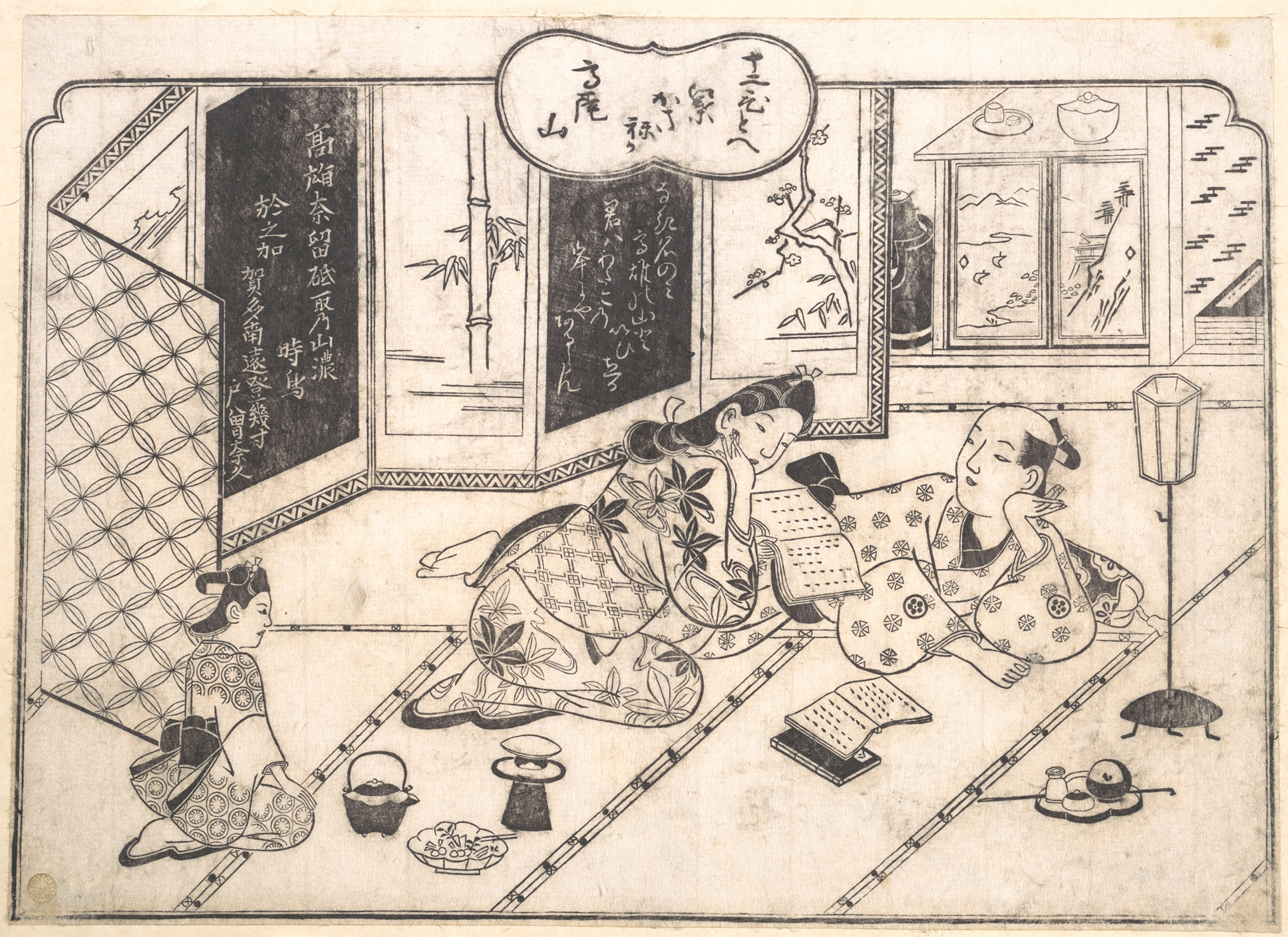
Go to Takaoyama to see Maple Leaves having Twelve Points
ca. 1690
Woodblock print; ink and color on paper
Frequently Asked Questions
A Banquet in a Joroya was created by Hishikawa Moronobu (菱川師宣) in ca. 1680.