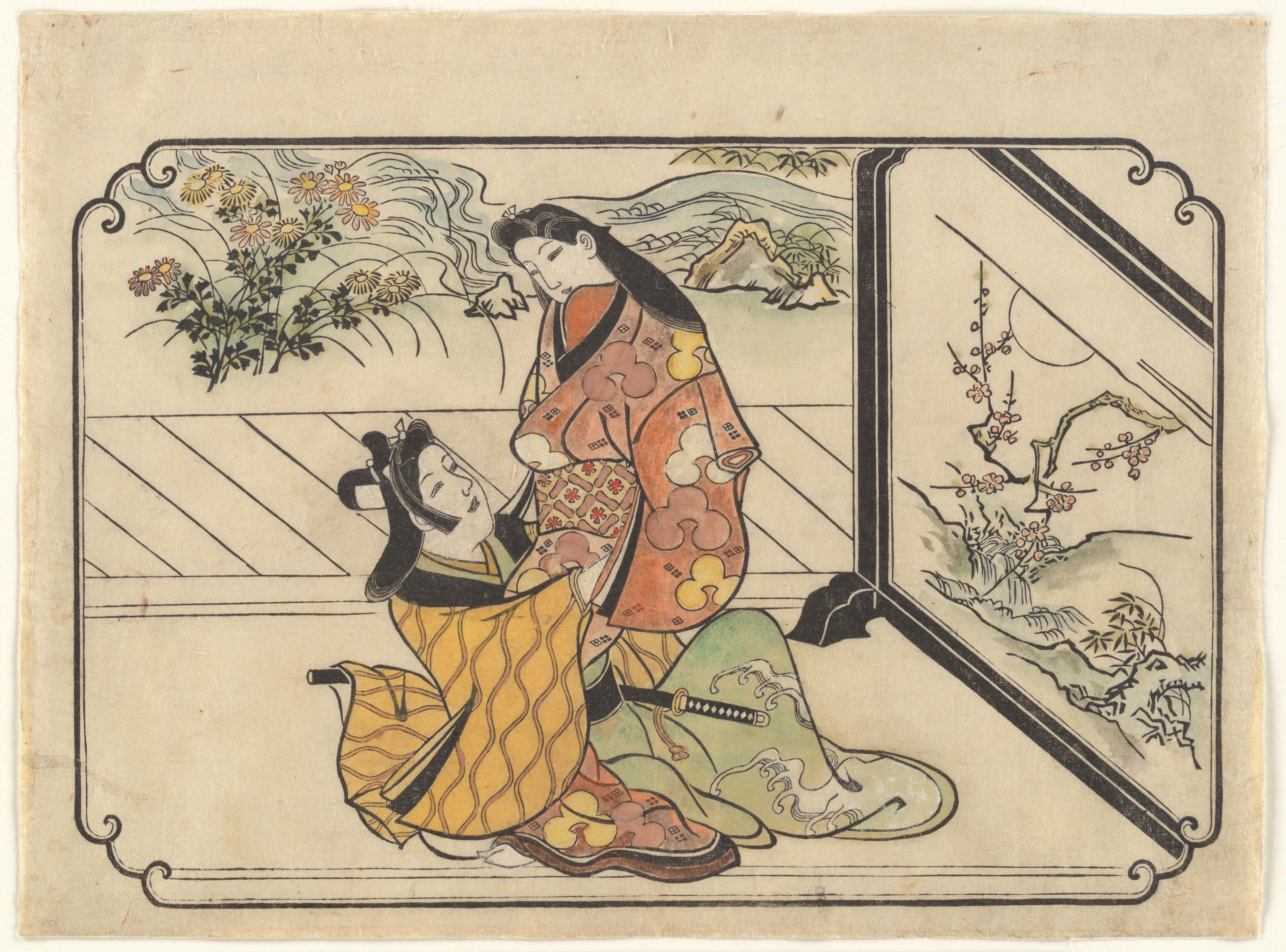
Courtesan with a Young Man (Wakashu) beside a Screen
- Date:
- ca. 1679–84
- Medium:
- Woodblock print (sumizuri-e); ink and hand-applied color on paper; horizontal ōban
- Source:
- Metropolitan Museum of Art
Description
Courtesan with a Young Man (Wakashu) beside a Screen, dated 1679 in the Metropolitan Museum of Art, is an interior scene by Hishikawa Moronobu showing one of the more nuanced relationships of Edo's pleasure culture. A wakashu—a young man whose distinctive forelock identifies him as still adolescent in social terms—reclines against a folding screen while an older courtesan sits beside him, leaning in to adjust the position of his robe or share an intimate aside. The folding screen behind them is painted with a stylized natural scene that closes off the composition and pushes all attention onto the two figures. The print belongs to a category of early Edo images that treated the wakashu as an object of romantic and erotic interest comparable to a female courtesan, a culturally specific role that Moronobu's prints documented with unusual frankness. The ukiyo-e founder constructs the image with his characteristic confident outlining: the courtesan's robe falls in unbroken curves, the wakashu's hairline and forelock are picked out in solid blacks, and the lacquered tray of saké between them is drawn with just enough perspective to anchor the figures in space. The architecture of the room is deliberately minimal, so that the human relationship carries the entire weight of the design. As an example of early Edo ukiyo-e, the leaf is invaluable for understanding both Hishikawa Moronobu's mature figural style and the inclusive social world that the licensed quarter and its private rooms made visible.
More Prints by Hishikawa Moronobu
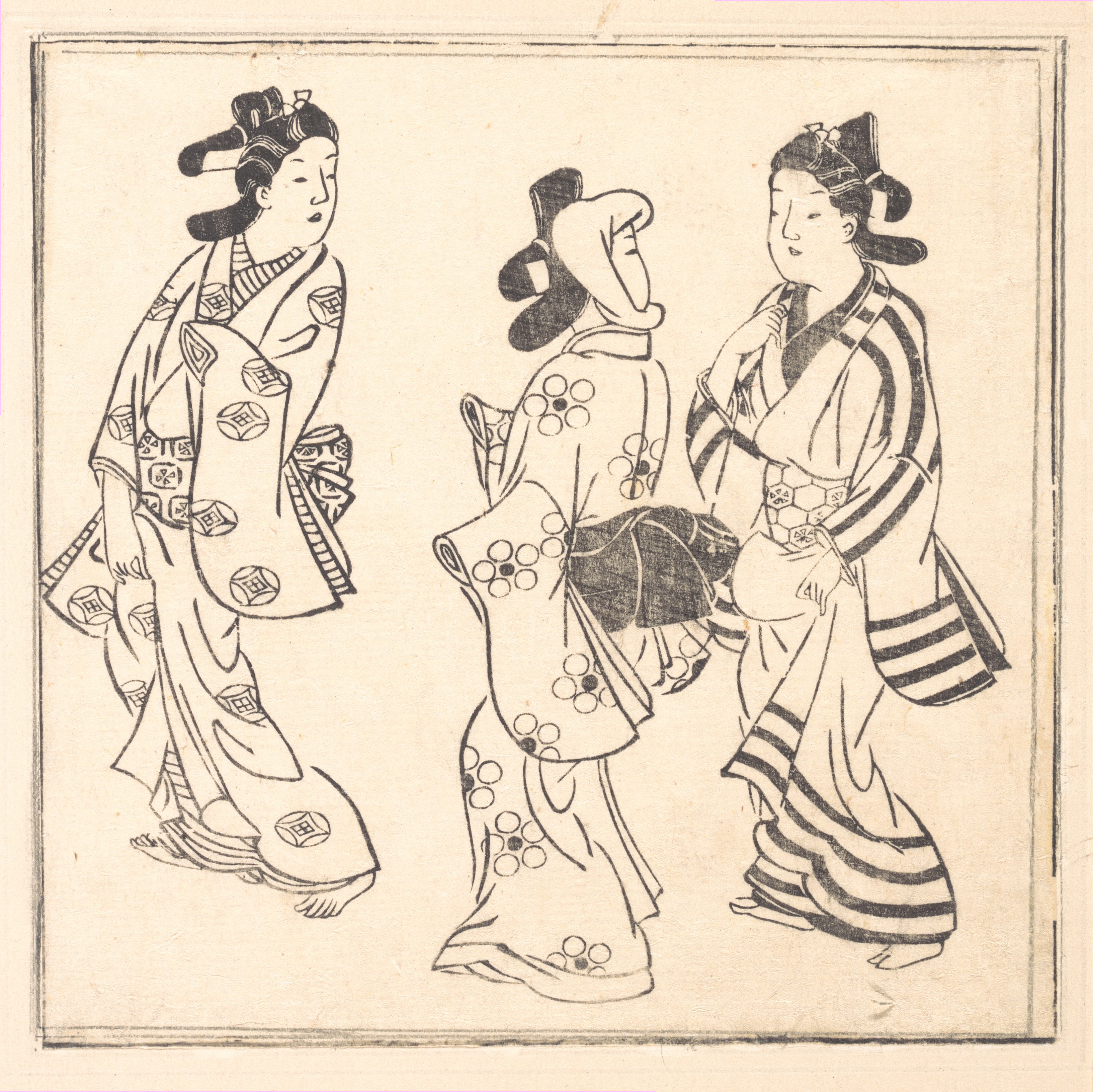
Leaf from a Book Entitled: Wakoku Hiaku-jo: One Hundred Japanese Women
Monochrome woodblock print; ink on paper

Fūryū sugatae hyakunin isshu
1695 Genroku 8
Woodblock- printed book; 3 vols.
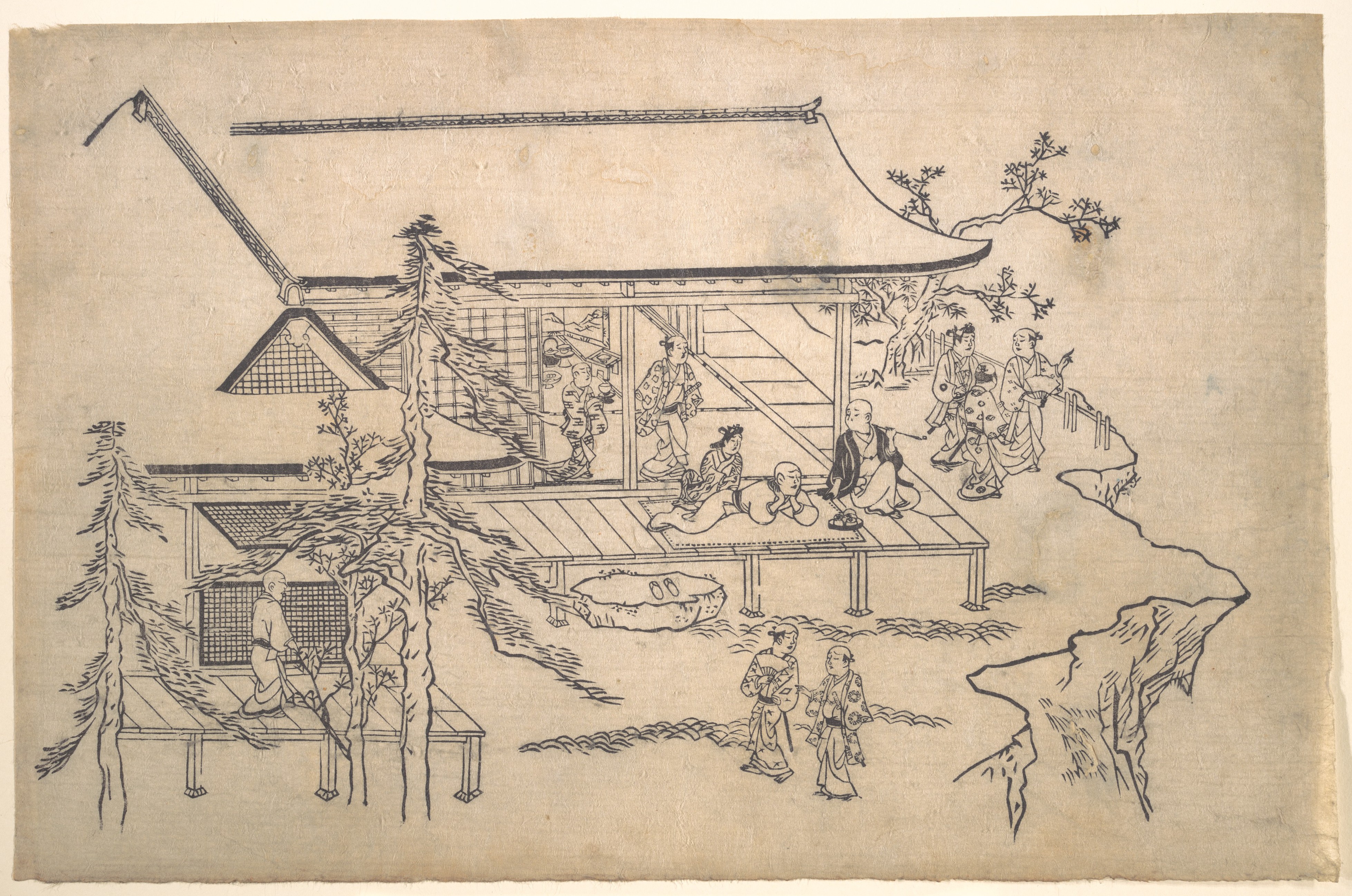
Flower-Viewing Scene
ca. 1685
Monochrome woodblock print (sumie); ink on paper
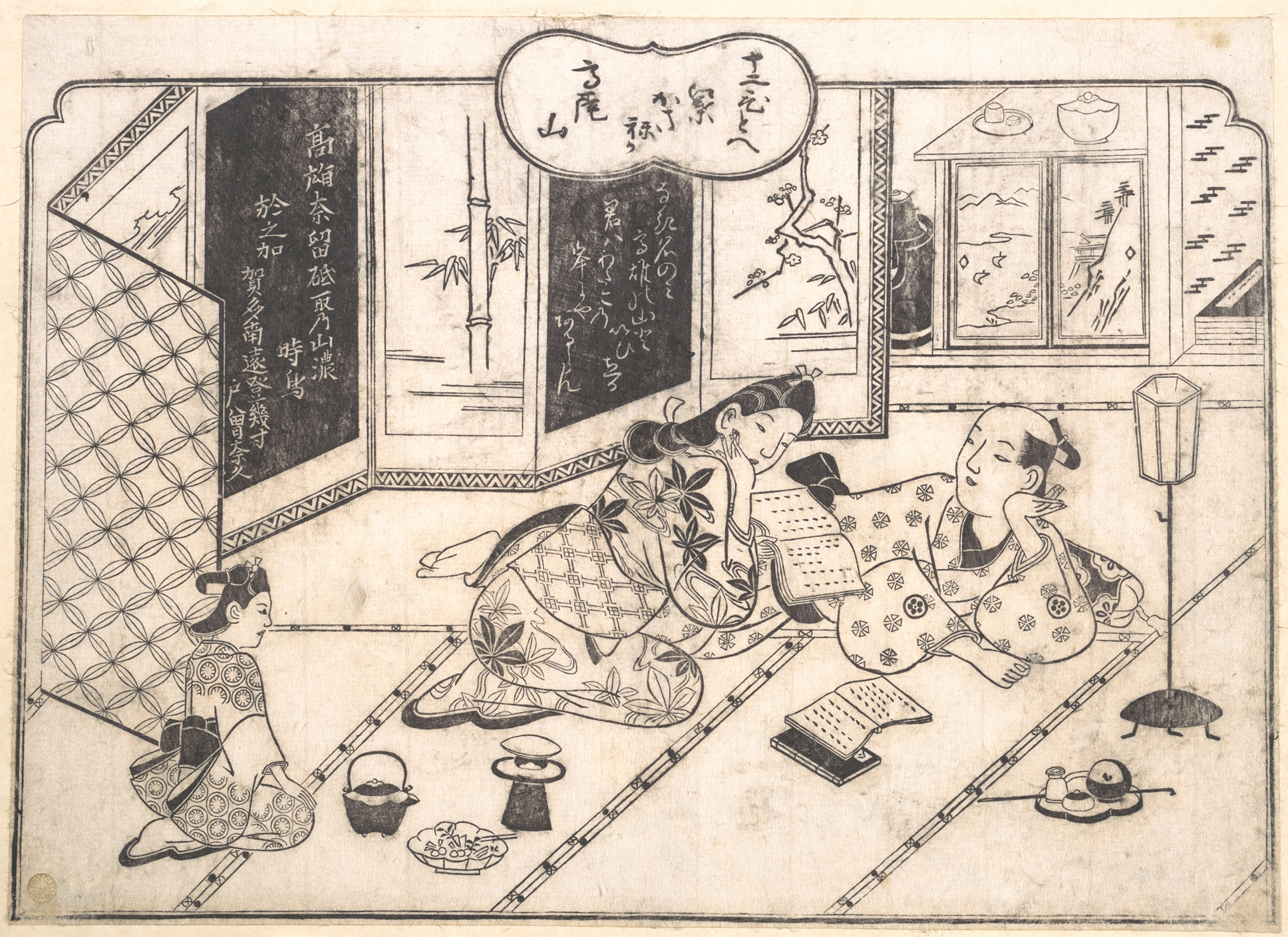
Go to Takaoyama to see Maple Leaves having Twelve Points
ca. 1690
Woodblock print; ink and color on paper
Frequently Asked Questions
Courtesan with a Young Man (Wakashu) beside a Screen was created by Hishikawa Moronobu (菱川師宣) in ca. 1679–84.