
Kozan-ji Temple
by Ido Masao
- Medium:
- Mokuhanga (Japanese woodblock)
- Image courtesy of
- Saru Gallery
Description
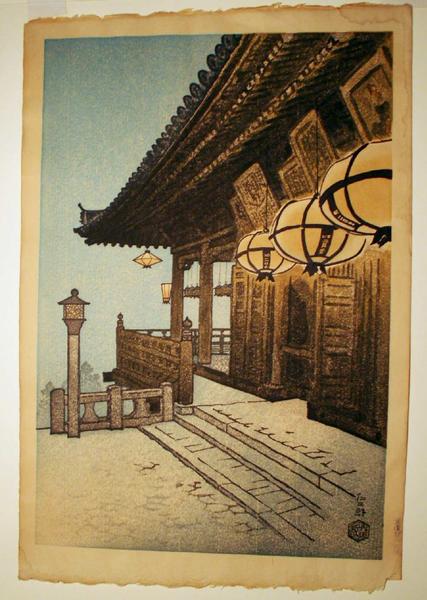
Kōzan-ji, in the cedar-clad Toganoo hills northwest of Kyoto, was refounded by the priest Myōe Shōnin in 1206 and houses the celebrated Chōjū-jinbutsu-giga scrolls of frolicking animals, traditionally regarded as among the earliest Japanese narrative paintings. The temple also occupies a place in tea history as the site where Myōe planted seeds brought from China by Eisai. Ido's depiction likely centres on the Sekisui-in, the small Kamakura-period sub-hall whose hipped-and-gabled roof and stepped stone approach are the most photographed elements of the complex. The compositional logic places that roof against a backdrop of cedar and maple, with bokashi gradations carrying atmosphere down the slope. As an off-season or non-koyō treatment, this version probably foregrounds the mossy stone steps and verdant cedar trunks rather than the autumn palette of its sibling sheet. Within Ido's Kyoto cycle, Kōzan-ji is one of the temples he returned to repeatedly across seasons, producing variants that together function as a small monographic study.
More Prints by Ido Masao


More Temples & Shrines Prints

Fushimi Inari Temple
伏見稲荷
Woodblock print

The Compound of the Tenman Shrine at Kameido in the Snow (Kameido Tenmangu keidai no yuki), from the series "Famous Places in the Eastern Capital (Toto meisho)"
c. 1832/38
Color woodblock print; oban
Temple with lanterns
Woodblock print

A Section of the Byodo Temple at Uji (Uji Byodoin no ichibu), from the series "Souvenirs of Travel, Second Series (Tabi miyage dai nishu)"
Uji Byodoin no ichibu
1921
Color woodblock print; oban
Featured in Collections
Curated cross-cuts that include this print.
Frequently Asked Questions
Kozan-ji Temple was created by Ido Masao (井堂雅夫).
Kozan-ji Temple depicts temples & shrines.