
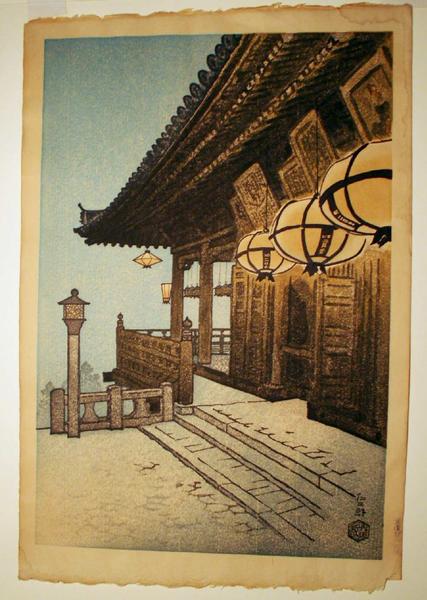
Obai Temple
by Ido Masao
- Medium:
- Mokuhanga (Japanese woodblock)
- Image courtesy of
- Saru Gallery
Description
Ōbai-in is a sub-temple within the vast Daitoku-ji complex in northern Kyoto, founded in 1583 as the bodaiji of the Mōri clan and closely tied to the wabi-cha tea tradition through its association with Sen no Rikyū. The Naka-roji moss garden and the Bokuseki-no-niwa rock garden are its principal subjects for landscape artists. Ido's print most likely takes the approach roji — a stepping-stone path crossing carpet-thick moss, flanked by clipped azalea and shaded by a few specimen maples — with a corner of the kuri kitchen building or zen-shū gate anchoring one side. Bokashi handles the dappled light across the moss surface, while careful key-block work delineates the irregular stepping stones. Printed on washi through multiple color passes, the sheet belongs to Ido's Daitoku-ji grouping alongside Kōtō-in and Daisen-in, all chosen for the way their Momoyama-period tea-garden design distills Kyoto's cultural inheritance into compact, intensively designed enclosures.
More Prints by Ido Masao


More Temples & Shrines Prints

Fushimi Inari Temple
伏見稲荷
Woodblock print

The Compound of the Tenman Shrine at Kameido in the Snow (Kameido Tenmangu keidai no yuki), from the series "Famous Places in the Eastern Capital (Toto meisho)"
c. 1832/38
Color woodblock print; oban
Temple with lanterns
Woodblock print

A Section of the Byodo Temple at Uji (Uji Byodoin no ichibu), from the series "Souvenirs of Travel, Second Series (Tabi miyage dai nishu)"
Uji Byodoin no ichibu
1921
Color woodblock print; oban
Featured in Collections
Curated cross-cuts that include this print.
Frequently Asked Questions
Obai Temple was created by Ido Masao (井堂雅夫).
Obai Temple depicts temples & shrines.