
Tokofuji Temple
by Ido Masao
- Medium:
- Mokuhanga (Japanese woodblock)
- Image courtesy of
- Saru Gallery
Description
The temple referenced is almost certainly Tofuku-ji, the great Rinzai Zen monastery in southeastern Kyoto founded in 1236 and famous for its valley of maples crossed by the covered Tsutenkyo bridge. Ido Masao returned to Tofuku-ji repeatedly, drawn to the dense canopy of momiji that turns crimson and gold in late November and frames the temple's austere monochrome architecture. A print of the subject would typically center the bridge or the Sanmon gate against a bokashi-graded ground of layered reds and oranges, with the maple foliage rendered through patterned carving rather than literal leaf shapes — a convention inherited from earlier ukiyo-e meisho-e treatments of autumn temples. The contrast between the disciplined dark timber of Zen architecture and the saturated chromatic intensity of the maples is a defining tension of the subject. Within Ido's broader Kyoto cycle, Tofuku-ji functioned as the canonical autumn temple, paired conceptually with his cherry-blossom views of the Philosopher's Path in spring.
More Prints by Ido Masao


More Temples & Shrines Prints
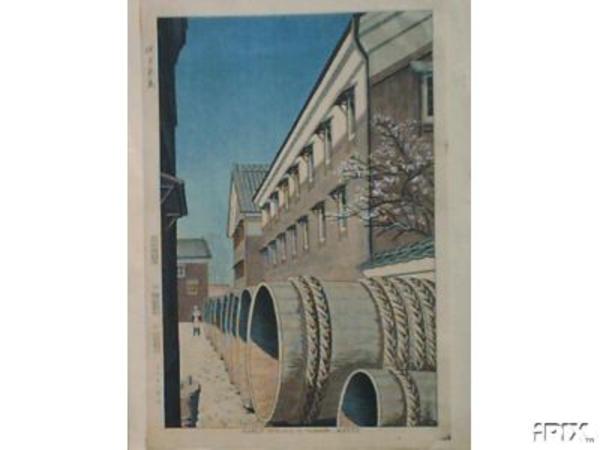
Fushimi Inari Temple
伏見稲荷
Woodblock print

The Compound of the Tenman Shrine at Kameido in the Snow (Kameido Tenmangu keidai no yuki), from the series "Famous Places in the Eastern Capital (Toto meisho)"
c. 1832/38
Color woodblock print; oban
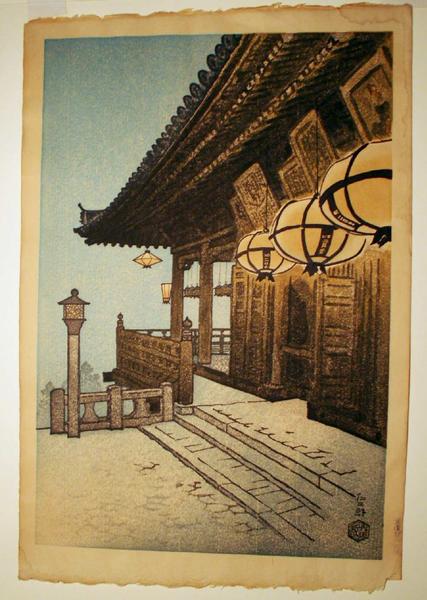
Temple with lanterns
Woodblock print

A Section of the Byodo Temple at Uji (Uji Byodoin no ichibu), from the series "Souvenirs of Travel, Second Series (Tabi miyage dai nishu)"
Uji Byodoin no ichibu
1921
Color woodblock print; oban
Featured in Collections
Curated cross-cuts that include this print.
Frequently Asked Questions
Tokofuji Temple was created by Ido Masao (井堂雅夫).
Tokofuji Temple depicts temples & shrines.