
Nihonbashi
- Medium:
- Mokuhanga (Japanese woodblock)
- Image courtesy of
- Saru Gallery
Description
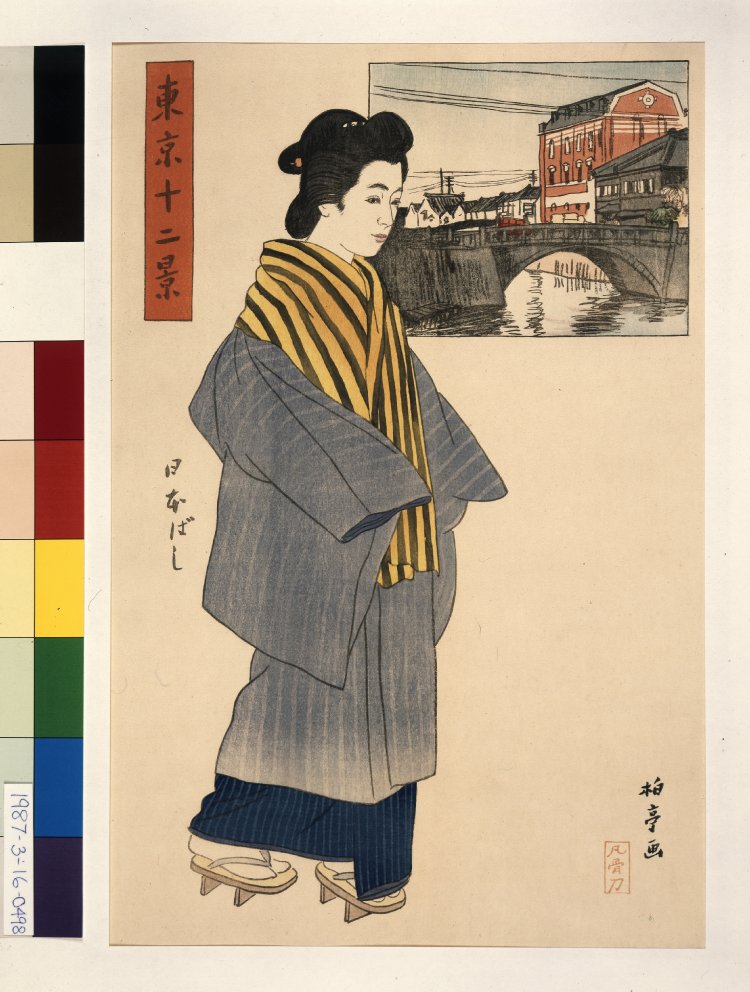
Nihonbashi (日本橋, 'Japan bridge') is the bridge in central Tokyo originally built in 1603 as the starting point of the five Edo-period highways and the symbolic kilometer zero of the Japanese road system. A subject treated by Hokusai and Hiroshige before him in their Tōkaidō and meisho series, in Hakutei's hands the bridge is approached through the sensibility of a twentieth-century artist trained in yoga (Western-style) painting. The print likely depicts the rebuilt stone bridge of 1911 — with its bronze kirin and lion finials — possibly framed by the elevated railway and surrounding stone-and-brick buildings, or a view of the Nihonbashi River with cargo boats. As a founding member of the Nihon Sosaku Hanga Kyokai (1918), Hakutei treated urban Tokyo not as a romanticized Edo survival but as a working modern city. The mokuhanga technique remains traditional — carved cherry blocks, washi, baren — while the color and composition register the modernist eye visible across his oils and watercolors.
More Prints by Ishii Hakutei
Featured in Collections
Curated cross-cuts that include this print.
Frequently Asked Questions
Nihonbashi was created by Ishii Hakutei (石井柏亭).