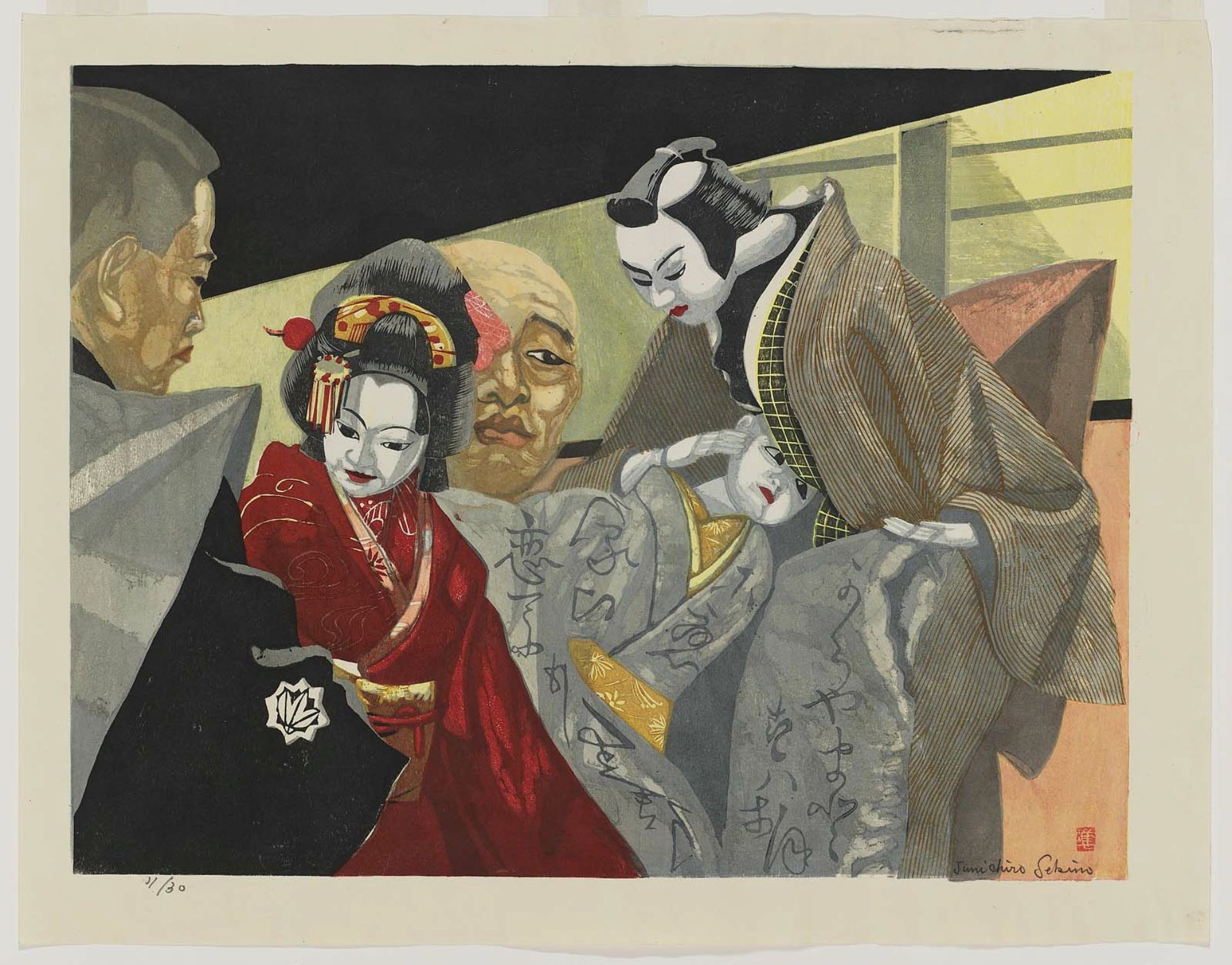
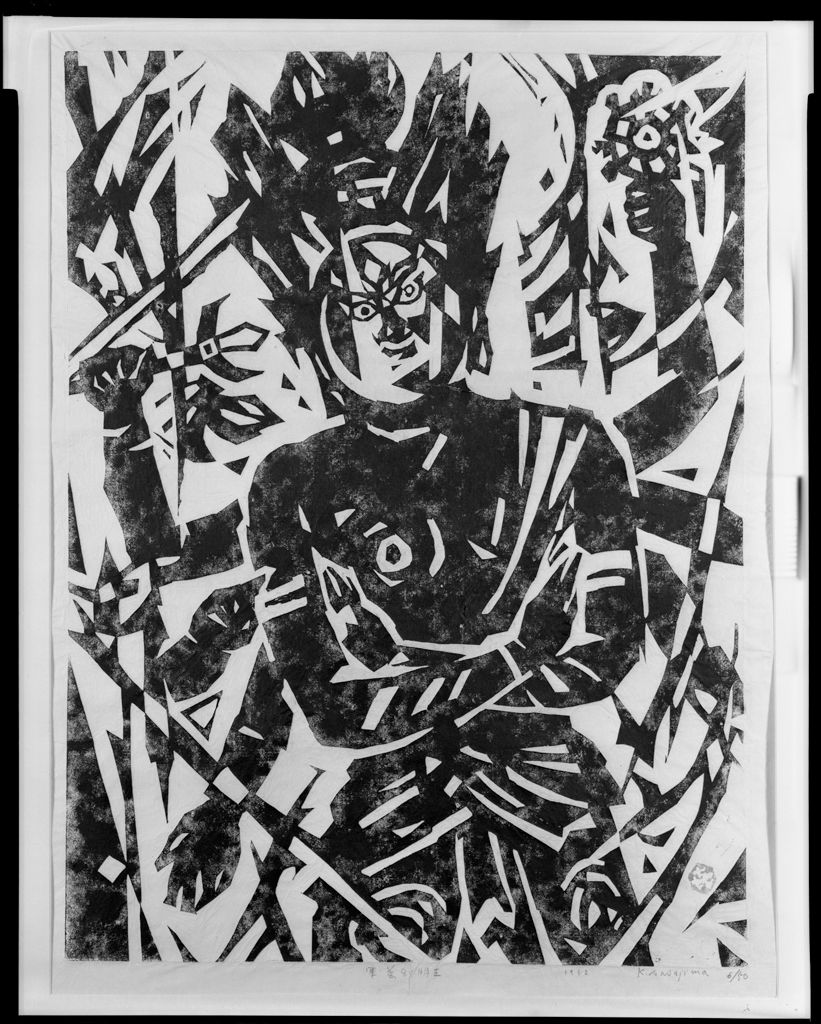
The Puppeteer Kiritake Monjuro with the Puppet Jihei (Right) and Other Puppeteers with Osui, the daughter of Jihei (Center) and Koharu (Left)
- Medium:
- Woodblock print
- Source:
- Museum of Fine Arts Boston
- Image courtesy of
- Museum of Fine Arts Boston
Description
This woodblock print depicts a scene from Bunraku—the Japanese puppet theater tradition that emerged in seventeenth-century Osaka—drawing on Chikamatsu Monzaemon's play Shinjū: Ten no Amijima (The Love Suicides at Amijima), one of the foundational texts of the repertoire. The full title identifies three characters: Jihei, the tragic merchant protagonist; his daughter Osui; and Koharu, the courtesan whose fate is bound to Jihei's in the play's final act. Kiritake Monjuro was among the preeminent puppeteers of twentieth-century Bunraku. Sekino's sosaku-hanga approach to theater subjects involved direct attendance at performances and personal carving of all blocks. The layered visual complexity of Bunraku—visible puppeteers in formal black manipulating richly costumed puppet figures against stage settings—offers abundant material for color registration and compositional arrangement across multiple woodblock layers. The print demonstrates Sekino's engagement with Japan's classical performing arts as a source of both cultural documentation and formal invention.
More Prints by Jun'ichiro Sekino
More Figures Prints
Featured in Collections
Curated cross-cuts that include this print.
Frequently Asked Questions
The Puppeteer Kiritake Monjuro with the Puppet Jihei (Right) and Other Puppeteers with Osui, the daughter of Jihei (Center) and Koharu (Left) was created by Jun'ichiro Sekino (関野準一郎).
The Puppeteer Kiritake Monjuro with the Puppet Jihei (Right) and Other Puppeteers with Osui, the daughter of Jihei (Center) and Koharu (Left) uses Nishiki-e, Moku-hanga, and Kento, on woodblock print.
The Puppeteer Kiritake Monjuro with the Puppet Jihei (Right) and Other Puppeteers with Osui, the daughter of Jihei (Center) and Koharu (Left) depicts figures and kabuki.