
Frontispiece for a Novel
- Source:
- Hara Shobō
Description
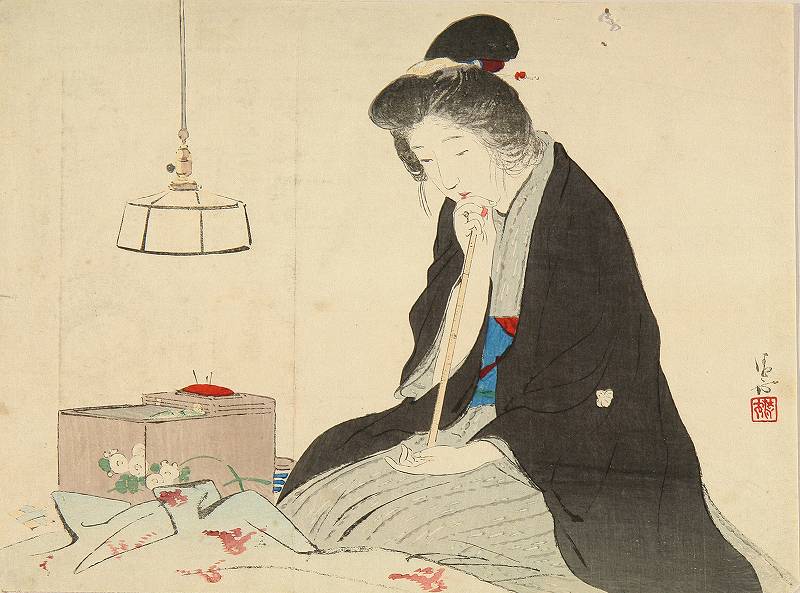
Frontispiece for a Novel, an undated sheet from the early years of Kaburaki Kiyokata's professional career, exemplifies the kuchi-e format in which the artist first made his public reputation at the turn of the twentieth century. The print is built around the slender figure of a young woman drawn in the careful contour and soft tonal palette that Kiyokata had absorbed during his apprenticeship under Mizuno Toshikata, the Meiji bijin-ga and historical designer whose own training under Tsukioka Yoshitoshi connected Kiyokata back to the great late-Edo and early-Meiji lineage of figural draftsmanship. The kuchi-e served as the folded color frontispiece for a bound novel or literary magazine, and the genre's commercial logic required that a single figure carry the narrative weight of an entire volume through gesture, costume, and the quiet emotional register of the face. Kiyokata's contribution to the format was to bring to it the careful observation of contemporary Tokyo women that would become the hallmark of his mature nihonga production: a young woman read in her dress, her posture, and the small adjustments of her hair as a specific urban type rather than a generic ideal of feminine beauty. The print's restrained palette, with color held in selected zones of robe and hair ornament against the lightly inked ground, registers the technical demands of the small-format woodblock and the visual reserve of late Meiji literary illustration. Such kuchi-e were avidly collected at the time and now offer a key route into the figural language Kiyokata would later transmit to his students Itō Shinsui and Kawase Hasui, both of whom carried elements of his observational discipline into the shin-hanga print revival of the 1910s and 1920s. The impression is preserved through Hara Shobō's dealer holdings on ukiyo-e.org (https://ukiyo-e.org/image/harashobo/4713_3).
More Prints by Kaburaki Kiyokata

Featured in Collections
Curated cross-cuts that include this print.
Frequently Asked Questions
Frontispiece for a Novel was created by Kaburaki Kiyokata (鏑木清方).