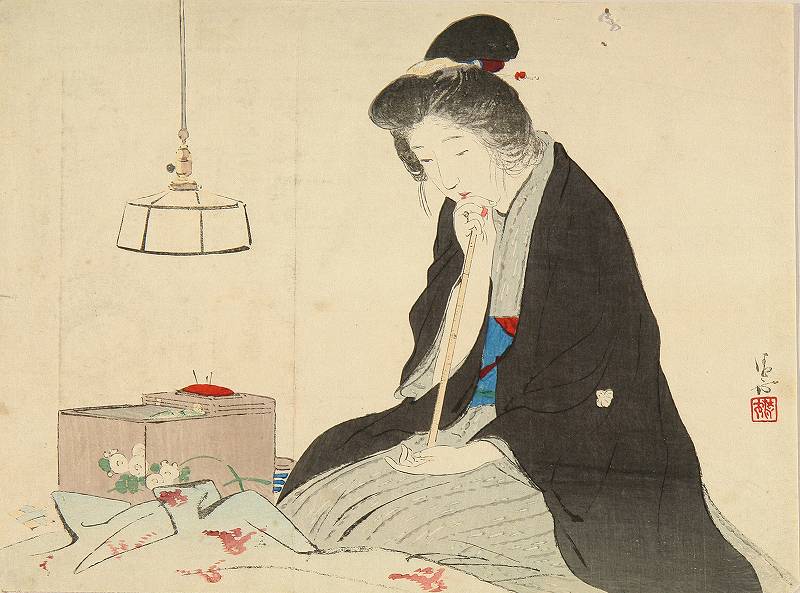
Frontispiece for a Novel, 1910 (II)
- Date:
- 1910
- Source:
- Hara Shobō
Description
Frontispiece for a Novel, dated 1910 and recorded here as the second sheet from that year, joins its companion in documenting Kaburaki Kiyokata's late kuchi-e production at a moment when the small-format color woodblock frontispiece was approaching the end of its commercial dominance in the Tokyo literary publishing market. The two 1910 sheets together illustrate the consistency of the aesthetic Kiyokata had constructed for the format across the preceding decade: a single slender Tokyo woman against a spare ground, drawn with the disciplined nihonga contour he had absorbed from his master Mizuno Toshikata, and registered with the textile and accessory detail that allowed an informed viewer to identify a specific urban type. Kiyokata's frontispieces had operated since the turn of the century as the visual face of late-Meiji literary fiction, with publishers and writers alike relying on his careful observation of contemporary femininity to attract readers and to set the literary atmosphere of a novel from its first opened plate. By 1910 the kuchi-e was beginning to face competition from the lithographic and photomechanical reproductions that would increasingly dominate magazine illustration in the Taishō era, and the body of late frontispieces from this year accordingly carries a certain historical weight as the closing chapter of the format Kiyokata had defined. The aesthetic he refined across his kuchi-e production would carry into the nihonga bijin-ga paintings of his mature career and would shape his students Itō Shinsui and Kawase Hasui, both of whom went on to lead the shin-hanga print revival. The impression is preserved through Hara Shobō's dealer holdings as recorded on ukiyo-e.org (https://ukiyo-e.org/image/harashobo/8088_3), and the record contributes to a fuller account of Kiyokata's kuchi-e output in its final productive year.
More Prints by Kaburaki Kiyokata


Featured in Collections
Curated cross-cuts that include this print.
Frequently Asked Questions
Frontispiece for a Novel, 1910 (II) was created by Kaburaki Kiyokata (鏑木清方) in 1910.