
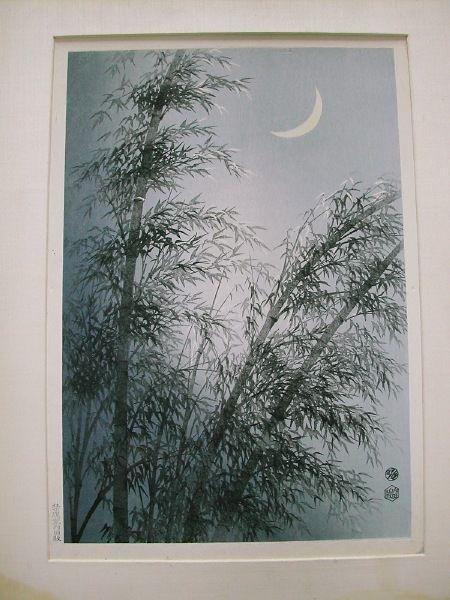
Grove in Kamo
- Medium:
- Mokuhanga (Japanese woodblock)
- Image courtesy of
- Saru Gallery
Description
Grove in Kamo depicts a stand of trees in the Kamo district, likely the wooded precincts associated with the Kamo shrines along the Kamo River in Kyoto, a setting long established in Japanese landscape painting and poetry. Suwa treats the grove as a study in mass and tonal weight rather than as a famous-place portrait in the meisho-e tradition, the trees probably built up through layered impressions and bokashi gradations that allowed soft transitions between foliage and ground. As a sosaku-hanga work, every stage of the print — design, block-cutting, and impression — would have been carried out by the artist himself, on washi pulled with the baren. The subject reflects the second-generation movement's interest in observed landscape over the codified seasonal conventions of earlier woodblock printmaking. Where Hiroshige's Kamo views had been composed for narrative recognition, Suwa's grove sits closer to the personal, atmospheric landscape studies that artists such as Hiratsuka Un'ichi were producing during the same period — the woodblock medium turned toward perception rather than place-making.
More Prints by Kanenori Suwa

More Trees Prints


Featured in Collections
Curated cross-cuts that include this print.
Frequently Asked Questions
Grove in Kamo was created by Kanenori Suwa (諏訪兼紀).
Grove in Kamo depicts trees.