
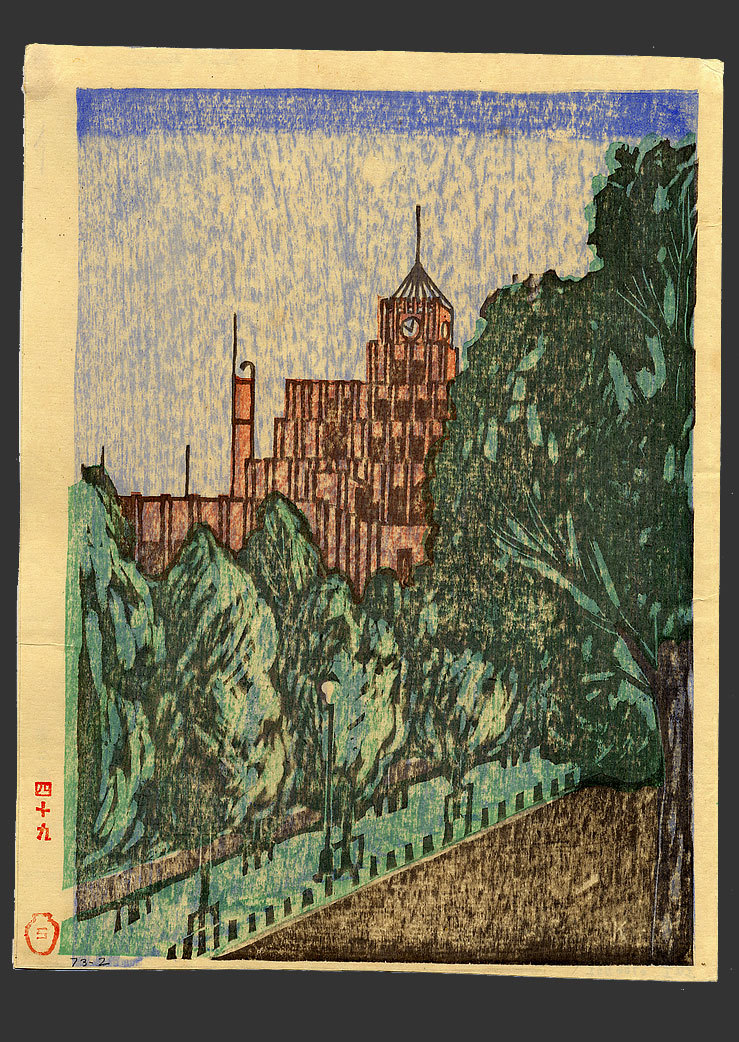
Hibiya Park
- Medium:
- Mokuhanga (Japanese woodblock)
- Image courtesy of
- Saru Gallery
Description
Hibiya Park takes as its subject Tokyo's first Western-style public park, opened in 1903 on the grounds of a former feudal residence and quickly absorbed into the city's everyday civic life. Suwa's choice reflects the sosaku-hanga interest in modern Tokyo as a lived, observed environment rather than the historical or seasonal landscapes of the earlier ukiyo-e meisho-e tradition. The park's geometric beds, gravel paths, and imported plantings would have offered a structured, almost architectural subject suited to the woodblock medium's capacity for flat color areas and incised line. Suwa, working in the artist-printmaker mode that defined sosaku-hanga from Kanae Yamamoto's 1904 Fisherman onward, would have cut his own blocks and pulled the impressions himself on washi. The print sits alongside other Taisho and early Showa creative-print depictions of public spaces — bridges, stations, parks — that registered the new civic infrastructure of the modernizing capital, treating it not as spectacle but as ordinary scenery suitable for the observational attention an earlier generation had given to riverbanks and mountain passes.
More Prints by Kanenori Suwa

More Gardens Prints
![[Garden of] Taj Mahal, No. 1 (Taji Maharu no niwa, dai ichi) by Hiroshi Yoshida](https://www.artic.edu/iiif/2/230993a7-d4f0-c979-c267-127d48e1ef1c/full/843,/0/default.jpg)
[Garden of] Taj Mahal, No. 1 (Taji Maharu no niwa, dai ichi)
Taji Maharu no niwa, dai ichi
1931
Color woodblock print; oban

Kiyozumi Garden in Moonlight
January 1938
Woodblock print, ink and color on paper

Moon over Kiyosumi Garden (Tsuki no Kiyosumien)
1938
Color woodblock print; oban
Rock garden
10/70, 1966
Woodblock print
Featured in Collections
Curated cross-cuts that include this print.
Frequently Asked Questions
Hibiya Park was created by Kanenori Suwa (諏訪兼紀).
Hibiya Park depicts gardens.