
Chohi (Zhang Fei) on Black Horse
- Date:
- 1810s
- Medium:
- Color woodblock print
- Source:
- Art Institute of Chicago
Description
Dated to the 1810s and held by the Art Institute of Chicago (accession 1954.721), this Katsukawa Shuntei woodblock print depicts Chōhi — the Japanese rendering of Zhang Fei (張飛, c. 167–221) — one of the three legendary warriors of the Chinese late Han dynasty whose deeds were preserved in the historical chronicle Records of the Three Kingdoms (Sanguozhi) and later canonized in the popular fourteenth-century novel Romance of the Three Kingdoms (Sanguo yanyi). The novel circulated widely in early-modern Japan in both Chinese and translated form, and its heroes — Liu Bei, Guan Yu (Kan'u), and Zhang Fei — became standard reference figures in late-Edo warrior imagery, depicted in popular prints, illustrated books, and theatrical productions. Zhang Fei was particularly associated with explosive physical strength and ferocious loyalty: stage and pictorial tradition typically depicted him as a black-bearded warrior of immense build, mounted on a powerful horse and wielding his characteristic eighteen-foot serpent spear. Shuntei's composition follows this iconographic convention, presenting the warrior on a black horse as a single-figure heroic portrait. The use of a Chinese hero in a late-Edo Japanese woodblock print reflects the broader cultural absorption of Chinese narrative material into the Edo popular imagination — Edo audiences encountered the Three Kingdoms heroes as fully naturalized members of their cultural repertoire, alongside Japanese figures from the Heike and Soga cycles. The print belongs to Shuntei's mature period of musha-e production and contributes to the development of single-figure heroic-warrior imagery that the Utagawa school would elaborate at greater scale in the 1820s and 1830s.
More Prints by Katsukawa Shuntei

No. 3: Kato Kiyomasa, from the series "Three Tales of Valor (Buyu sanban tsuzuki)"
1820
Color woodblock print; shikishiban, surimono

A Woman as Ebisu, from the series "Seven Women as the Gods of Good Fortune for the Hanagasa Poetry Club (Hanagasaren shichifukujin)"
c. 1820
Color woodblock print; shikishiban, surimono
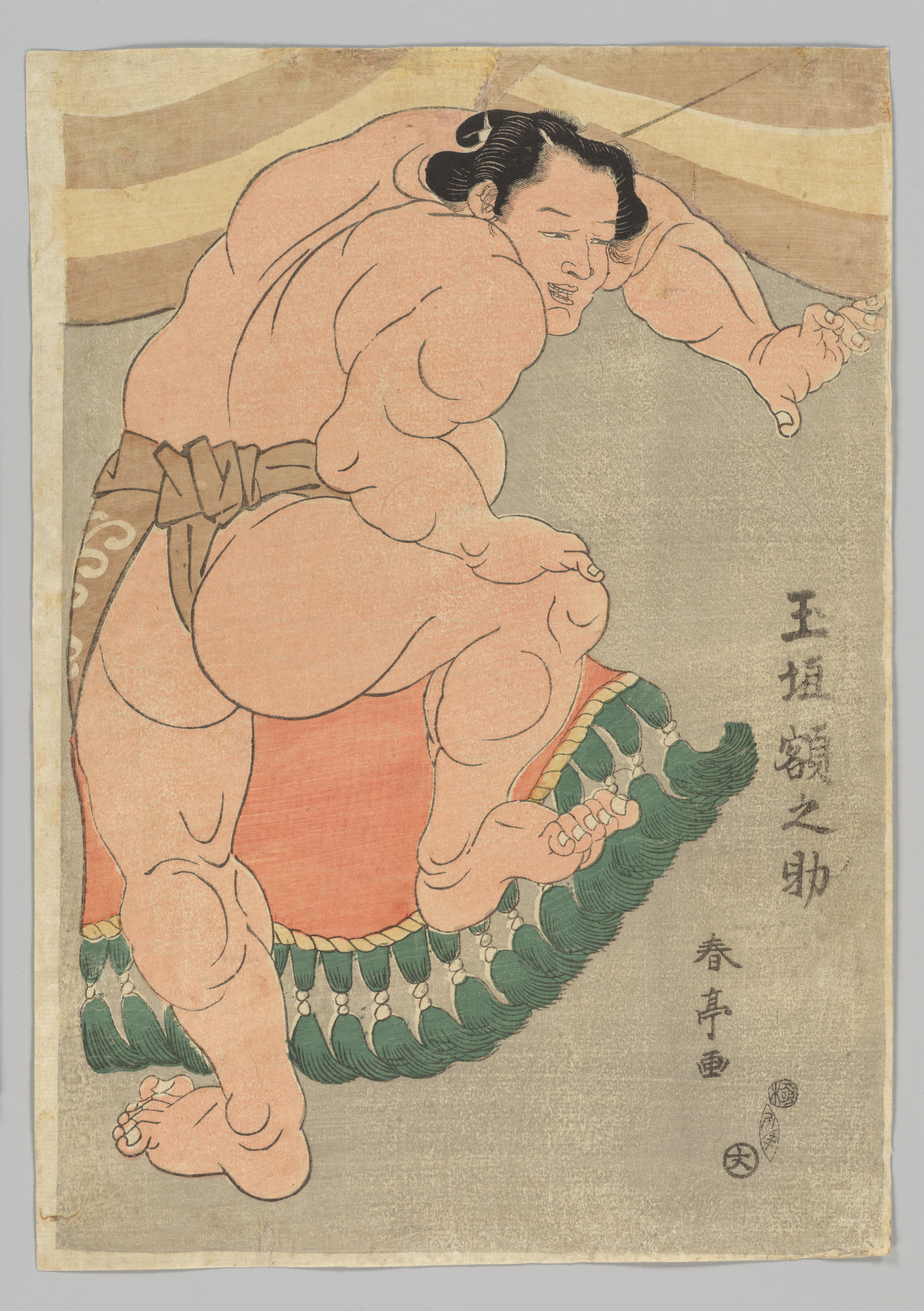
Sumo Wrestler Tamagaki Gakunosuke IV
1811-14 (possibly ca. 1813)
Wood-block print (nishiki-e); ink and color on paper

A Court Lady as Daikoku, from the series "Seven Women as the Gods of Good Fortune for the Hanagasa Poetry Club (Hanagasaren shichifukujin)"
c. 1820
Color woodblock print; shikishiban, surimono
Frequently Asked Questions
Chohi (Zhang Fei) on Black Horse was created by Katsukawa Shuntei (勝川春亭) in 1810s.