
Biography
Katsukawa Shuntei (勝川春亭, 1770–1820) was a designer of Japanese woodblock prints whose career spanned the late Kansei and Bunka eras, the decades in which Edo print publishing reorganized itself around new subject categories — musha-e (warrior prints), sumo-e (sumo wrestler prints), and the privately commissioned surimono — that would dominate the nineteenth century. A pupil of Katsukawa Shun'ei, Shuntei worked at a generational remove from the Katsukawa school's founding mission of An'ei-era actor portraiture and is remembered today primarily as a warrior-print specialist whose triptychs of samurai battles bridge the eighteenth-century Katsukawa style and the heroic musha-e of Utagawa Kuniyoshi a generation later.
Shuntei trained under Shun'ei (1762–1819), one of the leading second-generation Katsukawa designers and the head of the school in the years following the death of its founder Katsukawa Shunshō in 1792. As Shuntei came of age as a designer, the commercial center of Edo print publishing was already shifting away from actor prints — the Katsukawa school's traditional commercial base — and toward new genres responsive to the cultural movements of the Kansei reform period (1787–1793) and its aftermath. The Kansei reforms had restricted certain kinds of print imagery, particularly explicit actor portraiture associated with what authorities considered the moral disorder of the kabuki world, and publishers responded by expanding into subjects that occupied less politically sensitive ground: historical warriors, mythological battles, sumo wrestlers, and luxury surimono commissioned by literary clubs. Shuntei's career grew out of, and was shaped by, this commercial reorientation.
Musha-e — prints depicting samurai warriors, often drawn from the medieval war chronicles such as the Tale of the Heike (Heike monogatari) and the Soga monogatari — became Shuntei's primary specialty and the basis of his historical reputation. His ōban triptychs of battle scenes from the Genpei War (1180–1185) and from heroic legend, executed in the bold compositional manner that the Katsukawa school had developed in the 1790s, are now recognized as important precursors to the great heroic-warrior series of Utagawa Kuniyoshi in the 1820s and 1830s. A characteristic example is his treatment of the earth spider (tsuchigumo) slain by the Minamoto retainer Watanabe no Tsuna, a subject that had been a fixture of warrior iconography since the medieval period. He also produced compositions illustrating scenes from the Tale of the Heike, such as the encounter of Kumagai and Atsumori. These prints established the visual conventions — armored samurai in dynamic action, mythological monsters, atmospheric battle scenes with smoke and falling snow — that the next generation of Edo musha-e designers would inherit and elaborate.
Alongside warrior prints, Shuntei was a surimono designer. Surimono — privately commissioned, deluxe woodblock prints distributed within poetry-club networks rather than sold commercially — flourished in the Bunka and Bunsei eras (1804–1830) as a luxury alternative to the mass-market single-sheet print. The shikishiban (small square) format favored by surimono publishers permitted exceptional refinement of carving and printing: metallic pigments, mica grounds, and elaborate embossing distinguished the surimono from ordinary commercial prints. Shuntei contributed to this format, producing series such as Seven Women as the Gods of Good Fortune for the Hanagasa Poetry Club (Hanagasaren shichifukujin) around 1820, in which female figures embody the Seven Lucky Gods of the New Year. Impressions from this series survive in the Art Institute of Chicago. These prints reflect the literary, allusive sensibility of late-Edo surimono culture, and their carving and printing demonstrate the technical heights that the Edo print medium had reached by Shuntei's middle career. Shuntei also produced sumo prints (sumo-e) documenting individual ranked wrestlers — a genre closely associated with the Katsukawa school since the days of Shunshō and Shun'ei — and, more unusually for his era, occasionally applied Western-style perspective to his landscape and township compositions.
Shuntei died in 1820, around fifty years old. His surviving work is held today by major public museum collections, including the Art Institute of Chicago. For collectors of Japanese woodblock prints, Shuntei represents the second-generation Katsukawa-school designers who carried the school's tradition into the nineteenth century and whose warrior prints in particular form the bridge between the eighteenth-century origins of musha-e and the explosive heroic imagery that Kuniyoshi and his contemporaries would produce in the decades after Shuntei's death.
Key Facts
Frequently Asked Questions
Katsukawa Shuntei (勝川春亭, 1770–1820) was a designer of Japanese woodblock prints whose career spanned the late Kansei and Bunka eras, the decades in which Edo print publishing reorganized itself around new subject categories — musha-e (warrior prints), sumo-e (sumo wrestler prints), and the privately commissioned surimono — that would dominate the nineteenth century. A pupil of Katsukawa Shun'ei, Shuntei worked at a generational remove from the Katsukawa school's founding mission of An'ei-era actor portraiture and is remembered today primarily as a warrior-print specialist whose triptychs of samurai battles bridge the eighteenth-century Katsukawa style and the heroic musha-e of Utagawa Kuniyoshi a generation later.
Katsukawa Shuntei was active from 1770 to 1820. They were associated with the Ukiyo-e movement.
Katsukawa Shuntei's work was shaped by the Ukiyo-e tradition in Japanese woodblock printmaking. Ukiyo-e: ## What is ukiyo-e? Ukiyo-e ([浮世絵](/glossary/ukiyo-e)) — literally "pictures of the floating world" — is the Edo-period Japanese print and painting tradition that flourished from roughly 1660 to 1868, depicting the pleasures of urban life in Edo (modern Tokyo): courtesans, kabuki actors, sumo wrestlers, famous landscapes, and seasonal beauties.
Katsukawa Shuntei's prints frequently feature sumo.
Original prints by Katsukawa Shuntei can be found in collections including Art Institute of Chicago, Metropolitan Museum of Art.
Woodblock Prints by Katsukawa Shuntei (9)
The Earth Spider Slain by Brave Samurai Watanabe no Tauna (center image)
about 1800-1810
Color woodblock print
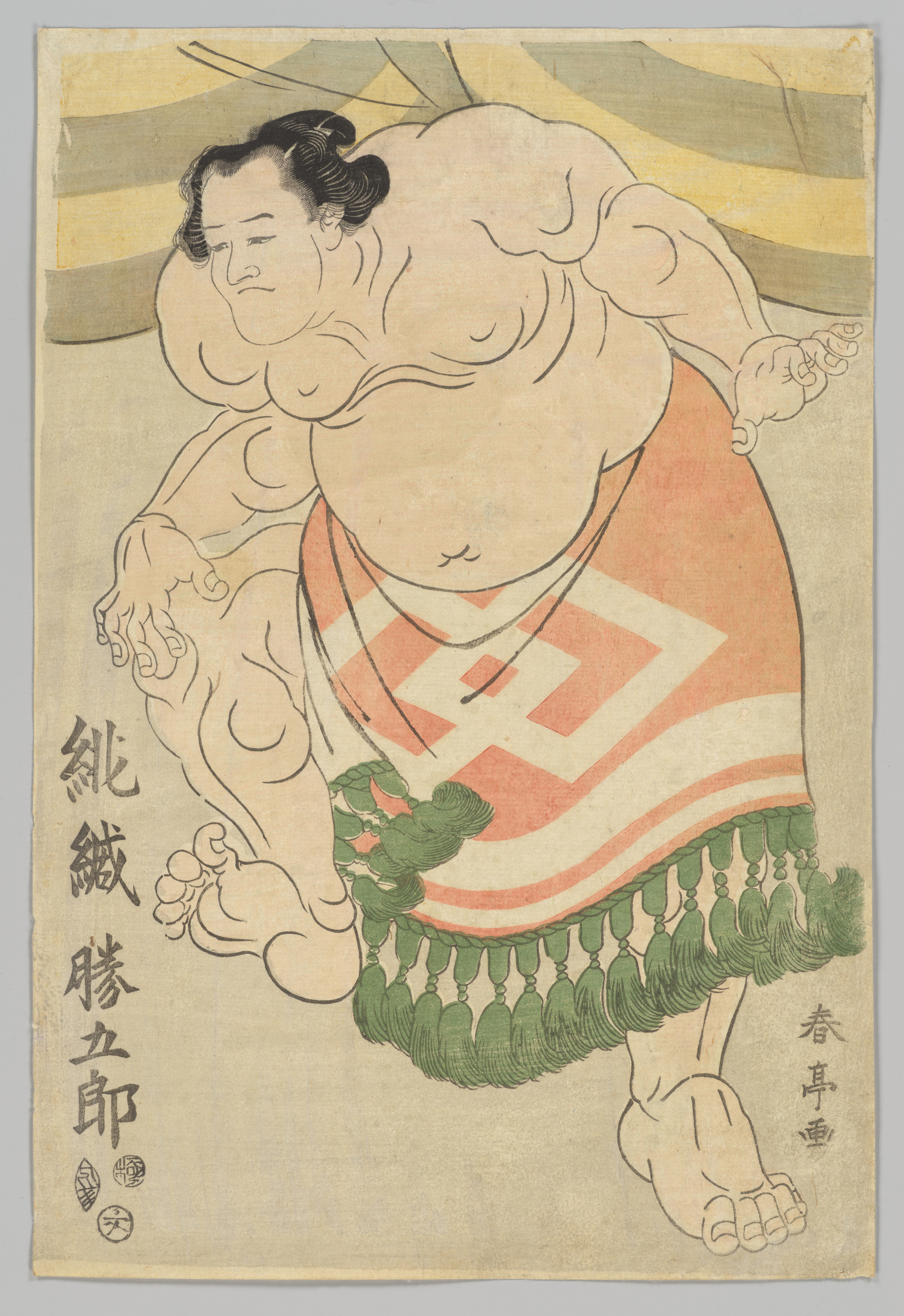
Sumo Wrestler Hiodoshi Katsugorō
1811-14 (possibly ca. 1813)
Wood-block print (nishiki-e); ink and color on paper
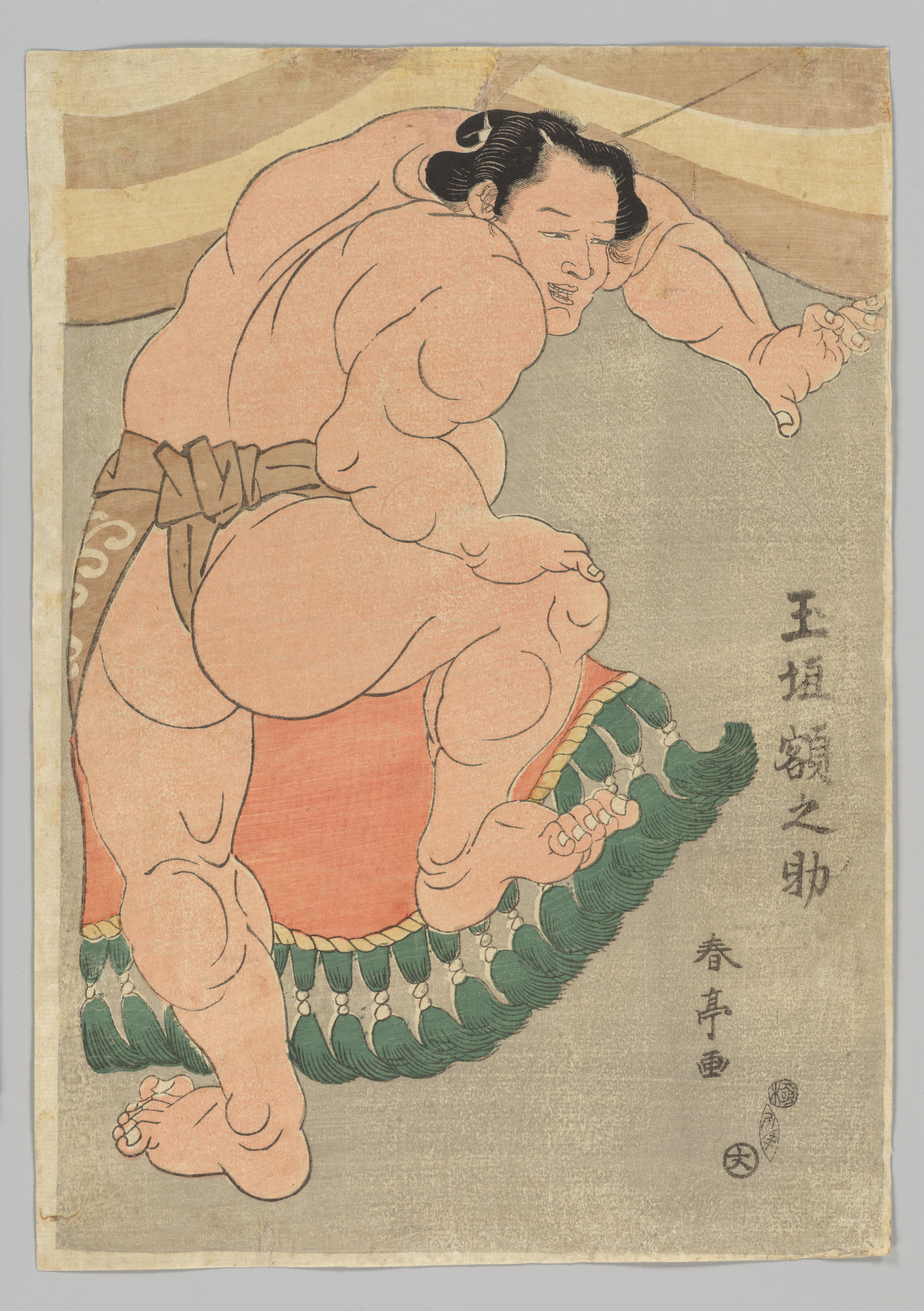
Sumo Wrestler Tamagaki Gakunosuke IV
1811-14 (possibly ca. 1813)
Wood-block print (nishiki-e); ink and color on paper

Chohi (Zhang Fei) on Black Horse
1810s
Color woodblock print
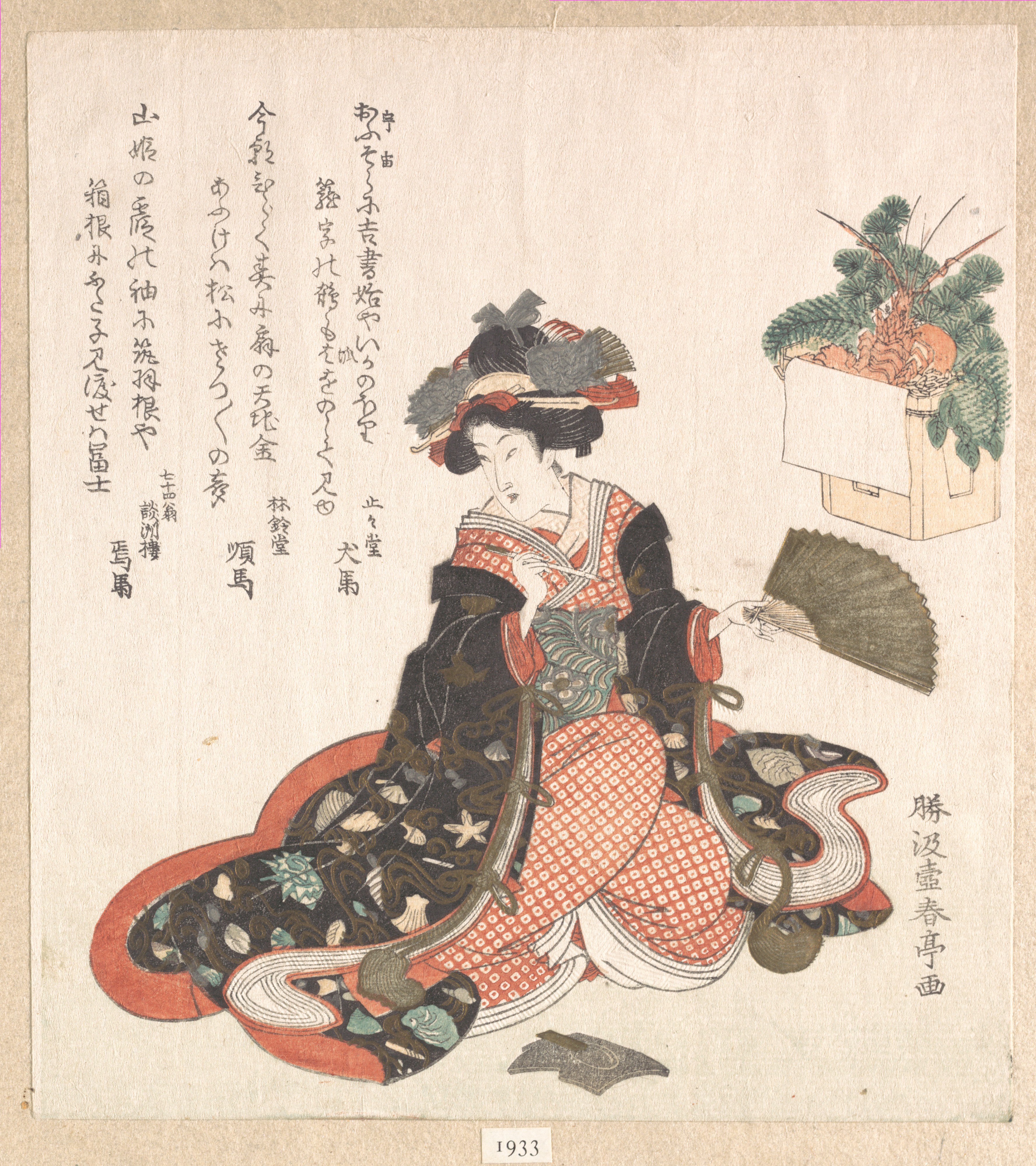
Courtesan and New Year Decoration
ca. 1816
Woodblock print (surimono); ink and color on paper

Two Young Attendants on New Year's Day from the series "Seven Women as the Gods of Good Fortune for the Hanagasa Poetry Club (Hanagasaren shichifukujin)"
c. 1820
Color woodblock print; shikishiban, surimono

A Woman as Ebisu, from the series "Seven Women as the Gods of Good Fortune for the Hanagasa Poetry Club (Hanagasaren shichifukujin)"
c. 1820
Color woodblock print; shikishiban, surimono

A Court Lady as Daikoku, from the series "Seven Women as the Gods of Good Fortune for the Hanagasa Poetry Club (Hanagasaren shichifukujin)"
c. 1820
Color woodblock print; shikishiban, surimono

No. 3: Kato Kiyomasa, from the series "Three Tales of Valor (Buyu sanban tsuzuki)"
1820
Color woodblock print; shikishiban, surimono