
Eight Bridges (Yatsuhashi)
八ツ橋
- Date:
- 1945
- Medium:
- Painting; mineral pigments
Description
Eight Bridges (八ツ橋, Yatsuhashi) is a 1945 painting by Kawabata Ryūshi held by the Yamatane Museum of Art in Tokyo, one of the principal nihonga-focused collections in Japan. The subject — irises blooming along zigzag plank bridges at the famous site of Yatsuhashi in Mikawa Province — is one of the great recurring motifs of Japanese painting, drawn from a celebrated passage in the tenth-century Tales of Ise and best known from Ogata Kōrin's pair of folding screens of c. 1709 in the Metropolitan Museum of Art (with a related pair at the Nezu Museum). Ryūshi takes the Rinpa-school motif and translates it into his own mid-twentieth-century idiom: the deep blue of the iris blossoms, the leaves rendered as broad green planes, and the bridges shown as long diagonal compositional spines extending across an extreme horizontal format. Painted in the final months of the Pacific War, the picture transposes a canonical decorative subject into the kaijō geijutsu language Ryūshi had been developing since the late 1920s — an extended public statement, on a scale unusual even within the Rinpa tradition, that places his Seiryūsha exhibition practice in deliberate dialogue with the great decorative paintings of the Edo period.
More Prints by Kawabata Ryūshi


More Bridges Prints
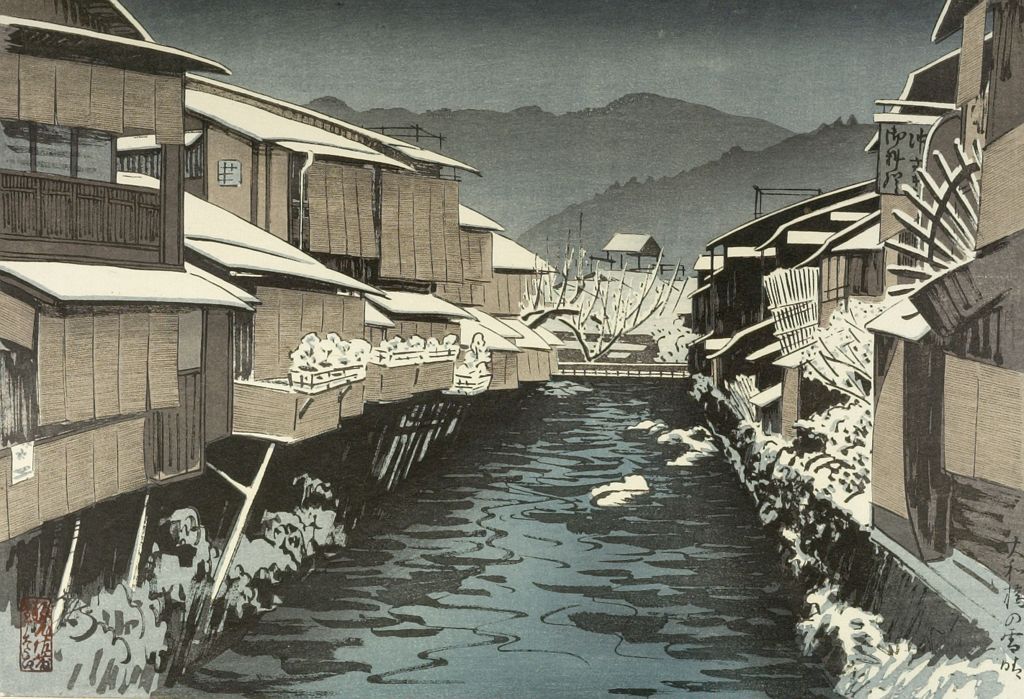
Fair Weather After Snow at Yamato Bridge, Kyoto (Yamato bashi no yukibare), Taishô period, dated 1924
Woodblock print
![Mount Fuji on a Moonlit Night, Kawai Bridge (Tsukiyo no Fuji [Kawaibashi]), from the series "Selection of Views of the Tokaido (Tokaido fukei senshu)" by Kawase Hasui](https://www.artic.edu/iiif/2/d0960668-1e73-339a-b182-fb995a54bff0/full/843,/0/default.jpg)
Mount Fuji on a Moonlit Night, Kawai Bridge (Tsukiyo no Fuji [Kawaibashi]), from the series "Selection of Views of the Tokaido (Tokaido fukei senshu)"
1947
Color woodblock print; oban

Shin Ohashi Bridge (Shin Ohashi), from the series "Twenty View of Tokyo (Tokyu nijukkei)"
1926
Color woodblock print; oban

Sacred Bridge in Nikko (Nikko Shinkyo)
1930
Color woodblock print; oban
Frequently Asked Questions
Eight Bridges (Yatsuhashi) (八ツ橋) was created by Kawabata Ryūshi (川端龍子) in 1945.
Eight Bridges (Yatsuhashi) depicts bridges.