
Landscape
山水図
- Date:
- before 1932
- Medium:
- Ink and color on silk
Description
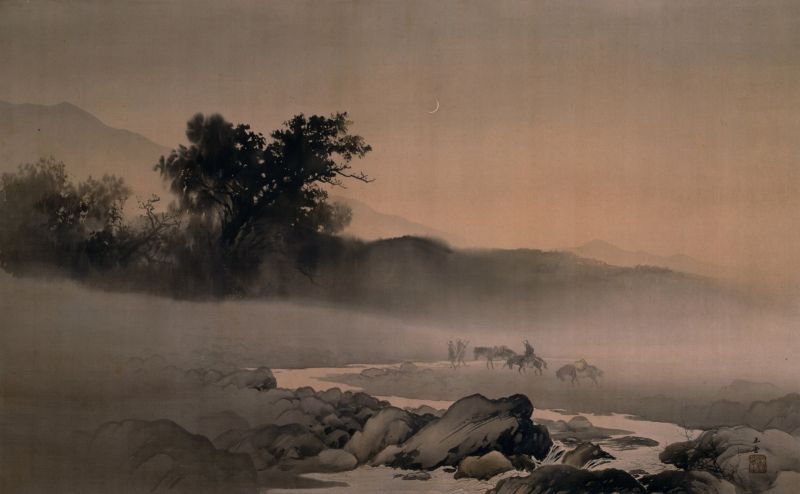
This landscape, reproduced from a Berlin 1931 exhibition catalogue and made available on Wikimedia Commons, is an example of Kawai Gyokudō's brush-and-ink mountain-and-river imagery from the late 1920s or earlier — the period of his greatest international visibility, just before the Berlin showing that helped earn him the French Légion d'Honneur of 1931 and the German First Class Red Cross Medal of 1933. The work is executed in the East Asian shan-shui (sansui) tradition of mountains, water, and small human figures, with rocks and ridge-lines built up in graduated ink wash and texture strokes (cunfa) descended ultimately from the Chinese literati tradition that Maruyama-Shijō and Kanō painters had domesticated in Japan over the preceding centuries. Gyokudō's handling combines the close brushwork of his Kyoto Shijō training under Mochizuki Gyokusen and Kōno Bairei with the broader atmospheric scale of his Tokyo training under Hashimoto Gahō, producing the calm, observed, humane landscape register that became his signature. Works of this kind helped consolidate Gyokudō's international reputation in the 1920s and 1930s and are the basis on which he was elected to the Imperial Art Academy and, in 1940, awarded the Order of Culture, the highest civilian artistic honor in Japan.
More Prints by Kawai Gyokudō

Moonlit Evening
月夜
1913
Hanging scroll; ink and light color on silk
New Moon (Futsuka zuki)
二日月
1907
Hanging scroll; ink and color on silk

Rooster on a Roof
屋根上の鶏
c. 1900–1930
Woodblock print; ink and color on paper

Parting Spring (Yuku haru) — right screen
行く春 右隻
1916
Six-panel folding screen; ink and color on paper
Frequently Asked Questions
Landscape (山水図) was created by Kawai Gyokudō (川合玉堂) in before 1932.