
Parting Spring (Yuku haru) — right screen
行く春 右隻
- Date:
- 1916
- Medium:
- Six-panel folding screen; ink and color on paper
Description
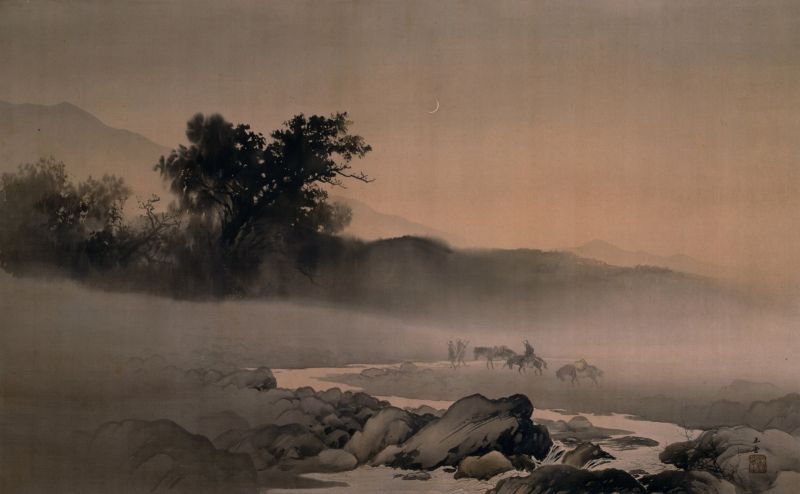
Parting Spring (Yuku haru) is a pair of six-panel folding screens (byōbu) executed by Kawai Gyokudō in 1916 in ink and color on paper, considered one of his supreme achievements in the screen format and a touchstone work of Taishō-period nihonga. This is the right screen (uhyaku) of the pair. The full composition extends across twelve combined panels and depicts the slow drift of cherry-blossom petals along a Japanese river in late spring, with a moored boat, a few small fishermen and travelers along the bank, and willow trees in fresh leaf softening the foreground. The right screen carries the upstream portion of the river scene, with the heavier concentration of buildings and figures. Gyokudō's brushwork draws together the Kyoto Shijō tradition of his master Kōno Bairei — close, observed treatment of branches, fishing boats, and figures — and the larger, Kanō-school atmospheric handling he had learned in Tokyo from Hashimoto Gahō. The work was exhibited at the tenth Bunten exhibition in 1916 and is now held by the National Museum of Modern Art, Tokyo. As an emblem of the way Gyokudō balanced classical Japanese poetic motifs (the falling cherry blossom, the departing spring, the river journey of life) against the looser, more atmospheric brushwork of the early twentieth century, Parting Spring has been reproduced and discussed continuously since its first showing.
More Prints by Kawai Gyokudō



More Spring Prints

Frequently Asked Questions
Parting Spring (Yuku haru) — right screen (行く春 右隻) was created by Kawai Gyokudō (川合玉堂) in 1916.
Parting Spring (Yuku haru) — right screen depicts spring.