
Biography
Kawai Gyokudō (1873-1957) was one of the most widely admired and institutionally honored Japanese painters of the first half of the twentieth century, a nihonga master whose lyrical landscapes of mountains, rivers, fishing villages, and the changing seasons defined a strand of modern Japanese painting running in parallel with the more avant-garde experiments of his contemporaries. Born Kawai Yoshisaburō in Ichinomiya in Aichi Prefecture on November 24, 1873, he came of age across the Meiji, Taishō, and Shōwa eras, eventually receiving Japan's highest civilian artistic honor, the Order of Culture (Bunka Kunshō), in 1940. He stands today alongside Yokoyama Taikan, Takeuchi Seihō, and Hashimoto Gahō as one of the central architects of modern nihonga.
Gyokudō's artistic training combined the two great Kyoto and Tokyo lineages of late nineteenth-century Japanese painting. In 1887, at the age of fourteen, he traveled to Kyoto to study with Mochizuki Gyokusen (1834-1913), a leading Maruyama-Shijō painter who gave him the art name "Gyokushū" (玉舟) and grounded him in the Shijō tradition of shasei (sketching from life) descended from Maruyama Ōkyo and Matsumura Goshun. He went on to study with Kōno Bairei (1844-1895), one of the most influential Kyoto teachers of his generation, whose pupils included Takeuchi Seihō, and from whose school Gyokudō absorbed the rigorous study of birds, plants, and seasonal motifs that would inform his landscape painting throughout his career; it was in these Kyoto years, in 1890, that he took the art name Gyokudō (玉堂) by which he became known. In 1896, at the age of twenty-three, he relocated to Tokyo to study with Hashimoto Gahō (1835-1908), the senior Kanō-school painter who, together with Ernest Fenollosa and Okakura Tenshin, led the institutional reform of Meiji Japanese painting. Under Gahō, Gyokudō took up the larger-scaled, more public-minded brushwork of the Kanō and Tosa lineages and began the lifelong synthesis between Kyoto Shijō sensibility and Tokyo nihonga ambition that gave his mature work its distinctive character.
In 1898, Gyokudō joined Okakura Tenshin and Yokoyama Taikan in founding the Nihon Bijutsuin (Japan Fine Art Academy) after Okakura's departure from the Tokyo School of Fine Arts. The Bijutsuin's early years were a period of intense debate over the future of nihonga, its relationship to European naturalism, and the reconciliation of native traditions with the demands of an internationalizing art world. Gyokudō's path through these debates was less polemical than Taikan's: he sought to modernize landscape painting from within, retaining the brush-and-ink discipline of his Shijō and Kanō teachers while loosening composition, deepening atmospheric effects, and developing a calmer, more humane register of feeling than the heroic energies that Taikan and Hishida Shunsō explored in the same years.
The consolidation of Gyokudō's mature manner came in the first decades of the twentieth century. New Moon (Futsuka-zuki, 1907) and the two six-fold screens of Parting Spring (Yuku haru), exhibited at the tenth Bunten exhibition in 1916, are both now held by the National Museum of Modern Art, Tokyo. Parting Spring, often cited as Gyokudō's masterpiece in the screen format, depicts falling cherry-blossom petals along a stretch of river, with a moored boat and a few small figures along the bank, all set against the soft green and ochre wash of late spring; it is an icon of Taishō-period nihonga and a touchstone for the way Gyokudō balanced classical Japanese landscape conventions against the looser, atmospheric handling of the early twentieth century.
Gyokudō's career was punctuated by a succession of institutional honors. He was appointed professor at the Tokyo School of Fine Arts (Tōkyō Bijutsu Gakkō), the forerunner of today's Tokyo University of the Arts, where he held the chair in nihonga. He served as a juror for the official Bunten exhibitions, was a member of the Imperial Art Academy (Teikoku Bijutsuin) and of its successor the Japan Art Academy, and in 1917 was appointed to the Art Committee of the Imperial Household (Teishitsu Gigeiin), the highest pre-war professional rank for a Japanese artist. International recognition followed: the French Légion d'Honneur in 1931, the German First Class Red Cross Medal in 1933, and the Japanese Order of the Sacred Treasure (Third Class) in 1935. In 1940, the Japanese government conferred on him the newly established Order of Culture (Bunka Kunshō), the highest cultural decoration in Japan, recognizing him as one of the central living masters of the Japanese painting tradition.
In 1944, with Tokyo subject to American bombing, Gyokudō relocated his studio and family to Mitake in the western mountains of Tokyo, on the Tama River, where he spent the last thirteen years of his life painting the surrounding hills and streams. His post-war work — many smaller river-village scenes and seasonal landscapes — retained the calm, humane register he had developed in the Taishō years while taking on the autumnal lyricism appropriate to old age. He died in Mitake on June 30, 1957, at the age of eighty-three. The Gyokudō Art Museum in Ōme, Tokyo, established in 1961 near his Mitake studio, preserves the largest single collection of his work. For collectors of Japanese prints today, Gyokudō occupies a particular place: he is one of the giants of nihonga, and the small, lyrical, seasonally specific landscape imagery he perfected is close to what the shin-hanga publishers also sought, making his work a bridge between the Kyoto Shijō tradition of the nineteenth century and the more programmatic Japanese landscape printmaking of Hiroshi Yoshida and Kawase Hasui in the early twentieth.
Key Facts
- Active Period
- 1873–1957
- Nationality
- 🇯🇵Japan
- Movement
- Meiji/Taishō Prints
- Subjects
- SpringMoonlightBirds & Flowers
- Works Indexed
- 7
Frequently Asked Questions
Kawai Gyokudō (1873-1957) was one of the most widely admired and institutionally honored Japanese painters of the first half of the twentieth century, a nihonga master whose lyrical landscapes of mountains, rivers, fishing villages, and the changing seasons defined a strand of modern Japanese painting running in parallel with the more avant-garde experiments of his contemporaries. Born Kawai Yoshisaburō in Ichinomiya in Aichi Prefecture on November 24, 1873, he came of age across the Meiji, Taishō, and Shōwa eras, eventually receiving Japan's highest civilian artistic honor, the Order of Culture (Bunka Kunshō), in 1940. He stands today alongside Yokoyama Taikan, Takeuchi Seihō, and Hashimoto Gahō as one of the central architects of modern nihonga.
Kawai Gyokudō was active from 1873 to 1957. They were associated with the Meiji/Taishō Prints movement.
Kawai Gyokudō's work was shaped by the Meiji/Taishō Prints tradition in Japanese woodblock printmaking. Meiji/Taishō Prints: Meiji and Taishō era prints (1868–1926) bridge the transition from traditional ukiyo-e to the modern shin-hanga and sosaku-hanga movements.
Kawai Gyokudō's prints frequently feature spring, moonlight, birds & flowers.
Original prints by Kawai Gyokudō can be found in collections including Adachi Museum of Art (via Google Arts & Culture / Wikimedia Commons), National Museum of Modern Art, Tokyo (via Wikimedia Commons), Wikimedia Commons (from Berlin 1931 exhibition catalogue), Honolulu Museum of Art (via Wikimedia Commons).
Woodblock Prints by Kawai Gyokudō (7)
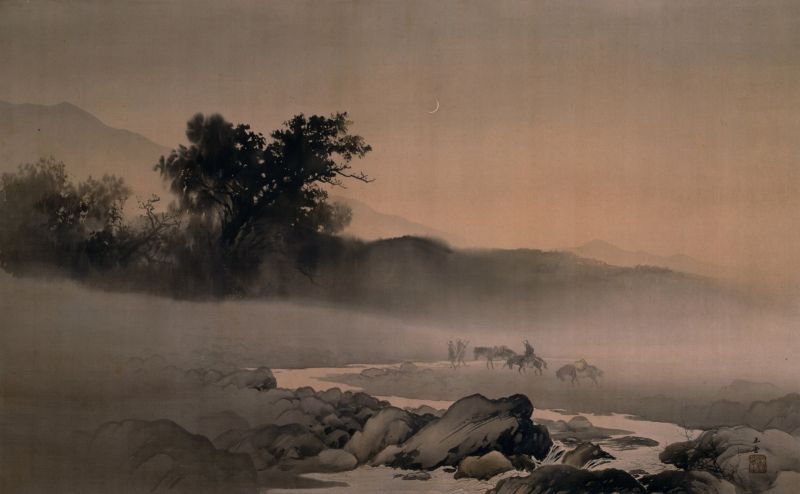
New Moon (Futsuka zuki)
二日月
1907
Hanging scroll; ink and color on silk

Moonlit Evening
月夜
1913
Hanging scroll; ink and light color on silk

Rooster on a Roof
屋根上の鶏
c. 1900–1930
Woodblock print; ink and color on paper

Parting Spring (Yuku haru) — right screen
行く春 右隻
1916
Six-panel folding screen; ink and color on paper

Parting Spring (Yuku haru) — left screen
行く春 左隻
1916
Six-panel folding screen; ink and color on paper

Red-Crowned Crane
丹頂鶴
early 20th century
Brush and ink on paper

Landscape
山水図
before 1932
Ink and color on silk