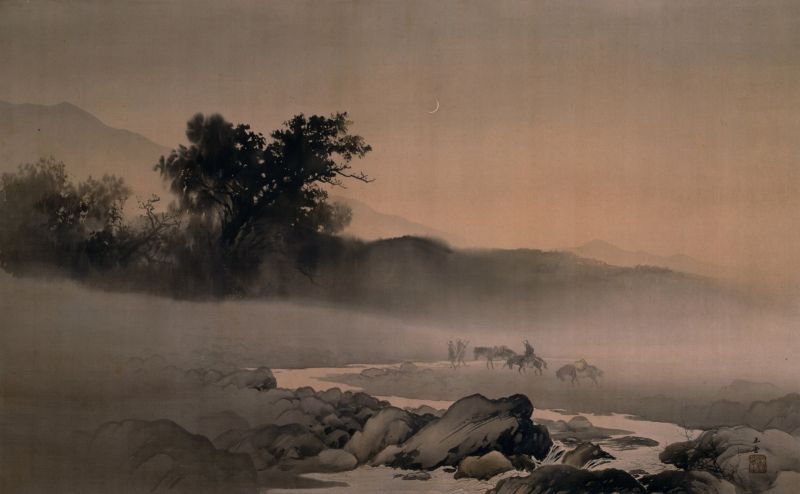
New Moon (Futsuka zuki)
二日月
- Date:
- 1907
- Medium:
- Hanging scroll; ink and color on silk
Description
New Moon (Futsuka zuki, literally "the moon of the second day") is a 1907 hanging-scroll painting by Kawai Gyokudō in ink and color on silk, depicting villagers gathered in the dusk of a mountain hamlet under a slender crescent of the new moon. The work won the top prize at the Tokyo Industrial Exhibition of 1907 and is one of the central paintings of Gyokudō's mature period, now held by the National Museum of Modern Art, Tokyo. The composition organizes a series of low rural dwellings along a winding path, with figures shown small and dispersed, set against an evening sky in which the thin moon is suspended above a hill. Stylistically, the painting consolidates the synthesis Gyokudō had been building since the late 1890s between his Kyoto Shijō training under Mochizuki Gyokusen and Kōno Bairei (close, observed brushwork applied to figures, vegetation, and architectural detail) and his Tokyo training under Hashimoto Gahō (larger atmospheric massing and a more public, monumental scale). The success of New Moon at the 1907 exhibition helped establish Gyokudō as a leading nihonga landscapist of his generation, alongside Yokoyama Taikan and Takeuchi Seihō, and signaled his commitment to a calm, humane, distinctly Japanese register of landscape against the more spectacular alternatives offered by yōga and Western-style oil painting in the same decade.
More Prints by Kawai Gyokudō


More Moonlight Prints
![Mount Fuji on a Moonlit Night, Kawai Bridge (Tsukiyo no Fuji [Kawaibashi]), from the series "Selection of Views of the Tokaido (Tokaido fukei senshu)" by Kawase Hasui](https://www.artic.edu/iiif/2/d0960668-1e73-339a-b182-fb995a54bff0/full/843,/0/default.jpg)
Mount Fuji on a Moonlit Night, Kawai Bridge (Tsukiyo no Fuji [Kawaibashi]), from the series "Selection of Views of the Tokaido (Tokaido fukei senshu)"
1947
Color woodblock print; oban

Evening Moon at Nakanoshima, Sapporo (Sapporo Nakanoshima no yuzuki), from the series "Collection of Views of Japan, Eastern Japan Edition (Nihon fukei shu higashi Nihon hen)"
March 1933
Color woodblock print; oban

Matsushima in Moonlight (Tsuki no Matsushima)
1919
Color woodblock print

Kiyozumi Garden in Moonlight
January 1938
Woodblock print, ink and color on paper
Frequently Asked Questions
New Moon (Futsuka zuki) (二日月) was created by Kawai Gyokudō (川合玉堂) in 1907.
New Moon (Futsuka zuki) depicts moonlight.