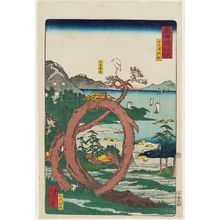
The Snake Pine at Tago Bay (Tago no ura hebimatsu), from the series Scenes of Famous Places along the Tôkaidô Road (Tôkaidô meisho fûkei), also known as the Processional Tôkaidô (Gyôretsu Tôkaidô), here called Tôkaidô meisho no uchi
- Medium:
- Woodblock print
- Source:
- Museum of Fine Arts Boston
- Image courtesy of
- Museum of Fine Arts Boston
Description
Tago no Ura, the bay near present-day Shizuoka, was one of the most poetically charged meisho along the Tōkaidō — celebrated in Manyōshū verse for its views of Mount Fuji rising above the water. This print focuses on the hebimatsu, a locally renowned pine tree whose contorted, serpentine branches gave it its name. Kyosai's composition likely positions the gnarled pine prominently in the foreground or middle ground, its writhing form creating a strong diagonal or lateral tension against the broad expanse of the bay and Fuji's profile in the distance. The contrast between the organic complexity of the pine's silhouette and the geometric clarity of the mountain — rendered through flat color and spare line — is characteristic of the meisho-e format. Travelers or fishermen near the shore provide human scale.
More Prints by Kawanabe Kyosai
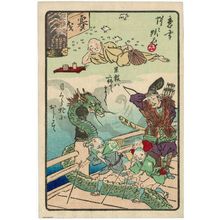
from the series One Hundred Pictures by Kyôsai (Kyôsai hyakuzu)
Woodblock print
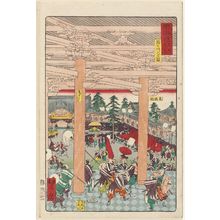
Old Picture of the Rashômon Gate (Rashômon no ko zu), from the series Scenes of Famous Places along the Tôkaidô Road (Tôkaidô meisho fûkei), also known as the Processional Tôkaidô (Gyôretsu Tôkaidô), here called Tôkaidô meisho tsuzuki
Woodblock print
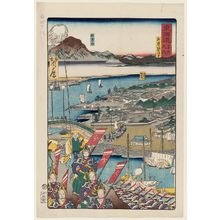
Tsukishimadera Temple in Hyôgo (Hyôgo Tsukishimadera), from the series Scenes of Famous Places along the Tôkaidô Road (Tôkaidô meisho fûkei), also known as the Processional Tôkaidô (Gyôretsu Tôkaidô), here called Tôkaidô meisho no uchi
Woodblock print
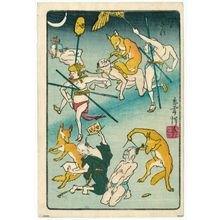
from the series One Hundred Pictures by Kyôsai (Kyôsai hyakuzu)
Woodblock print
More Landscapes Prints

Lake Kugushi in Wakasa Province (Wakasa Kugushiko), from the series Souvenirs of Travel I (Tabi miyage dai isshu)"
Wakasa Kugushiko
1920
Color woodblock print; oban
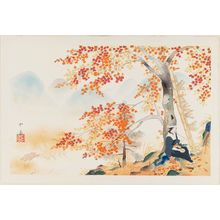
Autumn Maple Leaves at Takao, from the album Eight Views of Kyoto (Kyôto hakkei)
Woodblock print

The Beach at Kaiganji in Sanuki Province (Sanuki Kaiganji no hama), from the series "Collection of Views of Japan II, Kansai Edition (Nihon fukei shu II Kansai hen)"
1934
Color woodblock print; oban

Tea Kettle, section of a sheet from the series "Mirror of Stone Rubbings of Views of the Provinces" (Kohon meihitsu ishizuri kagami)
n.d.
Woodblock print; ishizuri-e, section of harimaze sheet
Featured in Collections
Curated cross-cuts that include this print.
Frequently Asked Questions
The Snake Pine at Tago Bay (Tago no ura hebimatsu), from the series Scenes of Famous Places along the Tôkaidô Road (Tôkaidô meisho fûkei), also known as the Processional Tôkaidô (Gyôretsu Tôkaidô), here called Tôkaidô meisho no uchi was created by Kawanabe Kyosai (河鍋暁斎).
Yes — The Snake Pine at Tago Bay (Tago no ura hebimatsu), from the series Scenes of Famous Places along the Tôkaidô Road (Tôkaidô meisho fûkei), also known as the Processional Tôkaidô (Gyôretsu Tôkaidô), here called Tôkaidô meisho no uchi is part of the Scenes of Famous Places along the Tôkaidô Road series by Kawanabe Kyosai.
The Snake Pine at Tago Bay (Tago no ura hebimatsu), from the series Scenes of Famous Places along the Tôkaidô Road (Tôkaidô meisho fûkei), also known as the Processional Tôkaidô (Gyôretsu Tôkaidô), here called Tôkaidô meisho no uchi depicts landscapes, tōkaidō, and famous places (meisho-e).