
The Battle of Pungdo in Korea
朝鮮豊島沖海戦之図
- Date:
- 1894
- Medium:
- Color woodblock print triptych; ink and color on paper
Description
The Battle of Pungdo in Korea (朝鮮豊島沖海戦之図, Chōsen Hōtō oki kaisen no zu) is a color woodblock triptych designed by Kawanabe Kyōsui in 1894 for the publisher Takegawa Seikichi in Tokyo. It depicts the first naval engagement of the First Sino-Japanese War, fought off Pungdo (P'ungdo) Island in Asan Bay on the western coast of Korea on 25 July 1894, in which cruisers of the newly modernized Imperial Japanese Navy engaged ships of the Chinese Beiyang Fleet and sank the British-flagged steamer Kowshing, which was transporting Qing troops to Korea. Across the three panels Kyōsui shows the disabled Chinese steamer ablaze under attack from a Japanese cruiser at right, while Chinese soldiers swim or struggle in a roughly rendered sea toward a foregrounded Korean shoreline. The print belongs to the substantial Meiji battle-print (sensō-e) production of 1894-1895, which together with the equivalent Russo-Japanese War triptychs of 1904-1905 represented the late nineteenth-century revival of ukiyo-e as a popular journalistic medium, mobilized in support of the Japanese war effort and the projection of imperial naval power. Kyōsui's triptych is unusual in being designed by a female artist; the great majority of First Sino-Japanese War sensō-e were the work of male designers in the Kobayashi Kiyochika, Mizuno Toshikata, Migita Toshihide, and Adachi Ginkō circles. The British Library copy (16126.d.2(76)), digitized in the British Library's Japanese woodblock print collection and reproduced through Wikimedia Commons, measures 39.6 × 75.8 cm and is signed Kyōsui at lower right.
More Prints by Kawanabe Kyōsui
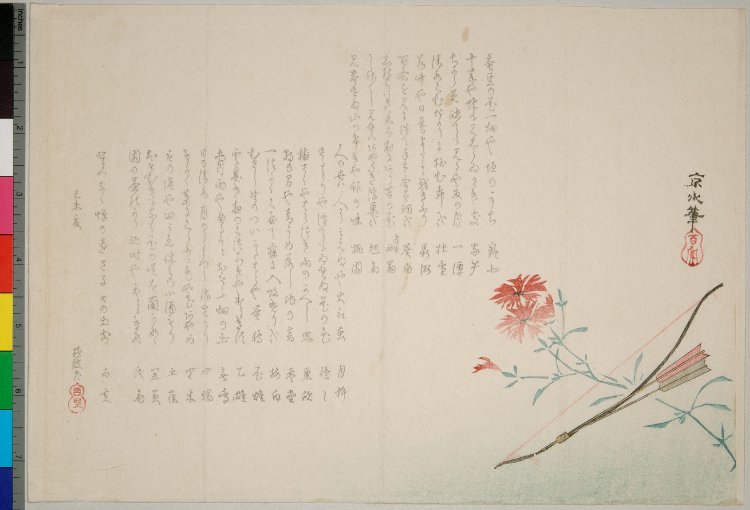
Surimono with Pinks and Bow and Arrow
摺物 撫子に弓矢
1895
Color woodblock print (surimono); ink and color on paper
.jpg)
Seven Lucky Gods, Year of the Dragon — Center Panel
七福神辰年図 中
Meiji period
Color woodblock print; ink and color on paper
.jpg)
Seven Lucky Gods, Year of the Dragon — Right Panel
七福神辰年図 右
Meiji period
Color woodblock print; ink and color on paper

Poetry Contest — Ladies in the Formal Poetry-Composing Event
歌合
c. 1894
Color woodblock print triptych (nishiki-e); ink and color on paper
Frequently Asked Questions
The Battle of Pungdo in Korea (朝鮮豊島沖海戦之図) was created by Kawanabe Kyōsui (河鍋暁翠) in 1894.