
Biography
Kawanabe Kyōsui (河鍋暁翠, 1868–1935) was a Meiji- and Taishō-period Japanese painter and printmaker working at the meeting point of nihonga and ukiyo-e, the daughter and principal heir of the great Edo-and-Meiji master Kawanabe Kyōsai (1831–1889), and one of the first women in Japan to hold a senior teaching post in a chartered art school. Across a career that began in the Kyōsai studio in the last years of the Tokugawa shogunate and ended in the early years of the Shōwa era, she produced bijin-ga (pictures of beautiful women), kachō-e (bird-and-flower) prints and paintings, history pictures, theatre scenes from nō and kyōgen, Buddhist devotional images, and battle prints, while also playing a pioneering role in the institutional education of women artists in modern Japan.
Kyōsui was born in Edo on 4 January 1868, the daughter of Kawanabe Kyōsai, the celebrated painter, caricaturist, and printmaker who had trained in the Kanō school and in the Utagawa ukiyo-e workshop and who became one of the most prolific and idiosyncratic Japanese artists of the nineteenth century. Her artistic training began at home, from about the age of five, in a workshop that was simultaneously a teaching atelier — Josiah Conder, the British architect of the Meiji modernization who became Kyōsai's pupil in the early 1880s, later recorded the studio's daily routine in his Paintings and Studies by Kawanabé Kyōsai (1911). Kyōsui absorbed her father's eclectic combination of Kanō brushwork, Maruyama-Shijō observation, Utagawa figural design, and a satirical Edo-period sensibility, becoming so accomplished a copyist that some of her early works in Kyōsai's manner have proved difficult to distinguish from her father's own hand. By the age of seventeen she was exhibiting in her own right, and in 1885 (Meiji 18) she was accepted into the second Naikoku Kaiga Kyōshinkai (Domestic Painting Competitive Exhibition), one of the principal national painting venues organized under the Meiji art-establishment reforms.
With Kyōsai's death in 1889, Kyōsui took over a substantial share of the studio's commissioned work in her early twenties. The 1890s were her most public decade. In 1891 she contributed four interior views to The Flowers of Japan and the Art of Floral Arrangement, the lavishly illustrated ikebana treatise by Josiah Conder (her father's pupil and the architect of much of Meiji Tokyo), published by Hakubunsha in Tokyo; of the book's fourteen color woodblock plates, six depictions of seasonal flowers were designed by Tsukioka Yoshitoshi — a project that placed Kyōsui, in her early twenties, in collaboration with the leading print designer of the previous generation. In 1894 she designed The Battle of Pungdo in Korea (朝鮮豊島沖海戦之図), a color triptych depicting the first naval engagement of the First Sino-Japanese War, in which the Imperial Japanese Navy sank the British-flagged transport Kowshing; it is one of the relatively rare First Sino-Japanese War triptychs designed by a female artist. The same year she produced a Poetry Contest (歌合) triptych showing court ladies engaged in formal waka composition — a virtuoso bijin-ga demonstrating her command of Heian-revival historical costume and interior. Around this time she was also among the group of Tokyo artists who illustrated the Choix de fables de La Fontaine, the celebrated French-language crêpe-paper edition of La Fontaine's fables edited by Pierre Barboutau and published in Tokyo — a project that carried her work into the European Japonisme market; her own contribution included an illustration to the fable of the mice in council. Surimono bearing her signature also survive from these same productive years.
In 1902, the year after the school opened, Kyōsui was appointed the first female professor at the Joshi Bijutsu Gakkō (Private Women's School of Fine Arts), the institution founded by Yokoi Tamako that later became Joshibi University of Art and Design. The appointment was historically significant: chartered painting schools in late-Meiji Japan had emerged largely as male professional bodies (the Tokyo School of Fine Arts had been founded as a men-only institution in 1887 and did not admit women until 1946), and Kyōsui's senior teaching role at Joshi Bijutsu Gakkō gave generations of early-twentieth-century women painters access to the kind of formal nihonga training that her own father had given her privately. She continued to teach there for much of the rest of her career, exercising a long influence on the first generation of professionally trained Japanese women artists.
In parallel with her teaching, Kyōsui maintained an active painting and printmaking practice. She specialized in soft, colorist bijin-ga and depictions of children, in nō and kyōgen scenes that drew on her father's deep interest in classical theatre, in Buddhist devotional imagery, in historical genre painting, and in kachō-e (bird-and-flower) prints. Her seal Kyōsui 暁翠, a sister-name to her father's gō Kyōsai 暁斎 (both built on the character 暁, "dawn"), appears on works ranging from intimate hanging scrolls to large public triptychs. The Kawanabe family's combined holdings and records were eventually preserved in the Kawanabe Kyōsai Memorial Museum in Warabi, Saitama, founded in 1977 by Kyōsai's great-granddaughter Kawanabe Kusumi.
Kyōsui died on 7 May 1935 at the age of sixty-seven. Her work is held by the British Museum in London, the Tokyo Fuji Art Museum (which in 2018 mounted a joint Kyōsai-and-Kyōsui exhibition drawn from the Kyōsai Memorial Museum's holdings), Joshibi University of Art and Design, the Kawanabe Kyōsai Memorial Museum, and numerous private collections in Japan, Europe, and North America. Recent scholarship and exhibitions — including the 2018 Tokyo Fuji show and the renewed international attention to Kyōsai marked by the Israel Goldman collection exhibition at the Royal Academy in London in 2022 — have begun to restore her to her proper place not only as Kyōsai's principal student and successor but as a significant Meiji-Taishō artist in her own right, both for the quality of her work and for her foundational contribution to the institutional training of women artists in modern Japan.
Key Facts
- Active Period
- 1868–1935
- Nationality
- 🇯🇵Japan
- Movement
- Ukiyo-e
- Subjects
- Birds & Flowers
- Works Indexed
- 7
Frequently Asked Questions
Kawanabe Kyōsui (河鍋暁翠, 1868–1935) was a Meiji- and Taishō-period Japanese painter and printmaker working at the meeting point of nihonga and ukiyo-e, the daughter and principal heir of the great Edo-and-Meiji master Kawanabe Kyōsai (1831–1889), and one of the first women in Japan to hold a senior teaching post in a chartered art school. Across a career that began in the Kyōsai studio in the last years of the Tokugawa shogunate and ended in the early years of the Shōwa era, she produced bijin-ga (pictures of beautiful women), kachō-e (bird-and-flower) prints and paintings, history pictures, theatre scenes from nō and kyōgen, Buddhist devotional images, and battle prints, while also playing a pioneering role in the institutional education of women artists in modern Japan.
Kawanabe Kyōsui was active from 1868 to 1935. They were associated with the Ukiyo-e movement.
Kawanabe Kyōsui's work was shaped by the Ukiyo-e tradition in Japanese woodblock printmaking. Ukiyo-e: ## What is ukiyo-e? Ukiyo-e ([浮世絵](/glossary/ukiyo-e)) — literally "pictures of the floating world" — is the Edo-period Japanese print and painting tradition that flourished from roughly 1660 to 1868, depicting the pleasures of urban life in Edo (modern Tokyo): courtesans, kabuki actors, sumo wrestlers, famous landscapes, and seasonal beauties.
Kawanabe Kyōsui's prints frequently feature birds & flowers.
Original prints by Kawanabe Kyōsui can be found in collections including British Museum, Ritsumeikan University Art Research Center, Pasamonares-Onila Collection (via Wikimedia Commons), British Library (via Wikimedia Commons).
Woodblock Prints by Kawanabe Kyōsui (7)
Momofuku-zu (A Hundred Symbols of Fortune)
百福図
1890
Ink and color on paper
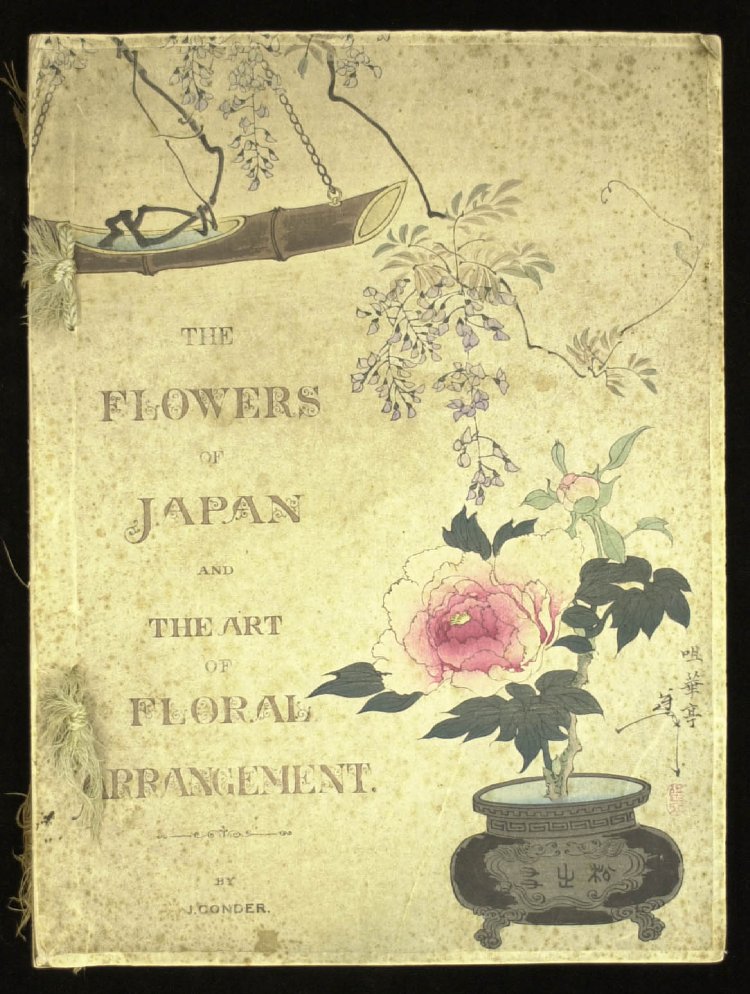
Interior with Flower Arrangement, from The Flowers of Japan and the Art of Floral Arrangement
日本花譜・挿花の図
1891
Color woodblock-printed book illustration; ink and color on paper

Poetry Contest — Ladies in the Formal Poetry-Composing Event
歌合
c. 1894
Color woodblock print triptych (nishiki-e); ink and color on paper

The Battle of Pungdo in Korea
朝鮮豊島沖海戦之図
1894
Color woodblock print triptych; ink and color on paper
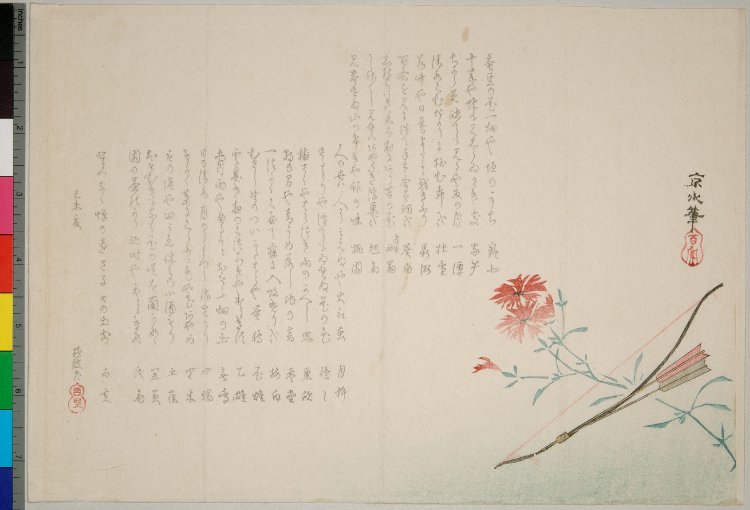
Surimono with Pinks and Bow and Arrow
摺物 撫子に弓矢
1895
Color woodblock print (surimono); ink and color on paper
.jpg)
Seven Lucky Gods, Year of the Dragon — Center Panel
七福神辰年図 中
Meiji period
Color woodblock print; ink and color on paper
.jpg)
Seven Lucky Gods, Year of the Dragon — Right Panel
七福神辰年図 右
Meiji period
Color woodblock print; ink and color on paper