![A Water Conduit, A Scene in Sado (Mizuagehi [Sado shoken]), from the series "Souvenirs of Travel, Second Series (Tabi miyage dai nishu)" by Kawase Hasui — Japanese Color woodblock print; oban, 1921](https://www.artic.edu/iiif/2/98bdd980-0d90-ac1c-9be2-35b57d8973e7/full/843,/0/default.jpg)
A Water Conduit, A Scene in Sado (Mizuagehi [Sado shoken]), from the series "Souvenirs of Travel, Second Series (Tabi miyage dai nishu)"
Mizuagehi [Sado shoken]
by Kawase Hasui
Mizuagehi [Sado shoken]
by Kawase Hasui
The Souvenirs of Travel series (First, Second, and Third Series, 1919–1922) represents Hasui's earliest major publishing relationship with Watanabe Shozaburo. Pre-earthquake impressions (before September 1923) are the rarest — the Kanto Earthquake destroyed Watanabe's workshop and most original blocks, making surviving early round-seal impressions exceptionally valuable at $2,500–$8,000. Post-earthquake editions were printed from recut blocks and trade at lower prices.
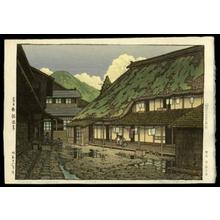
A Water Conduit in Sado, published in 1921 as part of the Souvenirs of Travel, Second Series, depicts a water-lifting or water-management structure — the mizuagehi (water-raising mechanism) — set within one of Sado Island's agricultural landscapes. Sado, Japan's sixth-largest island, developed extensive irrigation networks for its rice paddies and for the water management demands of its famous gold and silver mines at Aikawa. The water conduit subject is unusual in Hasui's catalog of scenic landscapes, suggesting an interest in the functional infrastructure of the island's working agricultural and mining economy.

1962
Woodblock print, ink and color on paper

Wakasa Kugushiko
1920
Color woodblock print; oban

Boshu Taikai
1925
Color woodblock print; oban

Niigata Gosaibori
1921
Color woodblock print; oban
Curated cross-cuts that include this print.
A Water Conduit, A Scene in Sado (Mizuagehi [Sado shoken]), from the series "Souvenirs of Travel, Second Series (Tabi miyage dai nishu)" (Mizuagehi [Sado shoken]) was created by Kawase Hasui (川瀬巴水) in 1921.
Yes — A Water Conduit, A Scene in Sado (Mizuagehi [Sado shoken]), from the series "Souvenirs of Travel, Second Series (Tabi miyage dai nishu)" is part of the Souvenirs of Travel, Second Series series (print 2) by Kawase Hasui.
A Water Conduit, A Scene in Sado (Mizuagehi [Sado shoken]), from the series "Souvenirs of Travel, Second Series (Tabi miyage dai nishu)" uses Bokashi, Nishiki-e, and Moku-hanga, on color woodblock print; oban.
A Water Conduit, A Scene in Sado (Mizuagehi [Sado shoken]), from the series "Souvenirs of Travel, Second Series (Tabi miyage dai nishu)" was published by Watanabe Shozaburo (1921).
A Water Conduit, A Scene in Sado (Mizuagehi [Sado shoken]), from the series "Souvenirs of Travel, Second Series (Tabi miyage dai nishu)" depicts travel scenes.
A Water Conduit, A Scene in Sado (Mizuagehi [Sado shoken]), from the series "Souvenirs of Travel, Second Series (Tabi miyage dai nishu)" measures 24.1 × 36.2 cm (Oban format).