
Tsuta Hot Springs in Mutsu Province (Mutsu Tsuta onsen), from the series "Souvenirs of Travel, First Series (Tabi miyage dai isshu)"
Mutsu Tsuta onsen
by Kawase Hasui
- Date:
- 1919
- Medium:
- Color woodblock print; oban
- Format:
- Oban
- Dimensions:
- 24.1 × 36.5 cm
- Publisher:
- Watanabe Shozaburo
- Edition:
- Published by Watanabe Shozaburo
- Source:
- Art Institute of Chicago
Description
A dusky blue-green nocturne of a thatched-roof hot-spring inn, its dark silhouette set against a tall, billowing mass of trees or steam rising behind the roofline into a deep blue sky. Two small windows glow pale yellow-white against the shadowed structure, the only warm light in the scene, while a stream or wet path curves through grassy foreground in front of the buildings. Kawase Hasui, "Tsuta Hot Springs in Mutsu Province (Mutsu Tsuta onsen)," from the series *Souvenirs of Travel, First Series (Tabi miyage dai isshu)*, 1919, color woodblock print (oban).
More Prints by Kawase Hasui

More Nude Prints

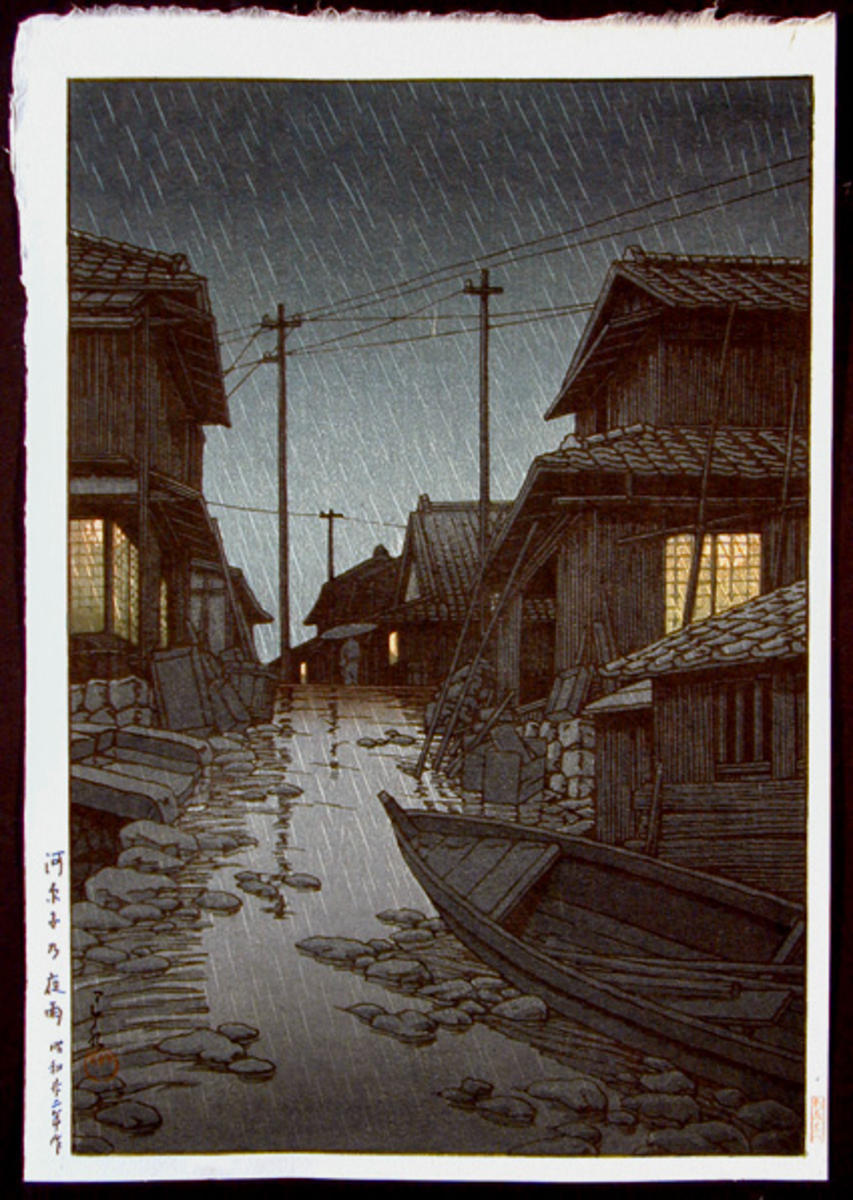
Namari Spa, Iwate Prefecture (Iwate ken Namari onsen)
1943
Color woodblock print

Autumn at the Arayu Hot Spring, Shiobara
Autumn 1920
Woodblock print, ink and color on paper

Arifuku Spa, Iwami, from the series "Souvenirs of Travel, Third Series" (Tabi miyage dai sanshu, Iwami Arifuku onsen)
1924
Color woodblock print
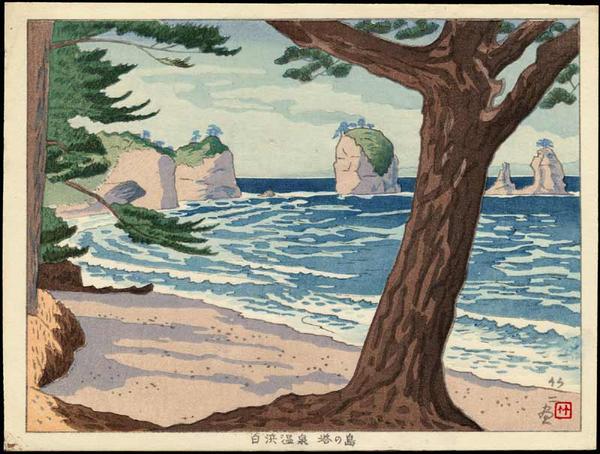
Shirahama Hot Spring
Woodblock print
Featured in Collections
Curated cross-cuts that include this print.
Frequently Asked Questions
Tsuta Hot Springs in Mutsu Province (Mutsu Tsuta onsen), from the series "Souvenirs of Travel, First Series (Tabi miyage dai isshu)" (Mutsu Tsuta onsen) was created by Kawase Hasui (川瀬巴水) in 1919.
Yes — Tsuta Hot Springs in Mutsu Province (Mutsu Tsuta onsen), from the series "Souvenirs of Travel, First Series (Tabi miyage dai isshu)" is part of the Souvenirs of Travel, First Series series (print 2) by Kawase Hasui.
Tsuta Hot Springs in Mutsu Province (Mutsu Tsuta onsen), from the series "Souvenirs of Travel, First Series (Tabi miyage dai isshu)" uses Moku-hanga, Nishiki-e, and Bokashi, on color woodblock print; oban.
Tsuta Hot Springs in Mutsu Province (Mutsu Tsuta onsen), from the series "Souvenirs of Travel, First Series (Tabi miyage dai isshu)" was published by Watanabe Shozaburo (1919).
Tsuta Hot Springs in Mutsu Province (Mutsu Tsuta onsen), from the series "Souvenirs of Travel, First Series (Tabi miyage dai isshu)" depicts nude, landscapes, and travel scenes, set at Tsuta Onsen.
Tsuta Hot Springs in Mutsu Province (Mutsu Tsuta onsen), from the series "Souvenirs of Travel, First Series (Tabi miyage dai isshu)" measures 24.1 × 36.5 cm (Oban format).