
Mt Fuji
- Medium:
- Mokuhanga (Japanese woodblock)
- Image courtesy of
- Saru Gallery
Description
Sasajima treated Mount Fuji repeatedly across his career, and his Fuji prints depart noticeably from the linear conventions of earlier ukiyo-e meisho-e. Where Hokusai and Hiroshige rendered Fuji in fine outline against carefully gradated bokashi skies, Sasajima reduces the mountain to a flat, broadly carved silhouette — often a single dark mass with the diagonal of the slopes meeting in a low, slightly off-center summit. The block's woodgrain is permitted to register through the printed area, giving the mountain's surface a tactile, pressed-into-washi quality rather than an illusion of atmospheric depth. Foreground and background are typically resolved into two or three flat tonal zones. The result aligns with the sosaku-hanga ethos he absorbed under Onchi Koshiro: the mountain is not transcribed but constructed, with the carved plank's physical character forming part of the final image. This impression sits within a sequence of Fuji studies he returned to as compositional exercises across decades.
More Prints by Kihei Sasajima

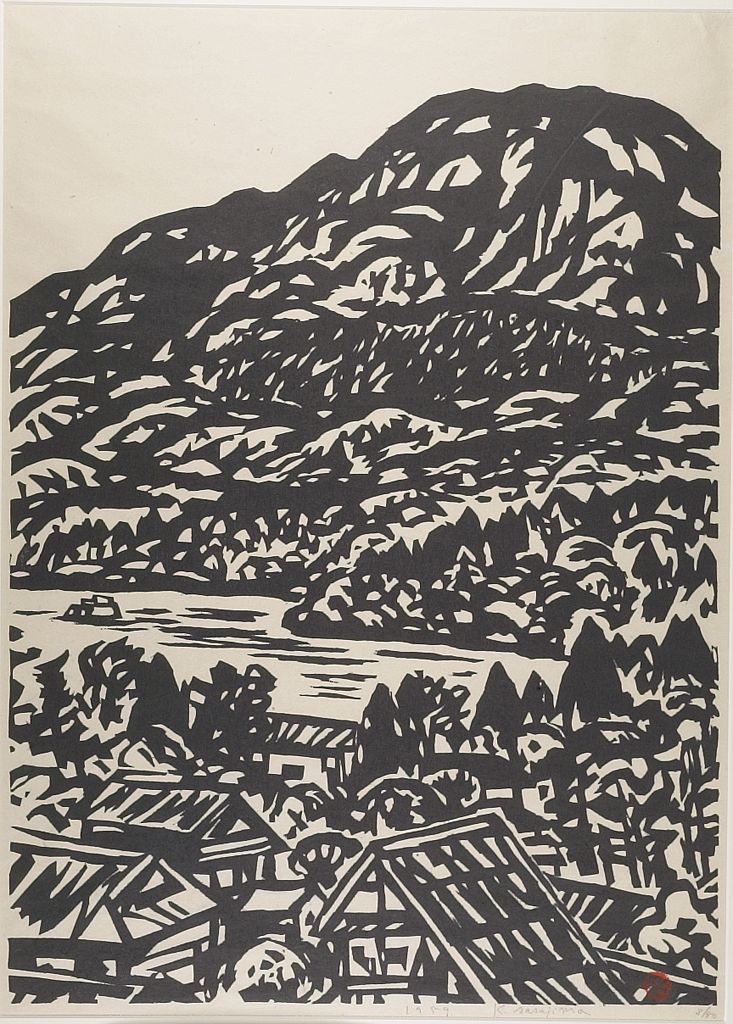
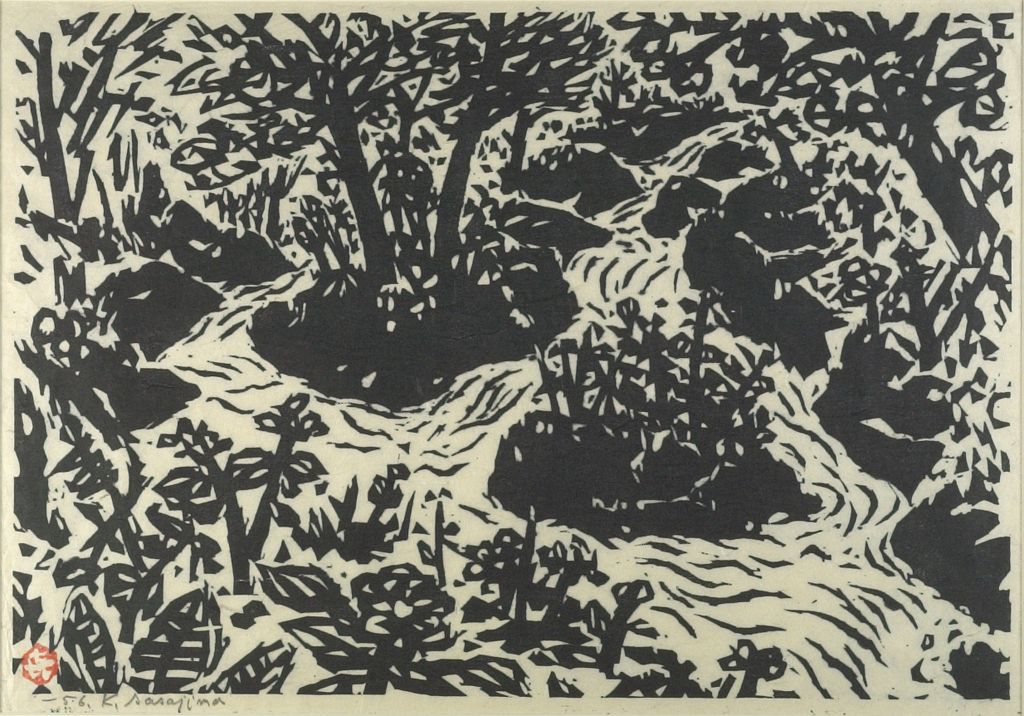

More Mount Fuji Prints
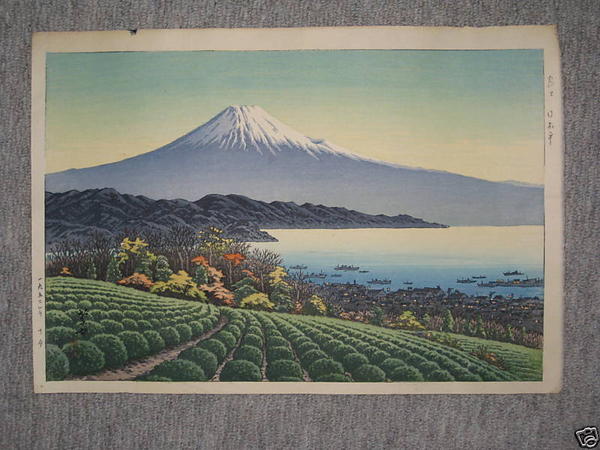
Fuji from tea farm
Woodblock print

Akasaka, Fujikawa, Okazaki, Chiryu, and Narumi, from the series "Famous Places on the Fifty-three Stations of the Tokaido, Five Stations (Tokaido gojusan eki goshuku meisho)"
c. 1830/35
Color woodblock print; oban
![Mount Fuji on a Moonlit Night, Kawai Bridge (Tsukiyo no Fuji [Kawaibashi]), from the series "Selection of Views of the Tokaido (Tokaido fukei senshu)" by Kawase Hasui](https://www.artic.edu/iiif/2/d0960668-1e73-339a-b182-fb995a54bff0/full/843,/0/default.jpg)
Mount Fuji on a Moonlit Night, Kawai Bridge (Tsukiyo no Fuji [Kawaibashi]), from the series "Selection of Views of the Tokaido (Tokaido fukei senshu)"
1947
Color woodblock print; oban

Mt. Fuji in Rain (Ame no Fuji)
n.d.
Color woodblock print
Featured in Collections
Curated cross-cuts that include this print.
Frequently Asked Questions
Mt Fuji was created by Kihei Sasajima (笹島喜平).
Mt Fuji depicts mount fuji.