
Mt Fuji
- Medium:
- Mokuhanga (Japanese woodblock)
- Image courtesy of
- Saru Gallery
Description
A second Fuji study from Sasajima, distinct from his first treatment of the subject and reflecting his practice of returning to a motif under altered carving and inking decisions. In Sasajima's Fuji prints the mountain is generally pared down to a flat silhouette achieved with broad gouges into a plank, the chisel marks left visible rather than smoothed. The print likely sets a single deep tone — sumi-derived black or an iron-oxide brown — against the unprinted washi or a lightly inked second block, with the woodgrain reading horizontally across the sky as a subtle striation. Sasajima rarely employed the elaborate baren bokashi gradations of nishiki-e tradition; instead the mountain registers as a near-iconic shape, more architectural than atmospheric. Such repeated treatments of Fuji parallel his obsessive returns to Todai-ji, Horyu-ji, and the great temples: variation is the working method, with each impression rebuilt from a freshly resolved block rather than retouched from an earlier version.
More Prints by Kihei Sasajima

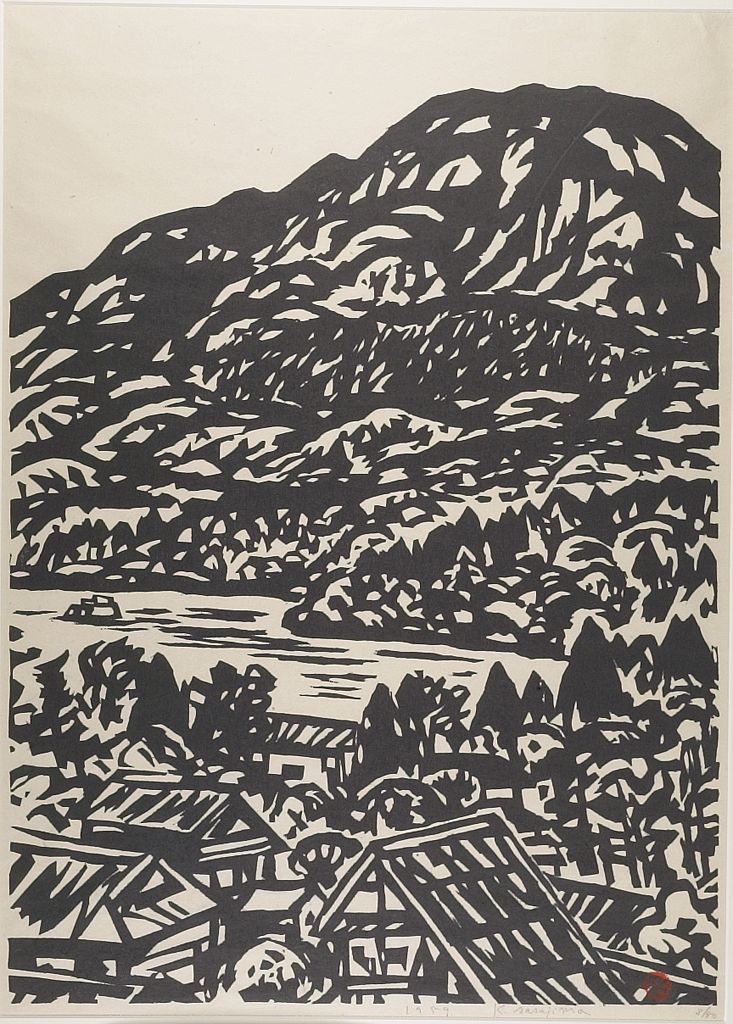
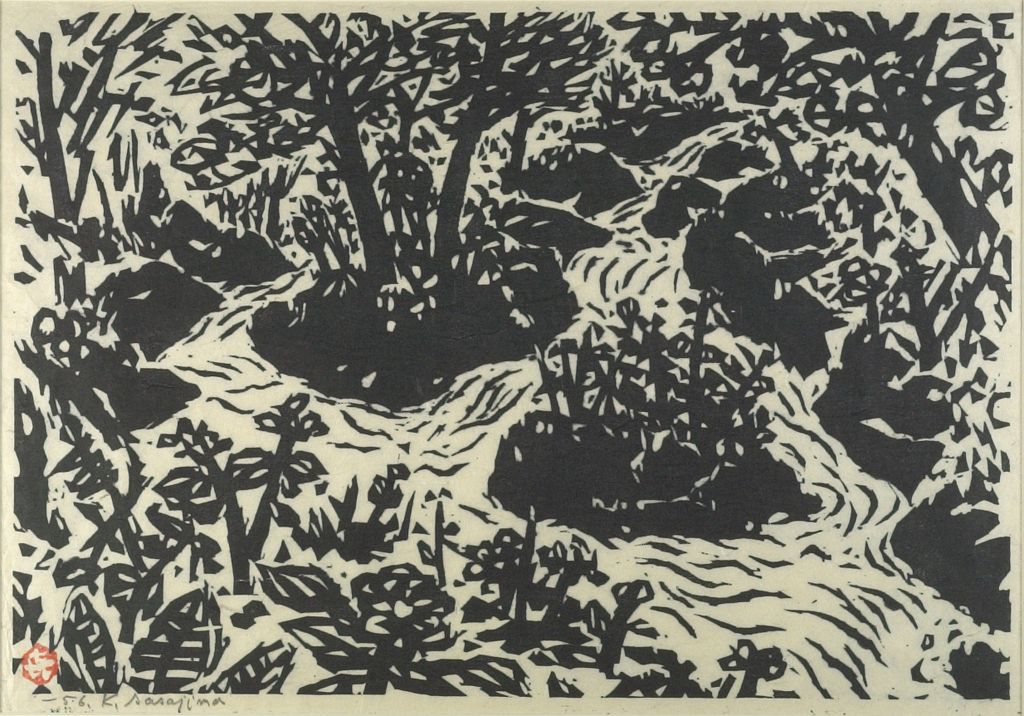

More Mount Fuji Prints
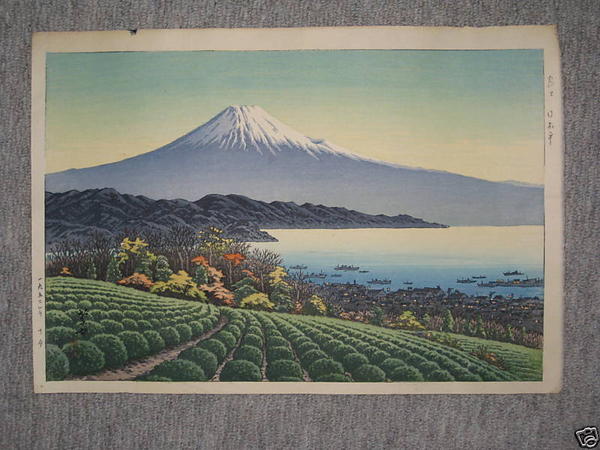
Fuji from tea farm
Woodblock print

Akasaka, Fujikawa, Okazaki, Chiryu, and Narumi, from the series "Famous Places on the Fifty-three Stations of the Tokaido, Five Stations (Tokaido gojusan eki goshuku meisho)"
c. 1830/35
Color woodblock print; oban
![Mount Fuji on a Moonlit Night, Kawai Bridge (Tsukiyo no Fuji [Kawaibashi]), from the series "Selection of Views of the Tokaido (Tokaido fukei senshu)" by Kawase Hasui](https://www.artic.edu/iiif/2/d0960668-1e73-339a-b182-fb995a54bff0/full/843,/0/default.jpg)
Mount Fuji on a Moonlit Night, Kawai Bridge (Tsukiyo no Fuji [Kawaibashi]), from the series "Selection of Views of the Tokaido (Tokaido fukei senshu)"
1947
Color woodblock print; oban

Mt. Fuji in Rain (Ame no Fuji)
n.d.
Color woodblock print
Featured in Collections
Curated cross-cuts that include this print.
Frequently Asked Questions
Mt Fuji was created by Kihei Sasajima (笹島喜平).
Mt Fuji depicts mount fuji.