
The Buddhist goddess Laksmi
- Medium:
- Mokuhanga (Japanese woodblock)
- Image courtesy of
- Saru Gallery
Description
"The Buddhist goddess Laksmi" depicts Kichijoten, the Japanese Buddhist counterpart to the Hindu Lakshmi, a deity associated with fortune, beauty, and merit. In Japanese iconography Kichijoten typically holds a cintamani jewel and wears the robes of a Tang-style noblewoman, an inheritance from Nara-period continental imagery. Sasajima's treatment likely reduces this devotional figure to a hand-carved silhouette articulated by visible knife marks and the textured pressure of the baren, the tools of his sosaku-hanga practice rather than the polished idiom of commercial nishiki-e. As a student of Onchi Koshiro, Sasajima carved and printed every block himself and refused outside studio assistance. The subject sits within his lifelong concern with Buddhist temple culture — the same impulse that drew him repeatedly to Todai-ji, Horyu-ji, and Kofuku-ji surfaces here in figural rather than architectural form, treating the goddess as another inhabitant of the sacred precincts he otherwise rendered in stone, timber, and roof tile.
More Prints by Kihei Sasajima


More Religious Prints

The Great Buddha, Kamakura (Kamakura Daibutsu)
Kamakura Daibutsu
1930
Color woodblock print

Hall of the Great Buddha (Nara Daibutsuden)
1950
Color woodblock print
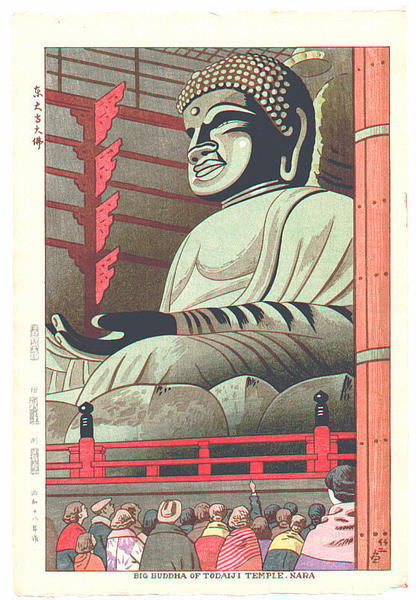
Great Buddha
大仏
Woodblock print

Clearing after a Snowfall at the Kannon Temple in Asakusa (Asakusa Kannon no yukibare), from the series "Twenty Views of Tokyo (Tokyo nijukkei)"
1926
Color woodblock print; oban
Featured in Collections
Curated cross-cuts that include this print.
Frequently Asked Questions
The Buddhist goddess Laksmi was created by Kihei Sasajima (笹島喜平).
The Buddhist goddess Laksmi depicts religious.