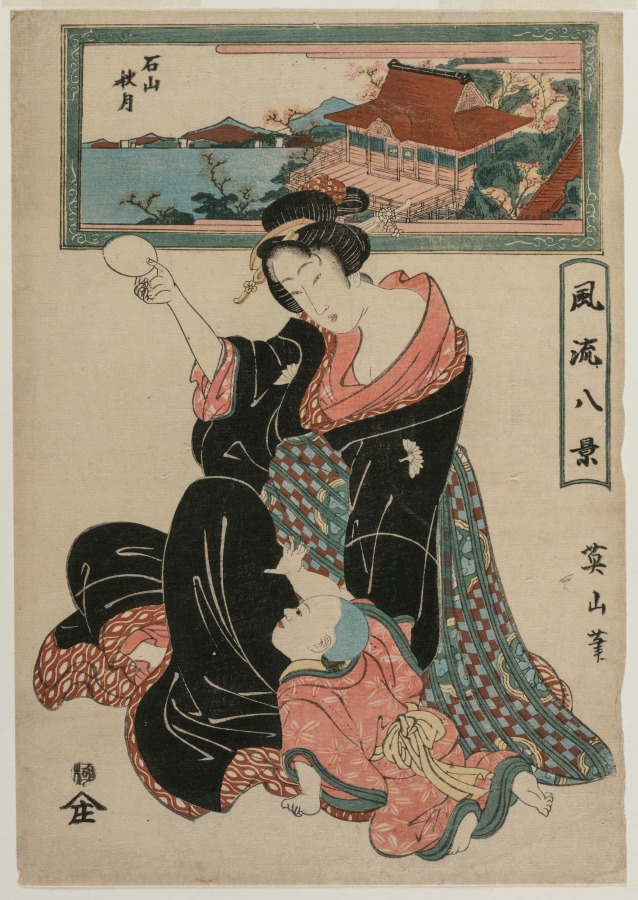
Autumn Moon at the Temple Ishiyamadera from the series Fashionable Eight Views
- Date:
- c. 1814–17
- Medium:
- Color woodblock print, ink and color on paper
- Source:
- Cleveland Museum of Art
Description
Autumn Moon at the Temple Ishiyamadera, from the series Fashionable Eight Views (Furyu Hakkei), dated 1814 in the Cleveland Museum of Art's catalog, transposes one of the canonical Eight Views of Omi onto the Edo bijin-ga of the Kikukawa school. The Eight Views of Omi, a Japanese localization of the Chinese Eight Views of the Xiao and Xiang Rivers, fixed eight scenes around Lake Biwa as the standard cycle of poetic landscape: autumn moon at Ishiyama temple, evening snow at Hira, returning sails to Yabase, evening bell at Mii temple, and so on. Kikukawa Eizan's furyu (fashionable, modish) variation replaces the landscape with a beauty whose attributes — a fan, a sleeve, an upturned face — evoke the named view. The autumn moon at Ishiyamadera carried particular literary weight: Murasaki Shikibu was traditionally said to have begun The Tale of Genji while watching the moon from that temple, and any image of the site invokes the most prestigious episode of Japanese literary biography. Eizan layers the reference into bijin-ga, his figure pose at once contemporary and Heian-allusive. The Cleveland Museum of Art's record may be consulted at https://clevelandart.org/art/1985.302. The series stands as a useful case study in the way the Kikukawa school used the Eight Views format to fold landscape and classical literature into the bijin-ga market.
More Prints by Kikukawa Eizan

The Theater District in Sakai-cho (Sakai cho shibai), from the "Fashionable Eight Views of the Eastern Capital (Furyu Toto hakkei)"
c. 1824/29
Color woodblock print; oban

Beauty standing beside morning glories
c. 1814/17
Color woodblock print; center sheet of oban triptych (right sheet: 1963.613)

Returning Sails at Yabase (Yabase kihan), from the series "Fashionable Eight Views of Omi (Furyu Omi hakkei)"
c. 1814/17
Color woodblock print; oban

Enjoying the Evening Cool at Ryogoku Bridge (Ryogokubashi noryo), from the series "Fashionable Eight Views of Edo (Furyu Edo hakkei)"
early 19th century
Color woodblock print; oban
More Moonlight Prints
![Mount Fuji on a Moonlit Night, Kawai Bridge (Tsukiyo no Fuji [Kawaibashi]), from the series "Selection of Views of the Tokaido (Tokaido fukei senshu)" by Kawase Hasui](https://www.artic.edu/iiif/2/d0960668-1e73-339a-b182-fb995a54bff0/full/843,/0/default.jpg)
Mount Fuji on a Moonlit Night, Kawai Bridge (Tsukiyo no Fuji [Kawaibashi]), from the series "Selection of Views of the Tokaido (Tokaido fukei senshu)"
1947
Color woodblock print; oban

Evening Moon at Nakanoshima, Sapporo (Sapporo Nakanoshima no yuzuki), from the series "Collection of Views of Japan, Eastern Japan Edition (Nihon fukei shu higashi Nihon hen)"
March 1933
Color woodblock print; oban

Matsushima in Moonlight (Tsuki no Matsushima)
1919
Color woodblock print

Kiyozumi Garden in Moonlight
January 1938
Woodblock print, ink and color on paper
Frequently Asked Questions
Autumn Moon at the Temple Ishiyamadera from the series Fashionable Eight Views was created by Kikukawa Eizan (菊川英山) in c. 1814–17.
Autumn Moon at the Temple Ishiyamadera from the series Fashionable Eight Views depicts moonlight and autumn foliage.