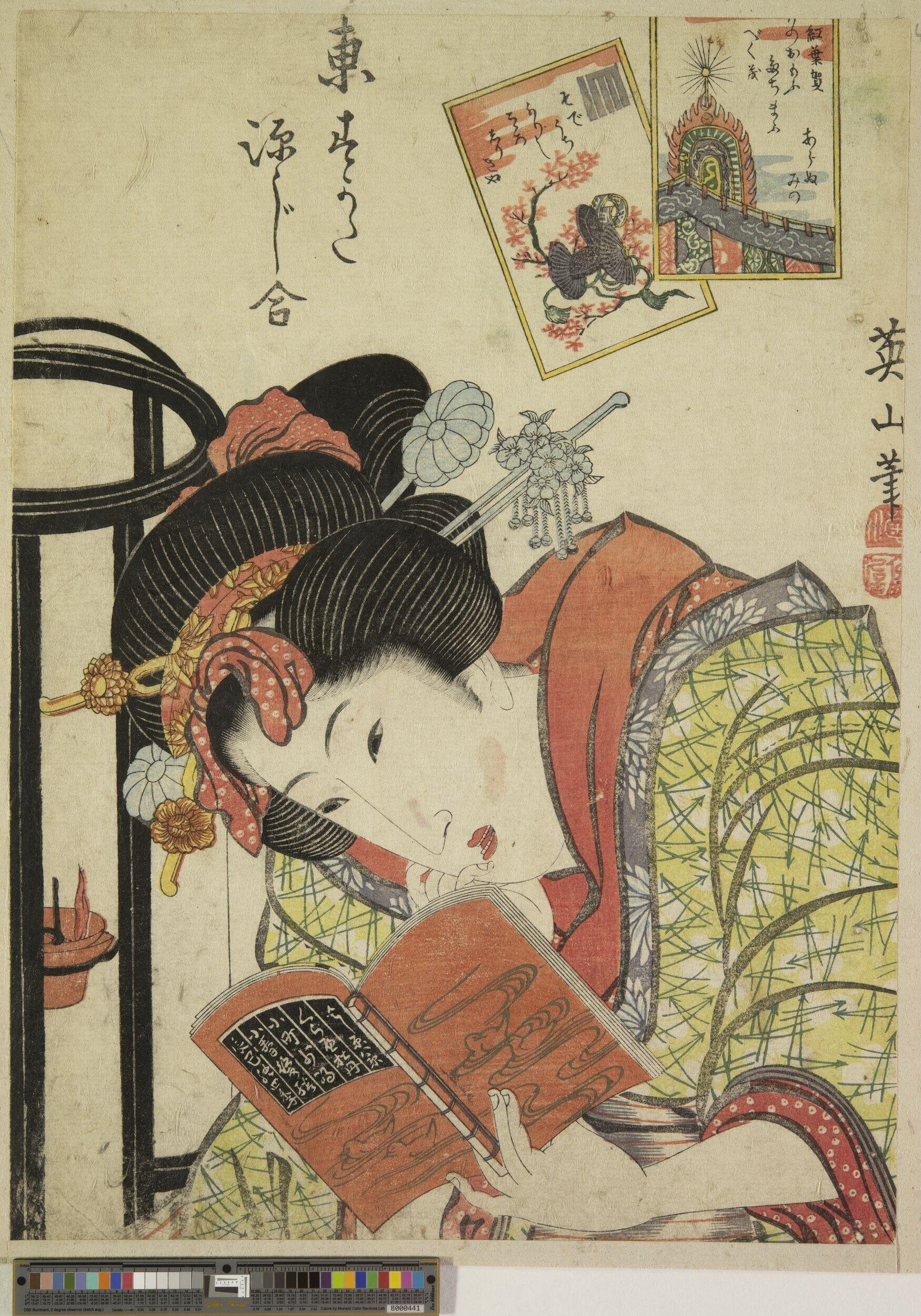
'Celebration of Autumn Foliage'
- Date:
- 1818-1823
- Medium:
- Source:
- Victoria and Albert Museum
Description
Celebration of Autumn Foliage, dated to 1818 in the Victoria and Albert Museum's catalog, gathers a group of Edo beauties for a momiji-gari — the autumn excursion to view colored maple leaves that organized the cultural calendar of the eighth and ninth months. The momiji-gari was one of the most established occasions in Edo bijin-ga, a counterpart to the spring hanami cherry-blossom viewing, and prints of leaf-viewing beauties had been a steady commercial subject from at least the Kanbun era. Kikukawa Eizan, by 1818 firmly at the head of the Kikukawa school, adapts the convention to his Bunsei-era manner. The figures' bodies are tall and slender, their outer robes densely patterned, their heads small and tilted in calibrated angles of attention. The leaves themselves are printed with the slightly heightened palette that the season permitted — the saturated reds and oranges of high autumn — and the composition uses the natural color event to give the bijin-ga its decorative climax. Prints of this kind sold particularly well in the autumn months and supplied a calendar-bound market that Edo's print publishers exploited every year. The Victoria and Albert Museum's catalog record for the sheet, including its provenance details, may be consulted at https://collections.vam.ac.uk/item/O412960. The work documents Eizan's sustained engagement with the seasonal subjects that anchored the Edo bijin-ga market.
More Prints by Kikukawa Eizan

The Theater District in Sakai-cho (Sakai cho shibai), from the "Fashionable Eight Views of the Eastern Capital (Furyu Toto hakkei)"
c. 1824/29
Color woodblock print; oban

Beauty standing beside morning glories
c. 1814/17
Color woodblock print; center sheet of oban triptych (right sheet: 1963.613)

Returning Sails at Yabase (Yabase kihan), from the series "Fashionable Eight Views of Omi (Furyu Omi hakkei)"
c. 1814/17
Color woodblock print; oban

Enjoying the Evening Cool at Ryogoku Bridge (Ryogokubashi noryo), from the series "Fashionable Eight Views of Edo (Furyu Edo hakkei)"
early 19th century
Color woodblock print; oban
More Autumn Foliage Prints

A Farmhouse in Autumn, Ayashi, Miyagi Prefecture (Noka no aki (Miyagi ken Ayashi)
Noka no aki (Miyagi ken Ayashi
1946
Color woodblock print
Yoro Waterfall in Mino Province (Mino no kuni Yoro no taki), from the series Tour of the Waterfalls in Various Provinces (Shokoku Takimeguri)
Woodblock print

Tengui Rock, Autumn in Shiobara (Shiobara no aki (Tenguiwa))
1950
Color woodblock print

Autumn at the Arayu Hot Spring, Shiobara
Autumn 1920
Woodblock print, ink and color on paper
Frequently Asked Questions
'Celebration of Autumn Foliage' was created by Kikukawa Eizan (菊川英山) in 1818-1823.
'Celebration of Autumn Foliage' depicts autumn foliage.