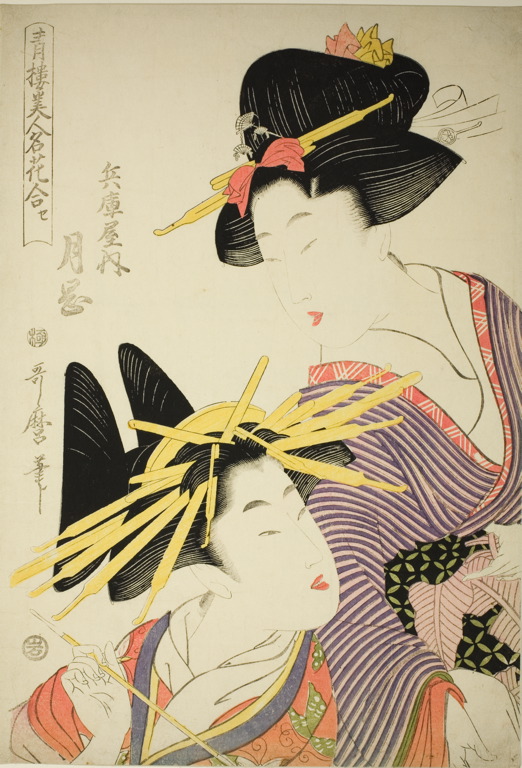
Famous Flowers of Beauty from the Pleasure Quarters (Seiro bijin meika awase): Tsukioka of the Hyogoya
- Medium:
- Woodblock print
- Source:
- Art Institute of Chicago
- Image courtesy of
- Art Institute of Chicago
Description
From the series Famous Flowers of Beauty from the Pleasure Quarters (Seiro bijin meika awase), this print depicts Tsukioka, a high-ranking courtesan of the Hyogoya establishment. The series title employs the awase structure — a competitive comparison format borrowed from classical poetry and incense appreciation — to rank the Yoshiwara's celebrated beauties through floral metaphor. Each courtesan is associated with a named flower, situating her within an aesthetic taxonomy that linked feminine beauty to seasonal botanical culture. Tsukioka is rendered in the detailed regalia of her station: multilayered uchikake robes with elaborate textile patterns, a complex coiffure secured with multiple kanzashi, and the composed, inward expression characteristic of Utamaro's mature bijin-ga. The mica or bokashi background isolates the figure against abstracted space.
More Prints by Kitagawa Utamaro
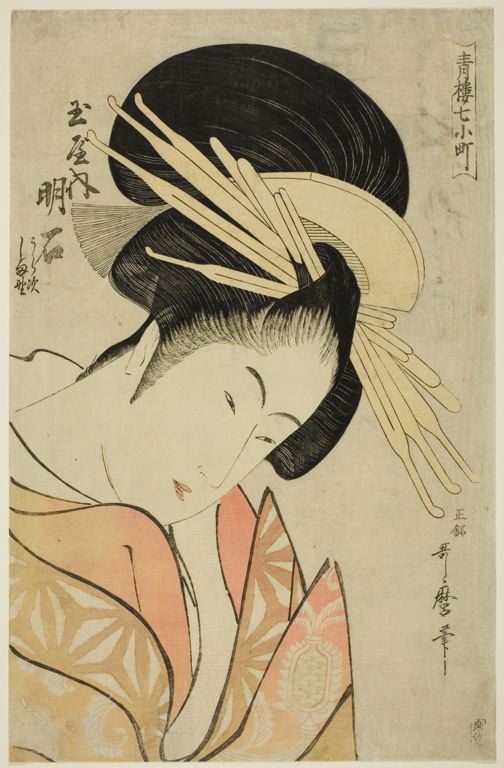
Akashi of the Tamaya, from the series Seven Komachis of Yoshiwara (Seiro nana Komachi) (Tamaya uchi Akashi, Uraji, Shimano)
Woodblock print
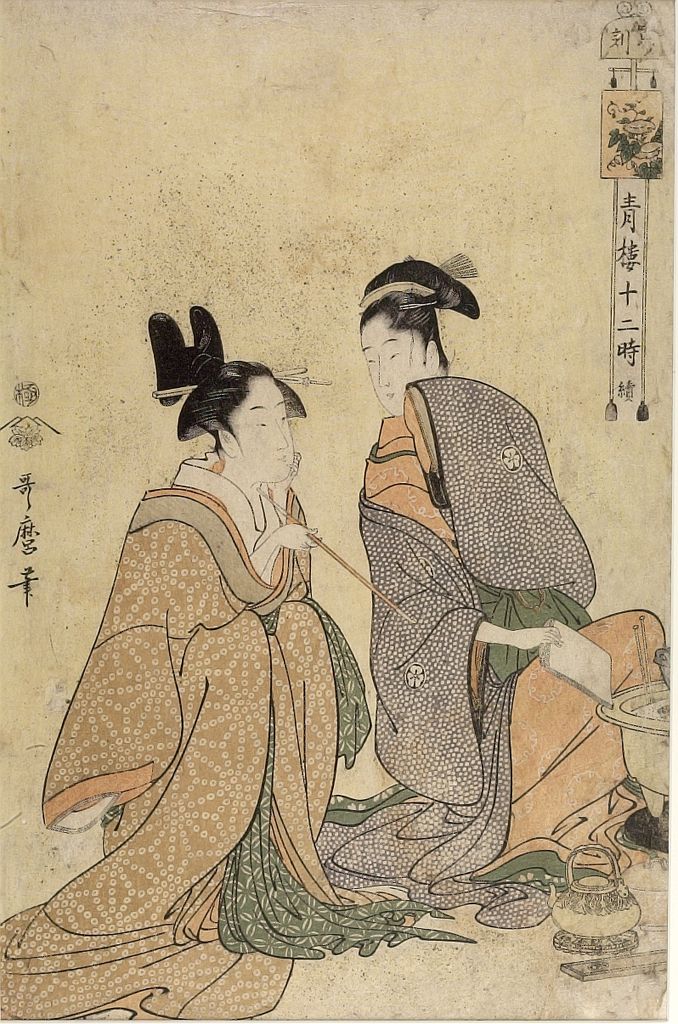
Hour of the Tiger (Tora no koku = 4 AM) from the series Twelve Hours in Yoshiwara (Seirô jûni toki tsuzuki), Late Edo period, circa 1794
Woodblock print
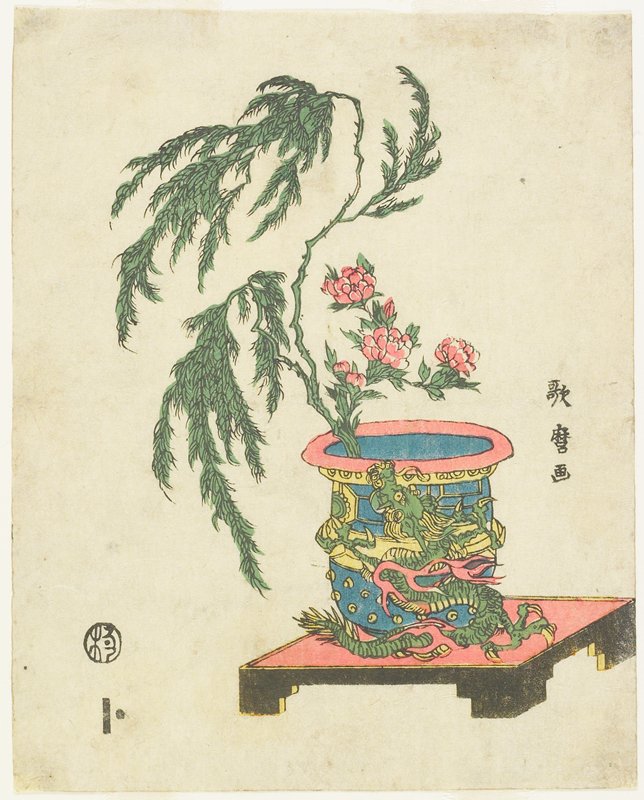
Ikebana arrangement of Peony and Willow in Dragon Pot
1781–1806
Woodblock print (nishiki-e), ink and color on paper
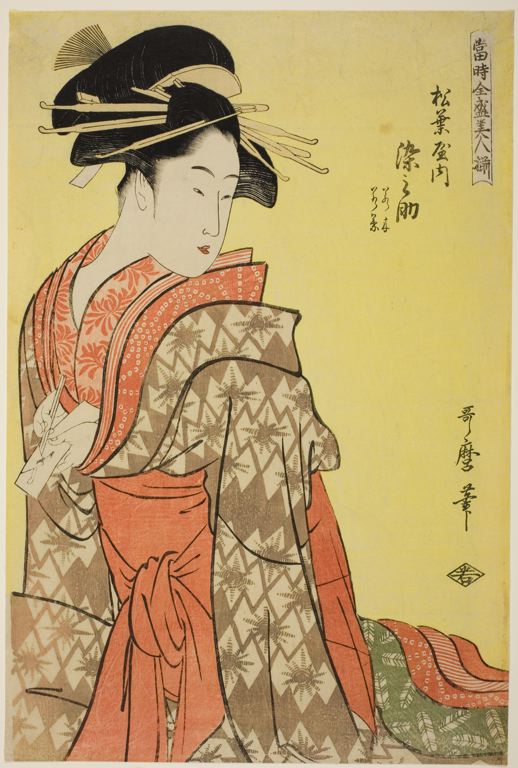
The Greatest Beauties of Our Time (Toji zensei bijin zoroe): Somenosuke of the Matsubaya with Attendants Wakagi and Wakaba
Woodblock print
More Bijin-ga Prints

Featured in Collections
Curated cross-cuts that include this print.
Frequently Asked Questions
Famous Flowers of Beauty from the Pleasure Quarters (Seiro bijin meika awase): Tsukioka of the Hyogoya was created by Kitagawa Utamaro (喜多川歌麿).
Famous Flowers of Beauty from the Pleasure Quarters (Seiro bijin meika awase): Tsukioka of the Hyogoya depicts bijin-ga.