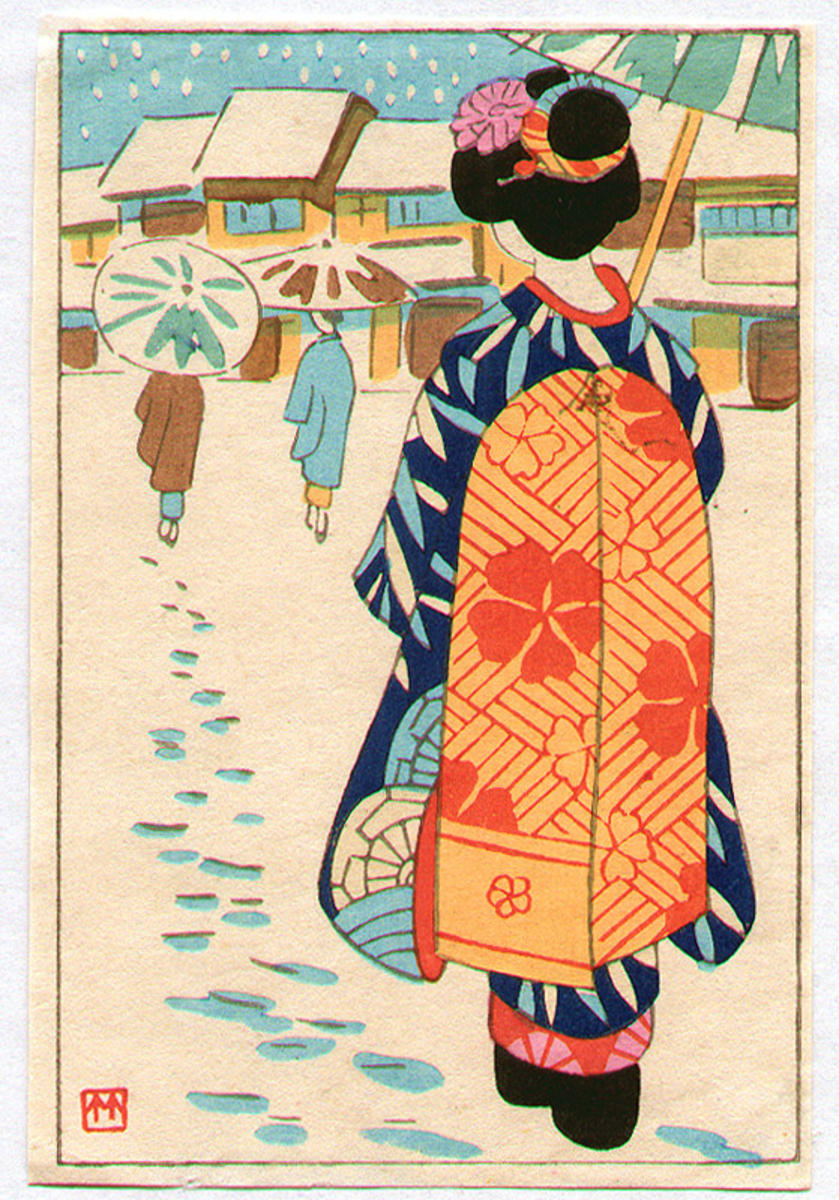
Woman with Parasol
- Date:
- 1915
- Medium:
- Color woodblock print
- Format:
- Oban
- Publisher:
- Watanabe Shozaburo
- Source:
- Art of Japan
Description
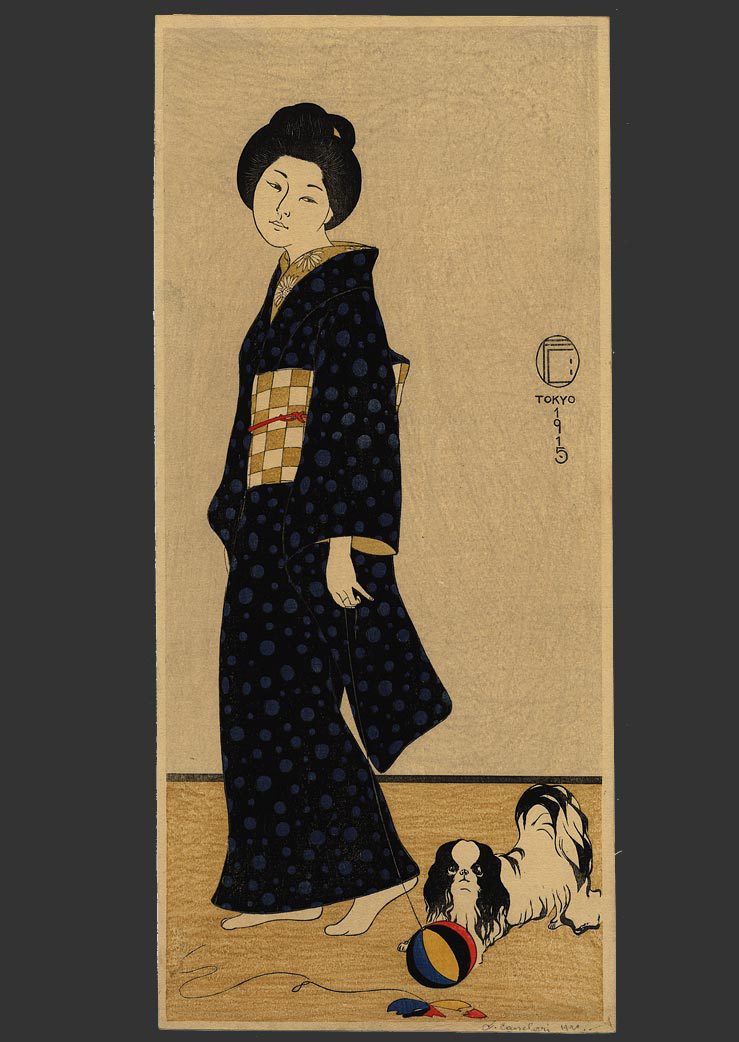
A woman in a dark navy kimono patterned with a scattered blue polka-dot motif stands in profile, her hair swept into a black chignon, a checkerboard obi tied at her waist with a red cord. She looks toward the viewer while holding a thin cord attached to a black-and-white spaniel-type dog playing with a striped red, blue, and yellow ball on the tan floor beside her. The background is a plain tan tone with a round artist's seal and "TOKYO 1915" inscribed at right; this color woodblock print, titled *Woman with Parasol*, was made by Fritz Capelari in 1915.
More Prints by Fritz Capelari


More Bijin-ga Prints

Featured in Collections
Curated cross-cuts that include this print.
Frequently Asked Questions
Woman with Parasol was created by Fritz Capelari (フリッツ・カペラリ) in 1915.
Woman with Parasol was published by Watanabe Shozaburo (1915).
Woman with Parasol depicts bijin-ga.