![Hour of the Hare [6am] (U no koku), from the series “The Twelve Hours in Yoshiwara” ("Seiro juni toki tsuzuki") by Kitagawa Utamaro — Japanese Color woodblock print; oban, c. 1794](https://www.artic.edu/iiif/2/a9a8d8c0-e642-2335-2538-b61cdd915c94/full/843,/0/default.jpg)
Hour of the Hare [6am] (U no koku), from the series “The Twelve Hours in Yoshiwara” ("Seiro juni toki tsuzuki")
- Series:
- Twelve Hours in Yoshiwara
- Date:
- c. 1794
- Medium:
- Color woodblock print; oban
- Source:
- Art Institute of Chicago
Description
Kitagawa Utamaro's Hour of the Hare (6 a.m.) (U no koku), from the series The Twelve Hours in Yoshiwara (Seiro juni toki tsuzuki), is held by the Art Institute of Chicago (artwork 23953). The Hour of the Hare corresponds roughly to 5 to 7 a.m., the moment of daybreak when the Yoshiwara's night world was visibly winding down: clients began their walk home, lanterns were extinguished, and the great houses transitioned from their nocturnal business to the quieter daytime routines. Utamaro's design assigns to this hour a Yoshiwara scene that registers daybreak through gesture and atmosphere, perhaps a parting, a moment of dressing, or an interior in which the night's activity is being closed down. Across the twelve sheets of Seiro juni toki tsuzuki the series traces the full diurnal cycle of the licensed quarter, making the Hour of the Hare a particularly meaningful station: the sheet of farewells and morning quiet that connects the night's pleasure economy to the public day of Edo. Stylistically the print belongs to Utamaro's mature bijin-ga, with refined keyblock drawing of face and hair, controlled nishiki-e color, and a half- or three-quarter-length composition that prioritizes the human figure over background. The Art Institute of Chicago's holding makes this Hour of the Hare available for study alongside the other sheets in the series. For collectors and researchers of Edo bijin-ga, the Twelve Hours in Yoshiwara remains one of Utamaro's most coherent and ambitious projects, and the Hour of the Hare sheet is among its quietly emotional moments, the threshold between night and day in the licensed quarter, drawn with Utamaro's characteristic restraint.
More Prints by Kitagawa Utamaro
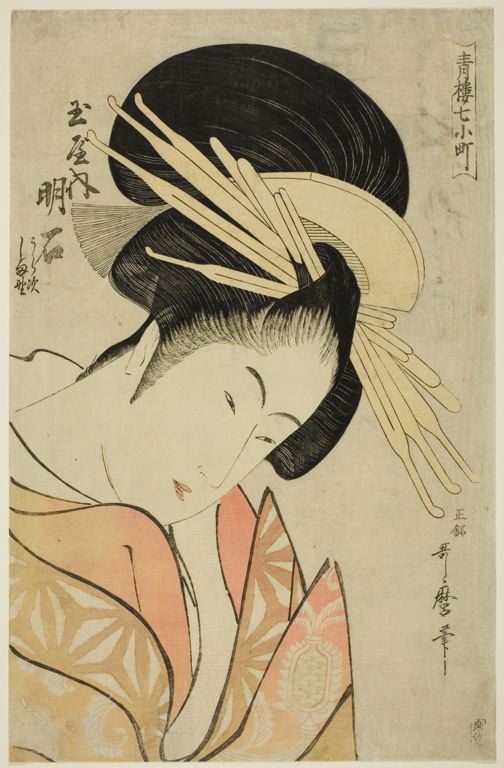
Akashi of the Tamaya, from the series Seven Komachis of Yoshiwara (Seiro nana Komachi) (Tamaya uchi Akashi, Uraji, Shimano)
Woodblock print
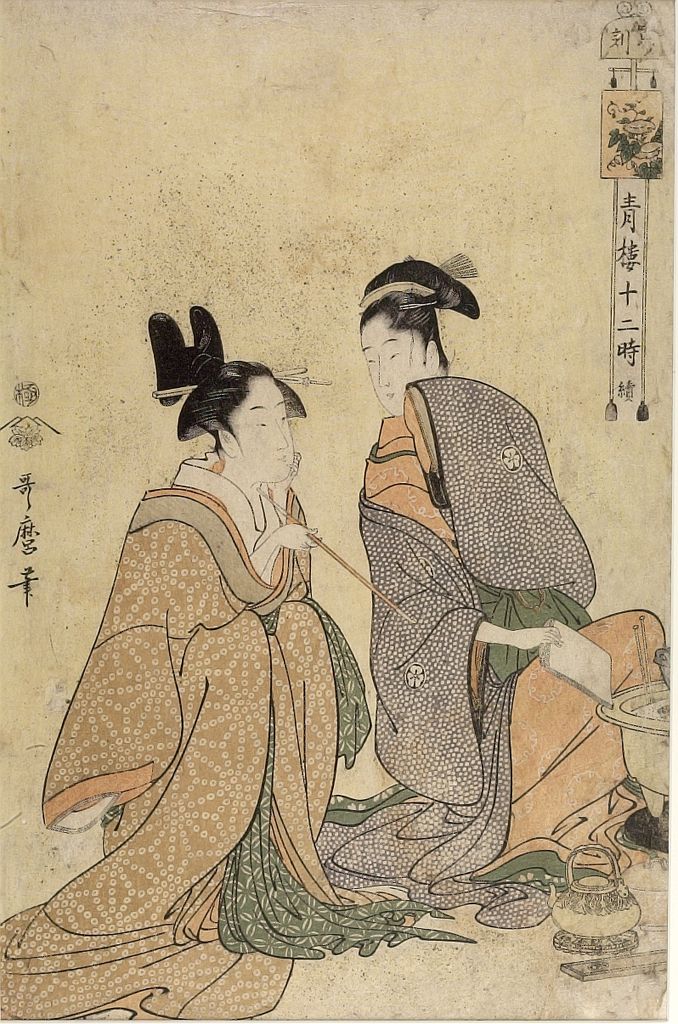
Hour of the Tiger (Tora no koku = 4 AM) from the series Twelve Hours in Yoshiwara (Seirô jûni toki tsuzuki), Late Edo period, circa 1794
Woodblock print
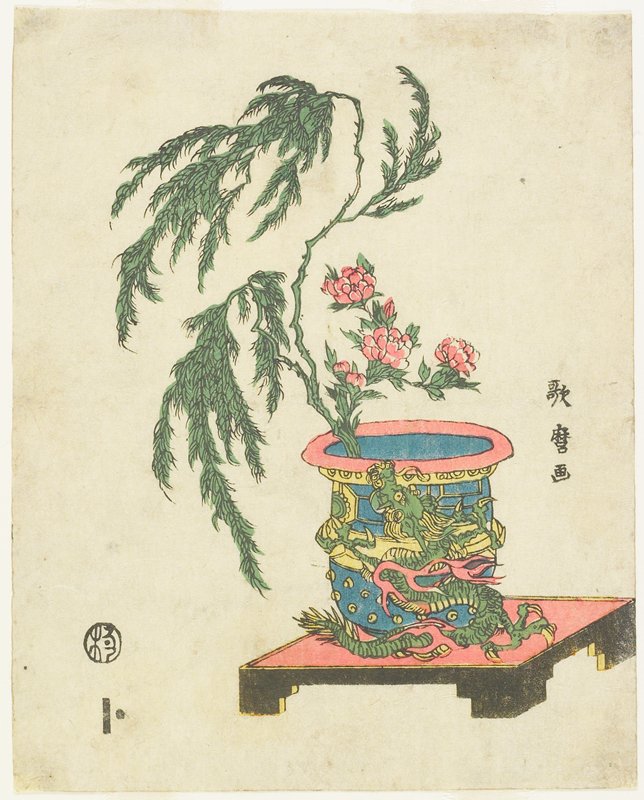
Ikebana arrangement of Peony and Willow in Dragon Pot
1781–1806
Woodblock print (nishiki-e), ink and color on paper
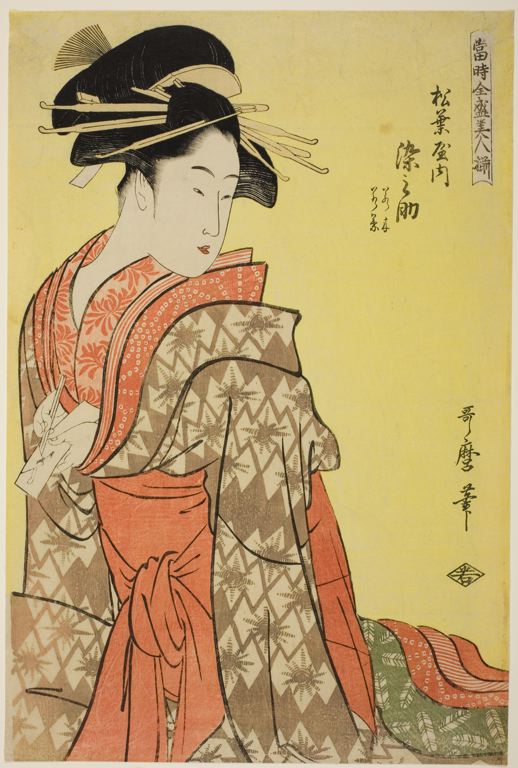
The Greatest Beauties of Our Time (Toji zensei bijin zoroe): Somenosuke of the Matsubaya with Attendants Wakagi and Wakaba
Woodblock print
More Yoshiwara Prints
Hour of the Tiger (Tora no koku = 4 AM) from the series Twelve Hours in Yoshiwara (Seirô jûni toki tsuzuki), Late Edo period, circa 1794
Woodblock print
![Hour of the Rat [12pm] (Ne no koku), from the series "The Twelve Hours in Yoshiwara (Seiro juni toki tsuzuki)" by Kitagawa Utamaro](https://www.artic.edu/iiif/2/df3242c0-3535-b828-b556-56ca889435cd/full/843,/0/default.jpg)
Hour of the Rat [12pm] (Ne no koku), from the series "The Twelve Hours in Yoshiwara (Seiro juni toki tsuzuki)"
c. 1794
Color woodblock print; oban
![Hour of the Ox [2am] (Ushi no koku), from the series "The Twelve Hours in Yoshiwara (Seiro juni toki tsuzuki)" by Kitagawa Utamaro](https://www.artic.edu/iiif/2/383194e4-1eb2-0166-ee78-500d2ef5d875/full/843,/0/default.jpg)
Hour of the Ox [2am] (Ushi no koku), from the series "The Twelve Hours in Yoshiwara (Seiro juni toki tsuzuki)"
c. 1794
Color woodblock print; oban
![Hour of the Monkey [4pm] (Saru no koku), from the series “The Twelve Hours in Yoshiwara” ("Seiro juni toki tsuzuki") by Kitagawa Utamaro](https://www.artic.edu/iiif/2/c1b9dc34-8fb4-0272-3a59-bb71dbda4ca5/full/843,/0/default.jpg)
Hour of the Monkey [4pm] (Saru no koku), from the series “The Twelve Hours in Yoshiwara” ("Seiro juni toki tsuzuki")
c. 1794
Color woodblock print; oban
Frequently Asked Questions
Hour of the Hare [6am] (U no koku), from the series “The Twelve Hours in Yoshiwara” ("Seiro juni toki tsuzuki") was created by Kitagawa Utamaro (喜多川歌麿) in c. 1794.
Yes — Hour of the Hare [6am] (U no koku), from the series “The Twelve Hours in Yoshiwara” ("Seiro juni toki tsuzuki") is part of the Twelve Hours in Yoshiwara series by Kitagawa Utamaro.
Hour of the Hare [6am] (U no koku), from the series “The Twelve Hours in Yoshiwara” ("Seiro juni toki tsuzuki") depicts yoshiwara.