Twelve Hours in Yoshiwara
About This Series
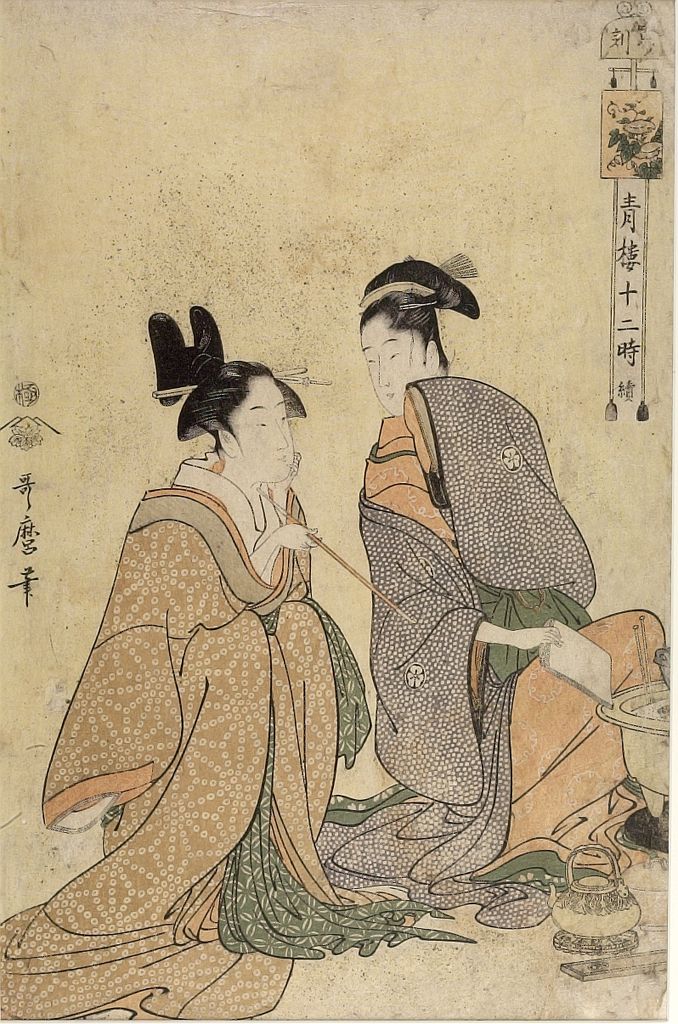
Kitagawa Utamaro's "Twelve Hours in Yoshiwara" (Seiro juni toki tsuzuki) is one of the artist's central bijin-ga cycles, organizing scenes from the daily life of the licensed quarter under the twelve traditional Japanese hours of the day. The series was issued by the publisher Tsutaya Juzaburo and is generally dated to around 1794, placing it at the height of Utamaro's collaboration with the publisher who shaped much of his most ambitious work. Each of the twelve sheets is identified with one of the duodecimal hours, named by zodiac animal, and depicts a courtesan or pair of figures from the Yoshiwara engaged in the activities appropriate to that hour, from late-night letter-writing through morning toilette and the slow ceremonial events of the afternoon and evening. The format is oban tate-e, and the figures are drawn in the elegant elongated proportions that had become Utamaro's hallmark, set against backgrounds in which architectural detail is suggested with the minimum necessary cues so that costume, gesture, and the rhythm of the hour carry the meaning. The series operates as both a fashion record and a documentary catalogue of Yoshiwara practice, signalling to the contemporary viewer the cycle of professional and social rituals that ordered the lives of the quarter's women. The complete set traces a full diurnal arc through the licensed quarter and demonstrates the consistent visual register Utamaro brought to the genre. Impressions and complete sets are held in the Museum of Fine Arts Boston, the British Museum, the Tokyo National Museum, the Honolulu Museum of Art, and the Chiba City Museum of Art, and the series is regularly singled out in the standard literature on the artist as one of his most fully realized cyclical bijin-ga projects of the mid-1790s.
Prints in This Series (6)
Complete series — all 1 prints catalogued.
![Hour of the Hare [6am] (U no koku), from the series “The Twelve Hours in Yoshiwara” ("Seiro juni toki tsuzuki")](https://www.artic.edu/iiif/2/a9a8d8c0-e642-2335-2538-b61cdd915c94/full/843,/0/default.jpg)
![Hour of the Monkey [4pm] (Saru no koku), from the series “The Twelve Hours in Yoshiwara” ("Seiro juni toki tsuzuki")](https://www.artic.edu/iiif/2/c1b9dc34-8fb4-0272-3a59-bb71dbda4ca5/full/843,/0/default.jpg)
![Hour of the Ox [2am] (Ushi no koku), from the series "The Twelve Hours in Yoshiwara (Seiro juni toki tsuzuki)"](https://www.artic.edu/iiif/2/383194e4-1eb2-0166-ee78-500d2ef5d875/full/843,/0/default.jpg)
![Hour of the Rat [12pm] (Ne no koku), from the series "The Twelve Hours in Yoshiwara (Seiro juni toki tsuzuki)"](https://www.artic.edu/iiif/2/df3242c0-3535-b828-b556-56ca889435cd/full/843,/0/default.jpg)
Frequently Asked Questions
Kitagawa Utamaro's "Twelve Hours in Yoshiwara" (Seiro juni toki tsuzuki) is one of the artist's central bijin-ga cycles, organizing scenes from the daily life of the licensed quarter under the twelve traditional Japanese hours of the day. The series was issued by the publisher Tsutaya Juzaburo and is generally dated to around 1794, placing it at the height of Utamaro's collaboration with the publisher who shaped much of his most ambitious work. Each of the twelve sheets is identified with one of the duodecimal hours, named by zodiac animal, and depicts a courtesan or pair of figures from the Yoshiwara engaged in the activities appropriate to that hour, from late-night letter-writing through morning toilette and the slow ceremonial events of the afternoon and evening. The format is oban tate-e, and the figures are drawn in the elegant elongated proportions that had become Utamaro's hallmark, set against backgrounds in which architectural detail is suggested with the minimum necessary cues so that costume, gesture, and the rhythm of the hour carry the meaning. The series operates as both a fashion record and a documentary catalogue of Yoshiwara practice, signalling to the contemporary viewer the cycle of professional and social rituals that ordered the lives of the quarter's women. The complete set traces a full diurnal arc through the licensed quarter and demonstrates the consistent visual register Utamaro brought to the genre. Impressions and complete sets are held in the Museum of Fine Arts Boston, the British Museum, the Tokyo National Museum, the Honolulu Museum of Art, and the Chiba City Museum of Art, and the series is regularly singled out in the standard literature on the artist as one of his most fully realized cyclical bijin-ga projects of the mid-1790s.
The Twelve Hours in Yoshiwara series contains 1 prints, created by Kitagawa Utamaro.
The Twelve Hours in Yoshiwara series was created by Kitagawa Utamaro (喜多川歌麿).
We currently have 6 of 1 known prints from the Twelve Hours in Yoshiwara series indexed in our collection. Browse them all on this page.
Want to rate prints from Twelve Hours in Yoshiwara?
Sign up to start rating