![Hour of the Monkey [4pm] (Saru no koku), from the series “The Twelve Hours in Yoshiwara” ("Seiro juni toki tsuzuki") by Kitagawa Utamaro — Japanese Color woodblock print; oban, c. 1794](https://www.artic.edu/iiif/2/c1b9dc34-8fb4-0272-3a59-bb71dbda4ca5/full/843,/0/default.jpg)
Hour of the Monkey [4pm] (Saru no koku), from the series “The Twelve Hours in Yoshiwara” ("Seiro juni toki tsuzuki")
- Series:
- Twelve Hours in Yoshiwara
- Date:
- c. 1794
- Medium:
- Color woodblock print; oban
- Source:
- Art Institute of Chicago
Description
Dated about 1789 and in the Art Institute of Chicago, the Hour of the Monkey (Saru no koku) belongs to Kitagawa Utamaro's Twelve Hours in Yoshiwara (Seirō jūni toki tsuzuki), a series that anatomizes the daily life of the licensed quarter by allocating each of the traditional twelve double-hours to a separate scene of beauty. The Hour of the Monkey, corresponding to roughly four in the afternoon, captures a transitional moment in the quarter: too late for the courtesans' rituals of preparation for the early evening, too early for the peak hours of patronage, a moment of relative quiet often spent on letters, music, conversation, or grooming. Utamaro uses this contemplative interval to construct a tightly framed composition that places the women at the visual center, with a few choice objects (a tobacco tray, a fan, perhaps a stringed instrument) anchoring the moment in everyday practice. His drawing of the figures shows the early signs of the okubi-e style that would soon dominate his Edo bijin-ga: elongated necks, refined oval faces, and careful gradations of expression. The series cartouche, often shaped like a clock face or a paired animal sign, helped collectors assemble the full twelve sheets, and it also tied the print into the broader visual culture of time-keeping that fascinated late-Edo viewers. As a comparatively early sheet from the series, the Art Institute's impression documents Utamaro's emerging ukiyo-e vocabulary and his characteristically humane vision of the Yoshiwara's daily rhythms.
More Prints by Kitagawa Utamaro
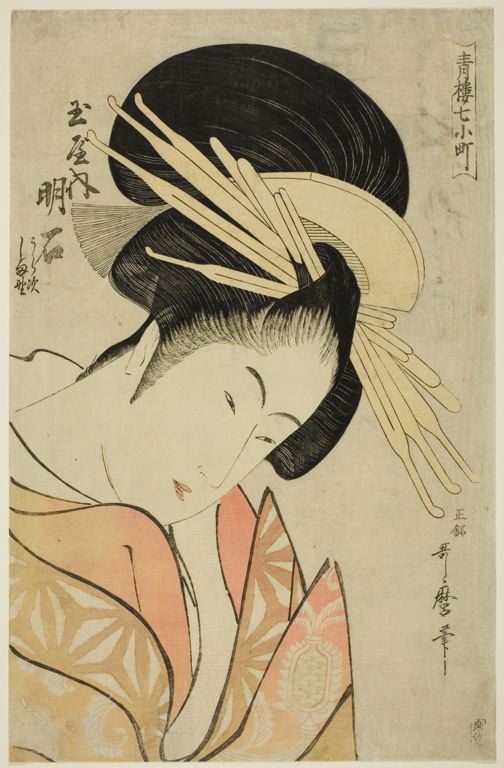
Akashi of the Tamaya, from the series Seven Komachis of Yoshiwara (Seiro nana Komachi) (Tamaya uchi Akashi, Uraji, Shimano)
Woodblock print
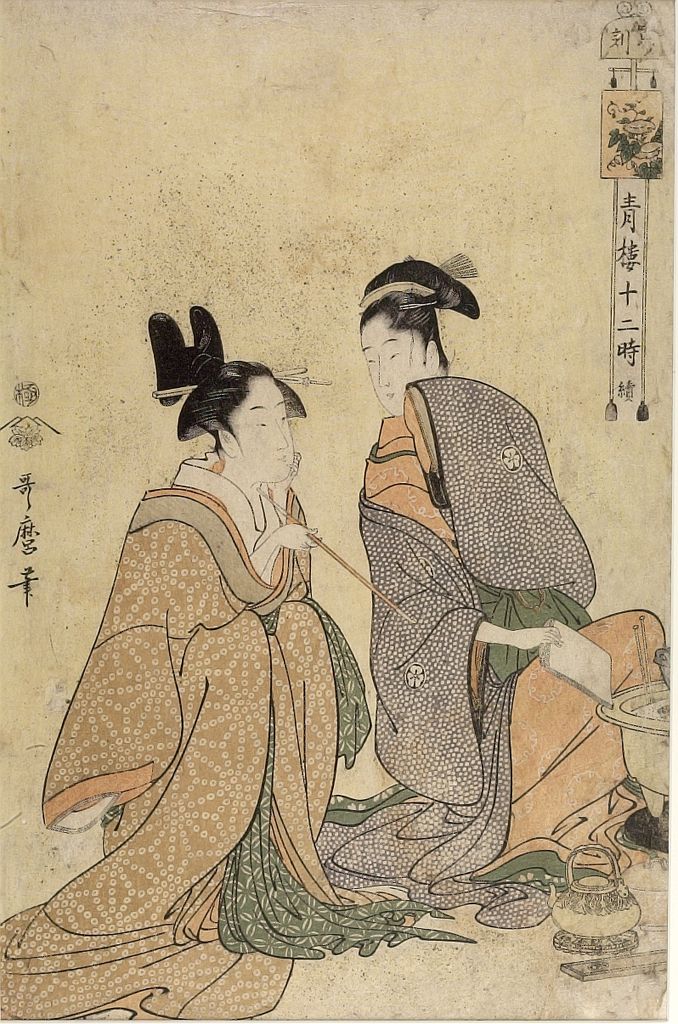
Hour of the Tiger (Tora no koku = 4 AM) from the series Twelve Hours in Yoshiwara (Seirô jûni toki tsuzuki), Late Edo period, circa 1794
Woodblock print
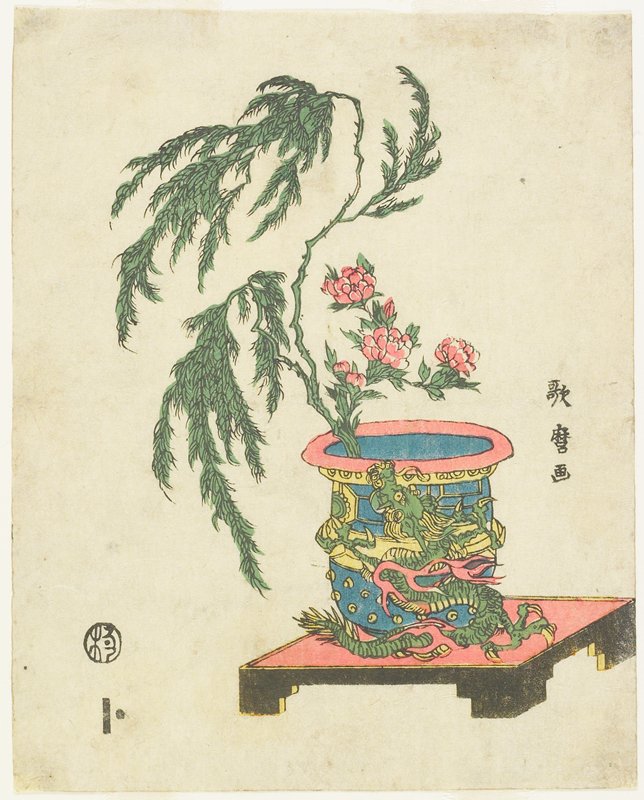
Ikebana arrangement of Peony and Willow in Dragon Pot
1781–1806
Woodblock print (nishiki-e), ink and color on paper
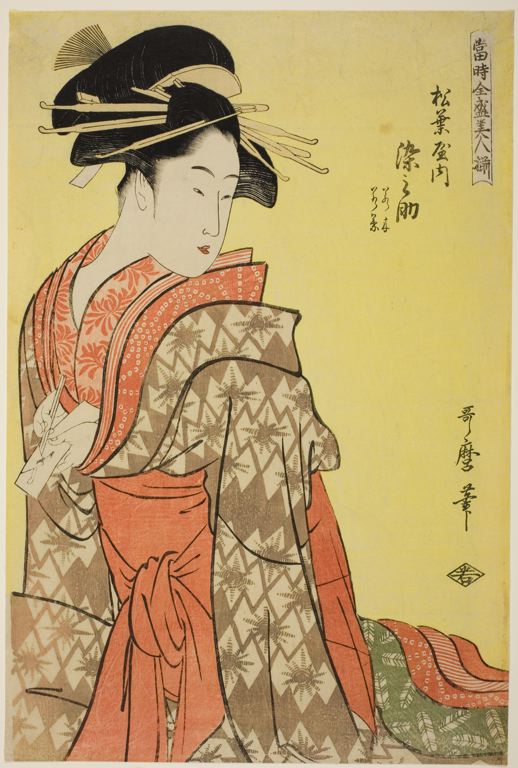
The Greatest Beauties of Our Time (Toji zensei bijin zoroe): Somenosuke of the Matsubaya with Attendants Wakagi and Wakaba
Woodblock print
More Yoshiwara Prints
Hour of the Tiger (Tora no koku = 4 AM) from the series Twelve Hours in Yoshiwara (Seirô jûni toki tsuzuki), Late Edo period, circa 1794
Woodblock print
![Hour of the Rat [12pm] (Ne no koku), from the series "The Twelve Hours in Yoshiwara (Seiro juni toki tsuzuki)" by Kitagawa Utamaro](https://www.artic.edu/iiif/2/df3242c0-3535-b828-b556-56ca889435cd/full/843,/0/default.jpg)
Hour of the Rat [12pm] (Ne no koku), from the series "The Twelve Hours in Yoshiwara (Seiro juni toki tsuzuki)"
c. 1794
Color woodblock print; oban
![Hour of the Ox [2am] (Ushi no koku), from the series "The Twelve Hours in Yoshiwara (Seiro juni toki tsuzuki)" by Kitagawa Utamaro](https://www.artic.edu/iiif/2/383194e4-1eb2-0166-ee78-500d2ef5d875/full/843,/0/default.jpg)
Hour of the Ox [2am] (Ushi no koku), from the series "The Twelve Hours in Yoshiwara (Seiro juni toki tsuzuki)"
c. 1794
Color woodblock print; oban
![Hour of the Hare [6am] (U no koku), from the series “The Twelve Hours in Yoshiwara” ("Seiro juni toki tsuzuki") by Kitagawa Utamaro](https://www.artic.edu/iiif/2/a9a8d8c0-e642-2335-2538-b61cdd915c94/full/843,/0/default.jpg)
Hour of the Hare [6am] (U no koku), from the series “The Twelve Hours in Yoshiwara” ("Seiro juni toki tsuzuki")
c. 1794
Color woodblock print; oban
Frequently Asked Questions
Hour of the Monkey [4pm] (Saru no koku), from the series “The Twelve Hours in Yoshiwara” ("Seiro juni toki tsuzuki") was created by Kitagawa Utamaro (喜多川歌麿) in c. 1794.
Yes — Hour of the Monkey [4pm] (Saru no koku), from the series “The Twelve Hours in Yoshiwara” ("Seiro juni toki tsuzuki") is part of the Twelve Hours in Yoshiwara series by Kitagawa Utamaro.
Hour of the Monkey [4pm] (Saru no koku), from the series “The Twelve Hours in Yoshiwara” ("Seiro juni toki tsuzuki") depicts yoshiwara.