![Hour of the Rat [12pm] (Ne no koku), from the series "The Twelve Hours in Yoshiwara (Seiro juni toki tsuzuki)" by Kitagawa Utamaro — Japanese Color woodblock print; oban, c. 1794](https://www.artic.edu/iiif/2/df3242c0-3535-b828-b556-56ca889435cd/full/843,/0/default.jpg)
Hour of the Rat [12pm] (Ne no koku), from the series "The Twelve Hours in Yoshiwara (Seiro juni toki tsuzuki)"
- Series:
- Twelve Hours in Yoshiwara
- Date:
- c. 1794
- Medium:
- Color woodblock print; oban
- Source:
- Art Institute of Chicago
Description
Kitagawa Utamaro's Hour of the Rat (12 p.m.) (Ne no koku), from the series The Twelve Hours in Yoshiwara (Seiro juni toki tsuzuki), is in the Art Institute of Chicago (artwork 23982). Like the other sheets in the series, the design takes one of the twelve traditional Japanese double-hours, here the Hour of the Rat, and assigns it a scene from the daily life of the Yoshiwara. The Hour of the Rat traditionally corresponds to roughly 11 p.m. to 1 a.m., the dead of night, when the licensed quarter's nocturnal activity is at its height for some functions and its quietest for others. Utamaro's choice of subject for this hour, whether an interior scene with a courtesan and an attendant, an after-hours conversation, or a moment of solitary preparation, conveys the rhythm of the great Yoshiwara houses across a 24-hour cycle. The Twelve Hours in Yoshiwara is therefore far more than a decorative series: it is a structured ethnography of the pleasure quarter, in which Utamaro's named and unnamed women act out the temporal logic of their professional world. Stylistically the print belongs to Utamaro's mature Edo bijin-ga, with refined keyblock drawing, restrained nishiki-e color, and a half- or three-quarter-length figural composition that throws hair, collar, and facial expression into relief. The Art Institute of Chicago's holding preserves the Hour of the Rat for researchers tracing the social organization of the Yoshiwara and the way ukiyo-e represented private space within the licensed quarter. For collectors of Utamaro, the Seiro juni toki tsuzuki is among the essential series, and the Hour of the Rat sheet is one of its most quietly observant moments.
More Prints by Kitagawa Utamaro
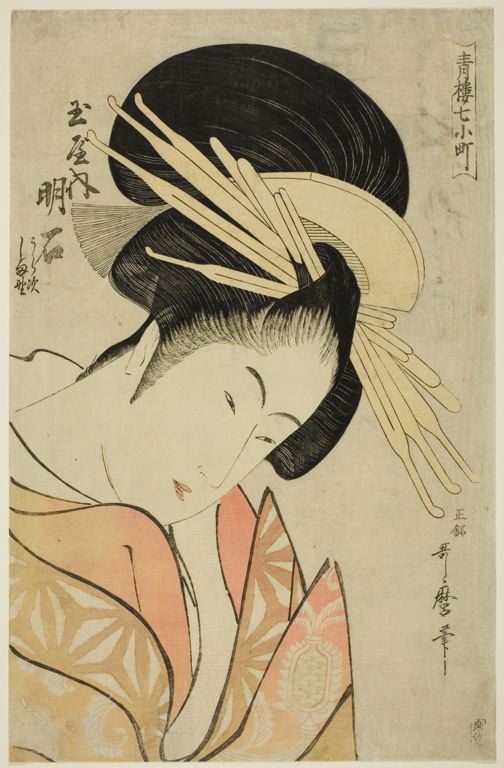
Akashi of the Tamaya, from the series Seven Komachis of Yoshiwara (Seiro nana Komachi) (Tamaya uchi Akashi, Uraji, Shimano)
Woodblock print
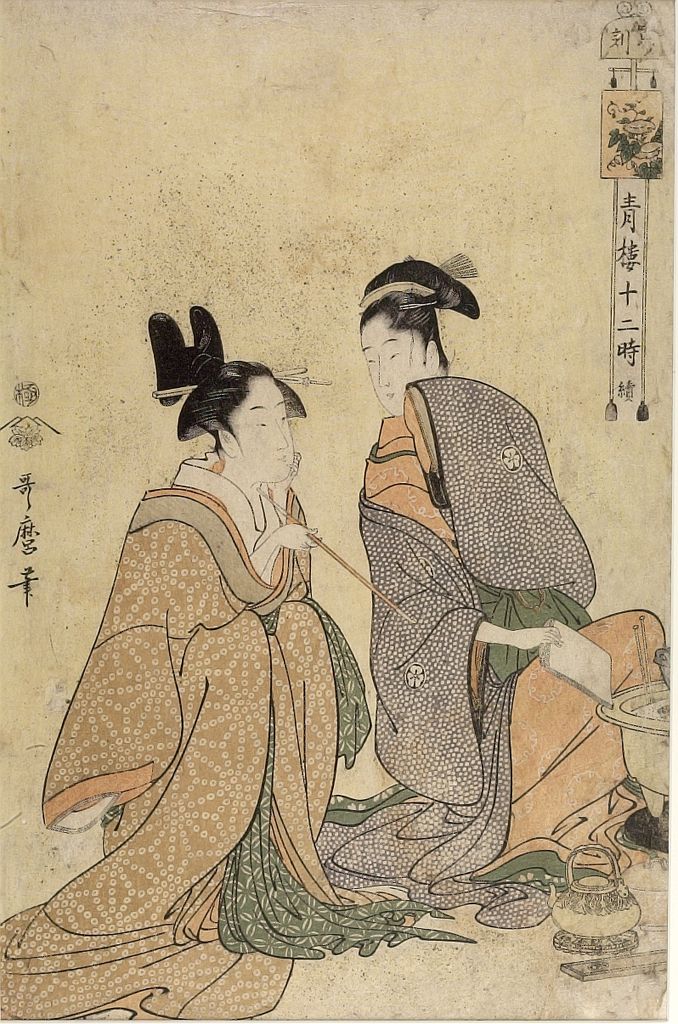
Hour of the Tiger (Tora no koku = 4 AM) from the series Twelve Hours in Yoshiwara (Seirô jûni toki tsuzuki), Late Edo period, circa 1794
Woodblock print
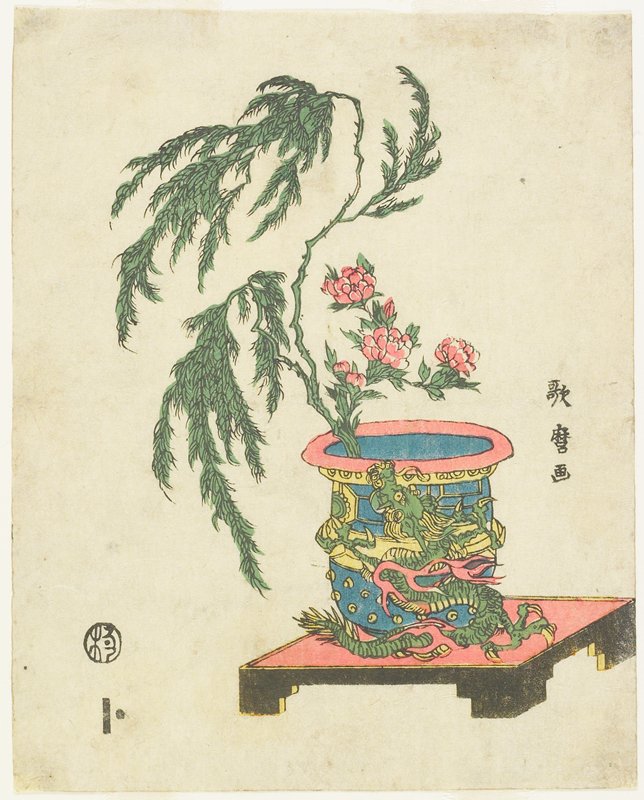
Ikebana arrangement of Peony and Willow in Dragon Pot
1781–1806
Woodblock print (nishiki-e), ink and color on paper
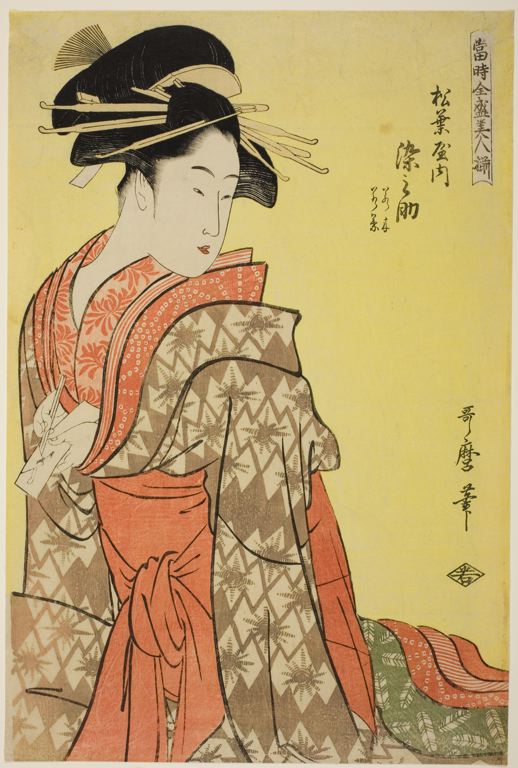
The Greatest Beauties of Our Time (Toji zensei bijin zoroe): Somenosuke of the Matsubaya with Attendants Wakagi and Wakaba
Woodblock print
More Yoshiwara Prints
Hour of the Tiger (Tora no koku = 4 AM) from the series Twelve Hours in Yoshiwara (Seirô jûni toki tsuzuki), Late Edo period, circa 1794
Woodblock print
![Hour of the Ox [2am] (Ushi no koku), from the series "The Twelve Hours in Yoshiwara (Seiro juni toki tsuzuki)" by Kitagawa Utamaro](https://www.artic.edu/iiif/2/383194e4-1eb2-0166-ee78-500d2ef5d875/full/843,/0/default.jpg)
Hour of the Ox [2am] (Ushi no koku), from the series "The Twelve Hours in Yoshiwara (Seiro juni toki tsuzuki)"
c. 1794
Color woodblock print; oban
![Hour of the Hare [6am] (U no koku), from the series “The Twelve Hours in Yoshiwara” ("Seiro juni toki tsuzuki") by Kitagawa Utamaro](https://www.artic.edu/iiif/2/a9a8d8c0-e642-2335-2538-b61cdd915c94/full/843,/0/default.jpg)
Hour of the Hare [6am] (U no koku), from the series “The Twelve Hours in Yoshiwara” ("Seiro juni toki tsuzuki")
c. 1794
Color woodblock print; oban
![Hour of the Monkey [4pm] (Saru no koku), from the series “The Twelve Hours in Yoshiwara” ("Seiro juni toki tsuzuki") by Kitagawa Utamaro](https://www.artic.edu/iiif/2/c1b9dc34-8fb4-0272-3a59-bb71dbda4ca5/full/843,/0/default.jpg)
Hour of the Monkey [4pm] (Saru no koku), from the series “The Twelve Hours in Yoshiwara” ("Seiro juni toki tsuzuki")
c. 1794
Color woodblock print; oban
Frequently Asked Questions
Hour of the Rat [12pm] (Ne no koku), from the series "The Twelve Hours in Yoshiwara (Seiro juni toki tsuzuki)" was created by Kitagawa Utamaro (喜多川歌麿) in c. 1794.
Yes — Hour of the Rat [12pm] (Ne no koku), from the series "The Twelve Hours in Yoshiwara (Seiro juni toki tsuzuki)" is part of the Twelve Hours in Yoshiwara series by Kitagawa Utamaro.
Hour of the Rat [12pm] (Ne no koku), from the series "The Twelve Hours in Yoshiwara (Seiro juni toki tsuzuki)" depicts yoshiwara.