Hour of the Tiger [4am] (Tora no koku), from the series The Twelve Hours in Yoshiwara (Seirō jūni toki tsuzuki)
- Series:
- Twelve Hours in Yoshiwara
- Date:
- c. 1794 (Kansei 6)
- Medium:
- Woodblock print (nishiki-e); ink, and metallic filings on paper
- Source:
- Harvard Art Museums
Description
Issued around 1794 and held by the Harvard Art Museums, the Hour of the Tiger (Tora no koku) belongs to The Twelve Hours in Yoshiwara (Seirō jūni toki tsuzuki), one of Kitagawa Utamaro's most celebrated bijin-ga series. Each design pairs a courtesan or attendant with one of the twelve double-hours of the traditional Japanese day, framing the entire daily rhythm of the licensed quarter as a sequence of female portraits. The Hour of the Tiger corresponds to roughly four in the morning, the chilly moment when the evening's clients have departed and the quarter is finally winding down. Utamaro renders this hush in the body language of his figures: a sleeve drawn close against the cold, a slight droop of the head, the careful, almost sleepwalking adjustment of disheveled hair. The composition is built on the half-length, near-frame okubi-e format he made his signature, allowing the viewer to read every nuance of the courtesan's expression. The series cartouche shaped like a small clock disk anchors the design and would have helped Edo buyers collect and arrange the set as a calendar of beauty. As an entry in his Edo bijin-ga catalogue, this Hour of the Tiger sheet shows how Utamaro fused commercial ukiyo-e with a remarkable psychological economy, transforming a simple time marker into a portrait of fatigue, intimacy, and the quiet professional rhythms behind the Yoshiwara's public glamour.
More Prints by Kitagawa Utamaro
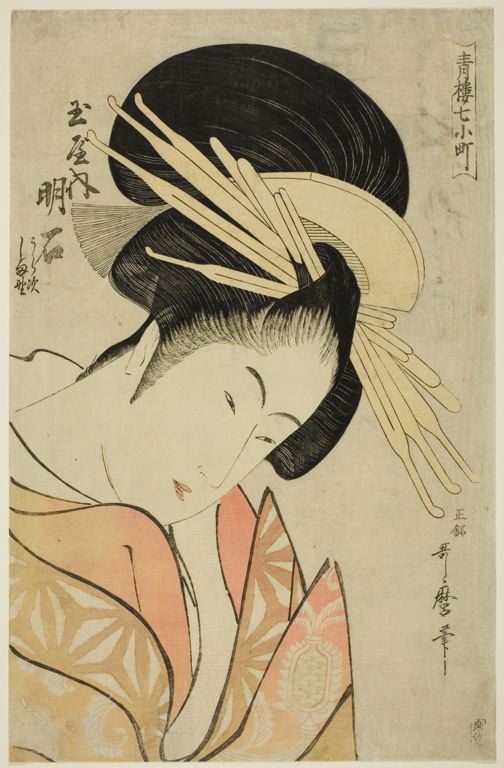
Akashi of the Tamaya, from the series Seven Komachis of Yoshiwara (Seiro nana Komachi) (Tamaya uchi Akashi, Uraji, Shimano)
Woodblock print
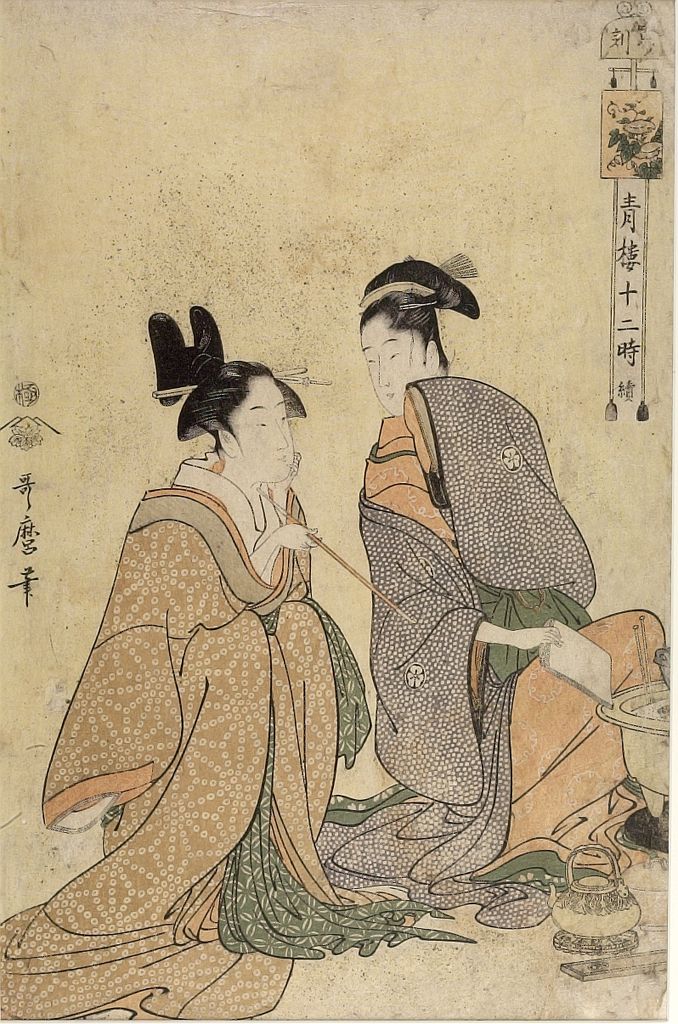
Hour of the Tiger (Tora no koku = 4 AM) from the series Twelve Hours in Yoshiwara (Seirô jûni toki tsuzuki), Late Edo period, circa 1794
Woodblock print
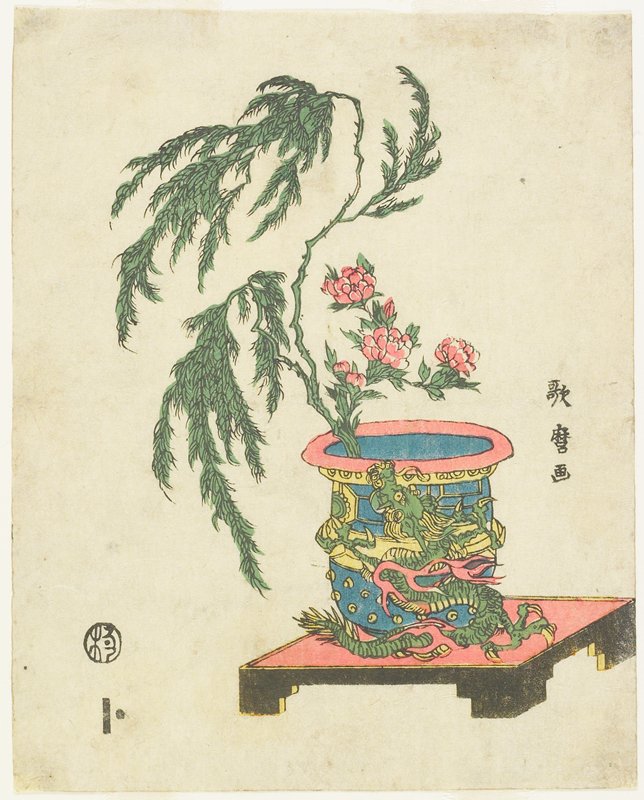
Ikebana arrangement of Peony and Willow in Dragon Pot
1781–1806
Woodblock print (nishiki-e), ink and color on paper
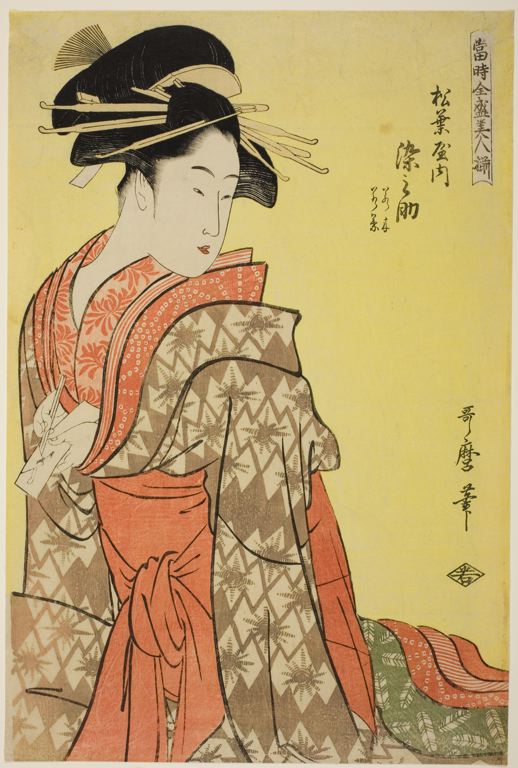
The Greatest Beauties of Our Time (Toji zensei bijin zoroe): Somenosuke of the Matsubaya with Attendants Wakagi and Wakaba
Woodblock print
More Yoshiwara Prints
Hour of the Tiger (Tora no koku = 4 AM) from the series Twelve Hours in Yoshiwara (Seirô jûni toki tsuzuki), Late Edo period, circa 1794
Woodblock print
![Hour of the Rat [12pm] (Ne no koku), from the series "The Twelve Hours in Yoshiwara (Seiro juni toki tsuzuki)" by Kitagawa Utamaro](https://www.artic.edu/iiif/2/df3242c0-3535-b828-b556-56ca889435cd/full/843,/0/default.jpg)
Hour of the Rat [12pm] (Ne no koku), from the series "The Twelve Hours in Yoshiwara (Seiro juni toki tsuzuki)"
c. 1794
Color woodblock print; oban
![Hour of the Ox [2am] (Ushi no koku), from the series "The Twelve Hours in Yoshiwara (Seiro juni toki tsuzuki)" by Kitagawa Utamaro](https://www.artic.edu/iiif/2/383194e4-1eb2-0166-ee78-500d2ef5d875/full/843,/0/default.jpg)
Hour of the Ox [2am] (Ushi no koku), from the series "The Twelve Hours in Yoshiwara (Seiro juni toki tsuzuki)"
c. 1794
Color woodblock print; oban
![Hour of the Hare [6am] (U no koku), from the series “The Twelve Hours in Yoshiwara” ("Seiro juni toki tsuzuki") by Kitagawa Utamaro](https://www.artic.edu/iiif/2/a9a8d8c0-e642-2335-2538-b61cdd915c94/full/843,/0/default.jpg)
Hour of the Hare [6am] (U no koku), from the series “The Twelve Hours in Yoshiwara” ("Seiro juni toki tsuzuki")
c. 1794
Color woodblock print; oban
Frequently Asked Questions
Hour of the Tiger [4am] (Tora no koku), from the series The Twelve Hours in Yoshiwara (Seirō jūni toki tsuzuki) was created by Kitagawa Utamaro (喜多川歌麿) in c. 1794 (Kansei 6).
Yes — Hour of the Tiger [4am] (Tora no koku), from the series The Twelve Hours in Yoshiwara (Seirō jūni toki tsuzuki) is part of the Twelve Hours in Yoshiwara series by Kitagawa Utamaro.
Hour of the Tiger [4am] (Tora no koku), from the series The Twelve Hours in Yoshiwara (Seirō jūni toki tsuzuki) depicts yoshiwara.