
Stone Bridge
- Date:
- c. 1801/02
- Medium:
- Color woodblock print; aiban
- Source:
- Art Institute of Chicago
Description
Held by the Art Institute of Chicago and dated about 1796, Stone Bridge is a design by Kitagawa Utamaro that turns away from his most familiar Yoshiwara subjects to engage with the visual world of stone-bridge (shakkyō) imagery drawn from Noh and kabuki theatre. In its theatrical source, the shakkyō dance unfolds at a legendary bridge in China, where lion spirits perform among peonies; print designers regularly transposed this iconography into bijin-ga by recasting the lion dancer as a beautiful woman, often a courtesan or shirabyōshi, posed against the bridge's curving stone span. Utamaro's contribution sits squarely within Edo bijin-ga, where literary and dramatic allusion was used to lend depth to images of contemporary women, much as poetry slips and waka headings did in other series. The figure is rendered with his characteristic elongated neck, slightly tilted head, and carefully balanced gestures of hand and sleeve, signaling familiarity with both the dance's standard choreography and current Edo fashion. The image's reduced palette and selective use of pattern reflect the printmaking values of the mid-1790s, when Utamaro and his publishers used disciplined backgrounds and rich figural detail to maximize impact. As a result, this Art Institute impression illustrates how a single Utamaro print can function on multiple levels: a fashion plate, a theatrical reference, and a piece of ukiyo-e visual rhetoric that connects the everyday glamour of Edo with the older Sinitic-Japanese literary canon.
More Prints by Kitagawa Utamaro
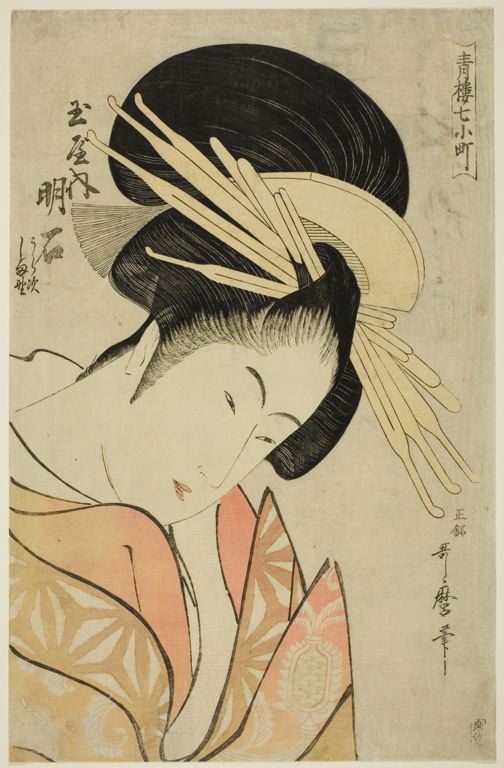
Akashi of the Tamaya, from the series Seven Komachis of Yoshiwara (Seiro nana Komachi) (Tamaya uchi Akashi, Uraji, Shimano)
Woodblock print
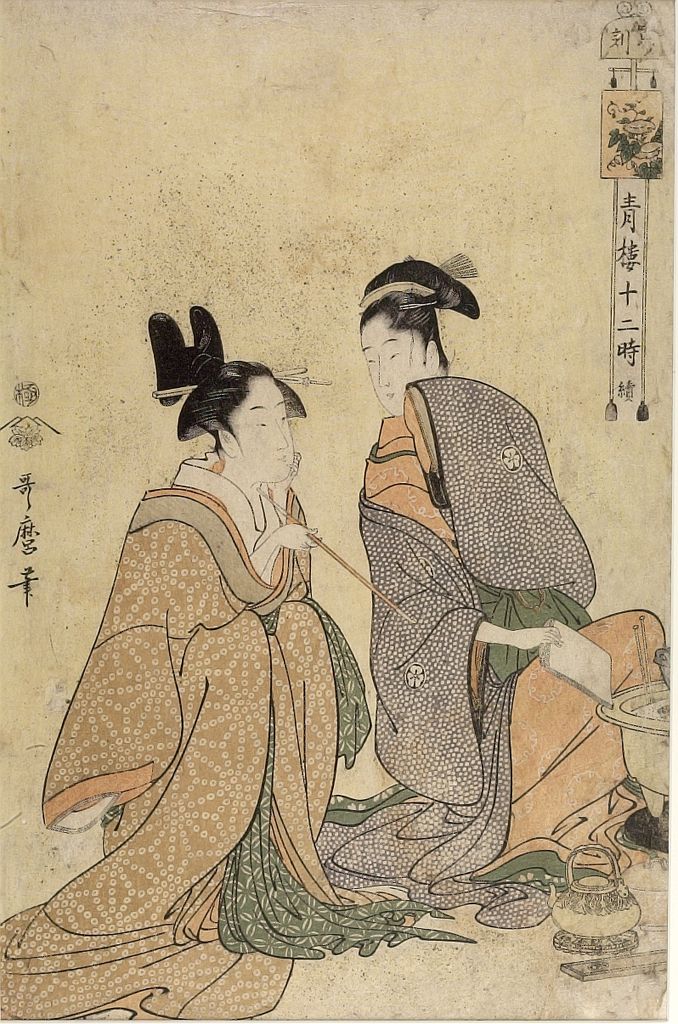
Hour of the Tiger (Tora no koku = 4 AM) from the series Twelve Hours in Yoshiwara (Seirô jûni toki tsuzuki), Late Edo period, circa 1794
Woodblock print
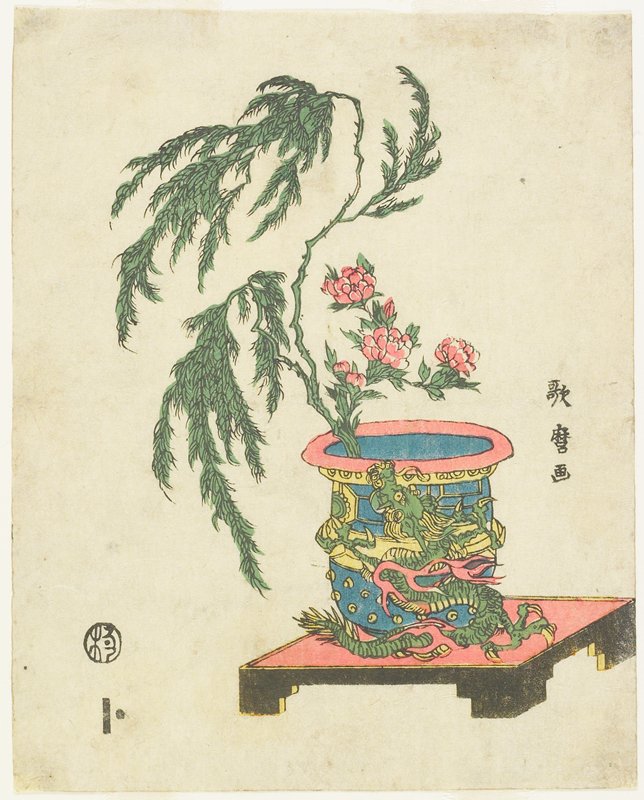
Ikebana arrangement of Peony and Willow in Dragon Pot
1781–1806
Woodblock print (nishiki-e), ink and color on paper
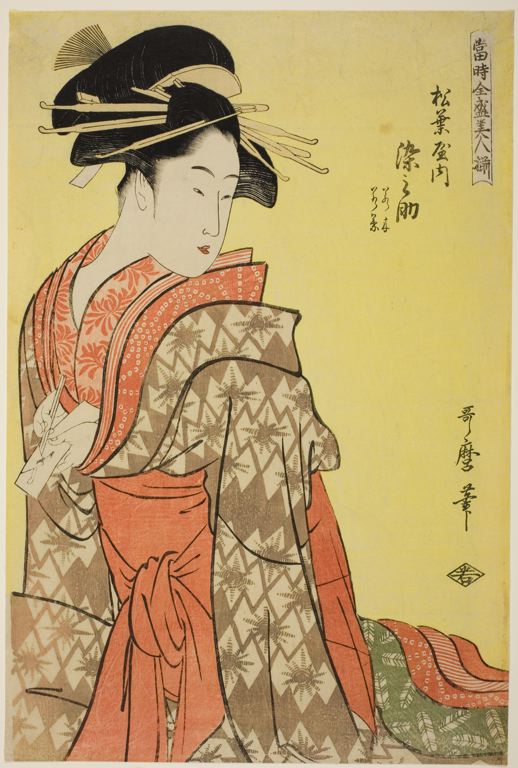
The Greatest Beauties of Our Time (Toji zensei bijin zoroe): Somenosuke of the Matsubaya with Attendants Wakagi and Wakaba
Woodblock print
More Bridges Prints
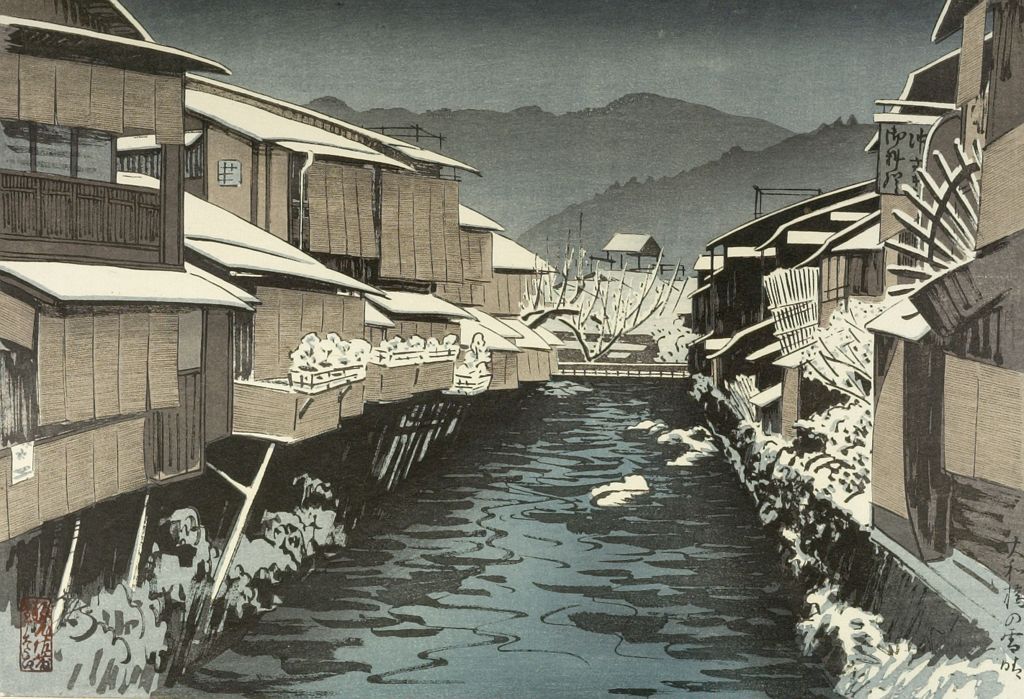
Fair Weather After Snow at Yamato Bridge, Kyoto (Yamato bashi no yukibare), Taishô period, dated 1924
Woodblock print
![Mount Fuji on a Moonlit Night, Kawai Bridge (Tsukiyo no Fuji [Kawaibashi]), from the series "Selection of Views of the Tokaido (Tokaido fukei senshu)" by Kawase Hasui](https://www.artic.edu/iiif/2/d0960668-1e73-339a-b182-fb995a54bff0/full/843,/0/default.jpg)
Mount Fuji on a Moonlit Night, Kawai Bridge (Tsukiyo no Fuji [Kawaibashi]), from the series "Selection of Views of the Tokaido (Tokaido fukei senshu)"
1947
Color woodblock print; oban

Shin Ohashi Bridge (Shin Ohashi), from the series "Twenty View of Tokyo (Tokyu nijukkei)"
1926
Color woodblock print; oban

Sacred Bridge in Nikko (Nikko Shinkyo)
1930
Color woodblock print; oban
Frequently Asked Questions
Stone Bridge was created by Kitagawa Utamaro (喜多川歌麿) in c. 1801/02.
Stone Bridge depicts bridges.